组成图示
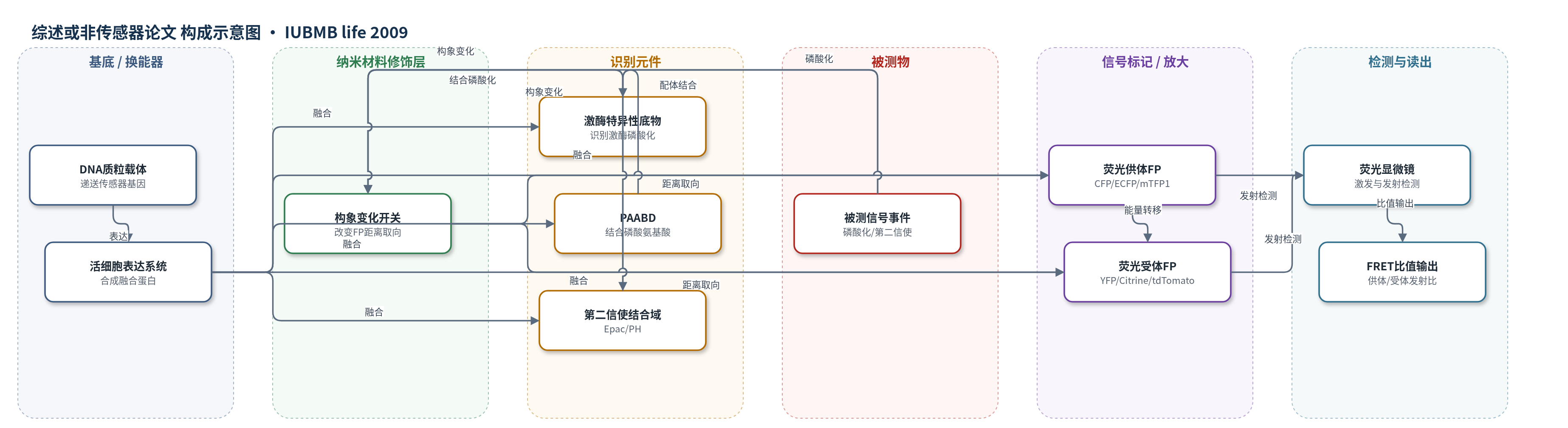
点击图片查看大图 · 依据论文自动绘制
传感器类型
综述或非传感器论文
检测对象
细胞内第二信使(Ca2+、cAMP、cGMP、PIP3、DAG、NO)与蛋白激酶活性(PKA、Akt/PKB、PKC、PKD、Src、EGFR、Abl、ERK、ATM、Aurora B、ZAP-70、IR);样品基质为活细胞、组织或整体生物体的亚细胞区室。
检测原理
遗传编码FRET生物传感器由两个荧光蛋白(FP)夹持识别域组成。当激酶将ATP的γ-磷酸基团转移到特异性底物,或第二信使结合到相应结合域时,识别事件引起融合蛋白构象变化,改变供体与受体FP之间的距离和取向。FRET效率随距离的六次方倒数变化,因此构象变化会改变供体发射与受体发射的比值。该比值型信号无需外部标记或酶放大,可直接反映磷酸化水平或第二信使浓度变化;对PIP3等结合构象变化不足的体系,可引入假配体在天然配体结合时被置换以放大构象变化。最终通过荧光显微镜采集供体/受体发射比,实现活细胞内信号事件的时空定量。
检测灵敏度
—
效应效果
该文为综述,未报告单一传感器的RSD、回收率或LOD。其强调FRET生物传感器为遗传编码、非破坏性、比值型检测,可定位至细胞膜、核、脂筏等区室;表1中各KAR/第二信使传感器动态范围为10%–60%的发射比变化。共成像策略可同步监测多个信号事件,如cAMP与PKA、PIP3与Akt、Ca2+与PKC;使用mAmetrine/mCitrine与tdTomato等四色FRET对时存在约14%交叉激发,可用校正因子处理。作者认为其价值在于绘制活细胞信号转导时空网络,揭示疾病相关激酶调控。
传感器的构成
- 表达载体:DNA质粒,将FRET生物传感器基因递送至活细胞、组织或整体生物体
- 识别元件:激酶特异性底物、磷酸氨基酸结合域(PAABD)或第二信使结合域(Epac、Akt PH域),识别磷酸化或配体结合
- 构象开关:底物磷酸化或第二信使结合/假配体置换引起融合蛋白构象变化,改变荧光蛋白距离或取向
- 荧光供体:CFP、ECFP、Cerulean、mTFP1、mAmetrine等,接受激发并向受体转移能量
- 荧光受体:YFP、Citrine、cpVE172、tdTomato、mCitrine等,接收FRET能量并产生发射
- 定位序列:细胞膜靶向序列、核定位序列、脂筏靶向序列等,将传感器定位到特定亚细胞区室
- 信号读出:荧光显微镜/FRET比值成像,检测供体与受体发射比变化
中文摘要
信号转导研究因遗传编码FRET生物传感器的快速发展而发生范式转变。这类传感器利用一对适合FRET的荧光蛋白,将激酶磷酸化或第二信使浓度变化等信号事件转化为融合蛋白的构象变化,并通过供体与受体荧光强度比的变化进行实时检测。激酶活性报告器通常由激酶特异性底物、磷酸氨基酸结合域和两侧荧光蛋白组成;第二信使传感器则依赖配体结合域在结合Ca2+、cAMP、cGMP、PIP3等分子时改变构象。单独使用这些传感器已阐明多种信号机制,但同步监测多个信号事件更能精确关联不同分子的时间动态并减少细胞间差异。通过设计光谱不同的荧光蛋白对和共成像策略,可在同一活细胞中同时成像多个信号事件,绘制细胞信号转导级联网络。由于第二信使和激酶异常与癌症、神经退行性疾病、糖尿病等相关,这些FRET传感器有望揭示疾病状态中信号转导改变的分子联系。
英文摘要
The study of signal transduction, or the highly regulated series of biochemical events which allow a cell to convert a given stimulus into a functional response, has seen a paradigm shift with a recent explosion in the number of genetically encoded FRET-based biosensors capable of detecting spatial and temporal regulation of various signaling events in living cells. The two classes of biosensors discussed, namely kinase activity and second messenger biosensors, utilize two fluorescent proteins (FP) suitable for FRET and convert a signaling event of interest into a conformational change in the biosensor that can be measured as a change in FRET between the two FPs. Individually, these biosensors have been used to elucidate many complex signal transduction mechanisms in various biological systems. However, it has become increasingly clear that it is often more desirable to study multiple signaling events simultaneously, allowing for precise correlation of the temporal profiles of multiple signaling molecules without the complication of cell to cell variability. With the design of spectrally distinct biosensors and new coimaging strategies, simultaneous imaging of multiple signaling events is not only possible, but has aided in mapping the intricate network of cellular signal transduction cascades. Furthermore, as aberrant signal transduction involving second messengers and kinases is implicated in numerous disease states, it is hopeful that these FRET-based biosensors and coimaging strategies can help to unravel the molecular links between altered signal transduction and certain disease states.