组成图示
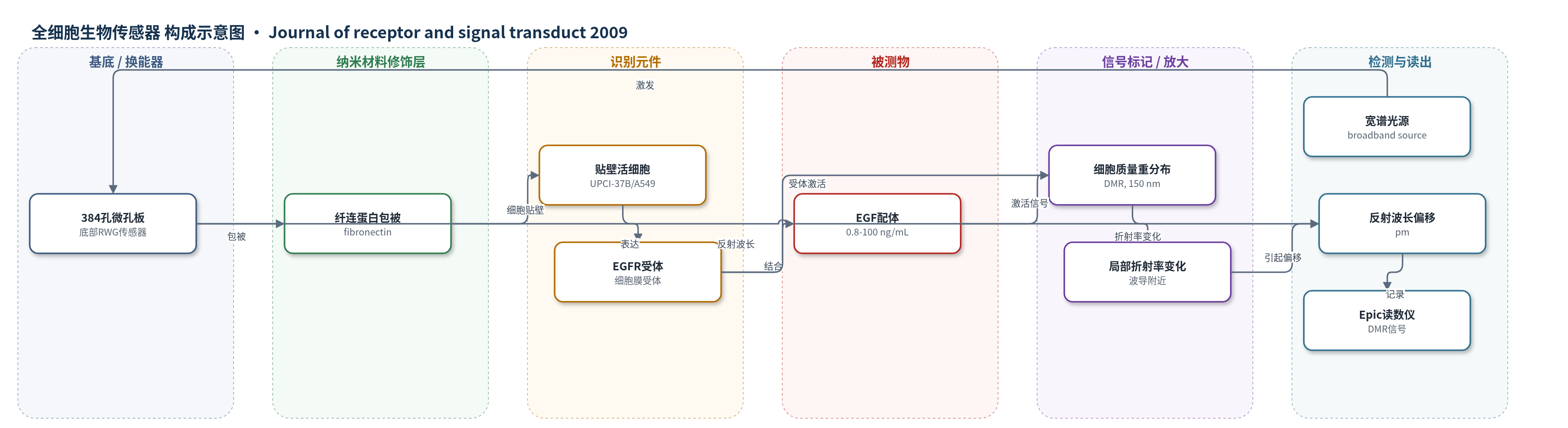
点击图片查看大图 · 依据论文自动绘制
传感器类型
全细胞生物传感器
检测对象
表皮生长因子(EGF);样品基质:癌细胞培养液(HBSS/HEPES缓冲液中的UPCI-37B或A549贴壁细胞)
检测原理
EGF与贴壁癌细胞膜上的EGFR结合,诱导受体二聚化、酪氨酸激酶激活及下游PI3K/Akt等信号事件,引起受体内吞、细胞骨架重组、细胞贴附或运动等质量重分布。Epic传感器仅探测波导表面附近约150 nm内的质量变化,这些事件改变局部折射率。宽谱光激发共振波导光栅(RWG)时,仅单一共振波长被反射;质量重分布使共振波长发生偏移,Epic读数仪以皮米(pm)记录该偏移,形成动态质量重分布(DMR)信号。EGF浓度升高使P-DMR或N-DMR幅度增大、达峰时间缩短,从而反映EGFR通路活性。
检测灵敏度
R^2 = 0.97;EC50: 19.9 ng/mL(UPCI-37B);EC50: 44.1 ng/mL(A549 N-DMR)、29.8 ng/mL(A549 P-DMR)
效应效果
该方法具有受体特异性:AG 1478剂量依赖抑制EGF诱导P-DMR,IC50 0.16 µM,0.5 µM完全阻断;SU 1498几乎无抑制(98.6%对照)。PI3K抑制剂wortmannin、LY 294002分别降至16.2%、30.4%对照,MAPK抑制剂U0126、PD98059无抑制(103.6%、104.6%)。吉非替尼、厄洛替尼在UPCI-37B中IC50为1.42 µM、0.57 µM。384孔板中EGF>25 ng/mL时Z9>0.5、S/B>3;A549细胞EGF≥50 ng/mL时Z9>0.5,100 ng/mL时Z9>0.8。实验至少三次重复,可用于EGFR通路药物筛选。
传感器的构成
- 基底/换能器:384孔微孔板底部共振波导光栅(RWG)光学传感器,宽谱光激发并反射共振波长,检测局部折射率变化
- 细胞附着层:纤连蛋白(fibronectin)包被的Corning Epic生物传感器微孔板,促进细胞贴壁
- 识别元件:贴壁活细胞膜上的表皮生长因子受体(EGFR),与EGF结合并激活下游信号
- 样品介质:Hanks平衡盐溶液(HBSS)含20 mM HEPES检测缓冲液,维持细胞环境并提供背景
- 信号标记物:无外源标记物(label-free),细胞质量重分布本身引起传感器表面附近折射率变化
- 信号读出:Corning Epic微孔板读数仪记录反射波长偏移(pm),转换为动态质量重分布(DMR)信号
中文摘要
靶向肿瘤中失调的信号通路已推动信号转导抑制剂的发展,包括表皮生长因子受体(EGFR)抑制剂。为解析致癌通路、识别关键通路决定因素并评价靶向药物疗效,需要在生理条件下检测时间依赖性信号事件。本文报道了一种无标记光学生物传感器的应用,用于揭示癌细胞对表皮生长因子(EGF)的快速响应,该响应以动态质量重分布(DMR)信号表达。在EGF刺激下,头颈鳞状细胞癌细胞表现出DMR信号快速上升,而肺腺癌细胞呈现双相DMR谱,提示细胞类型依赖性DMR响应。药理学研究表明,EGFR和磷脂酰肌醇-3激酶(PI3K)通路在介导EGF诱导的DMR响应中具有重要作用。所定义的DMR特征为评价EGFR靶向药物提供了简单而敏感的工具,吉非替尼和厄洛替尼的实验结果证明了这一点。该检测还可用于EGF通路抑制剂的细胞高通量筛选,在384孔板格式中表现出稳健性能(Z9>0.5)。该技术可应用于其他致癌通路,以发现治疗多种癌症的新型治疗药物。
英文摘要
Targeting dysregulated signaling pathways in tumors has led to the development of a novel class of signal transduction inhibitors, including inhibitors of the epidermal growth factor (EGF) receptor (EGFR). To dissect oncogenic pathways, identify key pathway determinants, and evaluate the efficacy of targeted agents, it is vital to develop technologies that allow the detection of temporal signaling events under physiological conditions. Here we report the application of a label-free optical biosensor to reveal the rapid response of cancer cells to EGF, expressed as a dynamic mass redistribution (DMR) signal. In response to EGF, squamous cell carcinoma of the head and neck cells exhibited a rapid rise in DMR signal, whereas lung adenocarcinoma cells showed a biphasic DMR profile, suggesting a cell type-dependent DMR response. Pharmacological studies suggested the importance of EGFR and the phosphatidylinositol-3 kinase pathway in mediating the EGF-induced DMR response. The defined DMR signatures offer a simple yet sensitive tool for evaluating EGFR-targeted agents, as shown with gefitinib and erlotinib. The assay can also be used for cell-based high-throughput screening of EGF pathway inhibitors, as demonstrated by its robust performance in a 384-well plate format (Z' > 0.5). This technology is applicable to other oncogenic pathways for the discovery of novel therapeutic agents for the treatment of various cancers.