组成图示
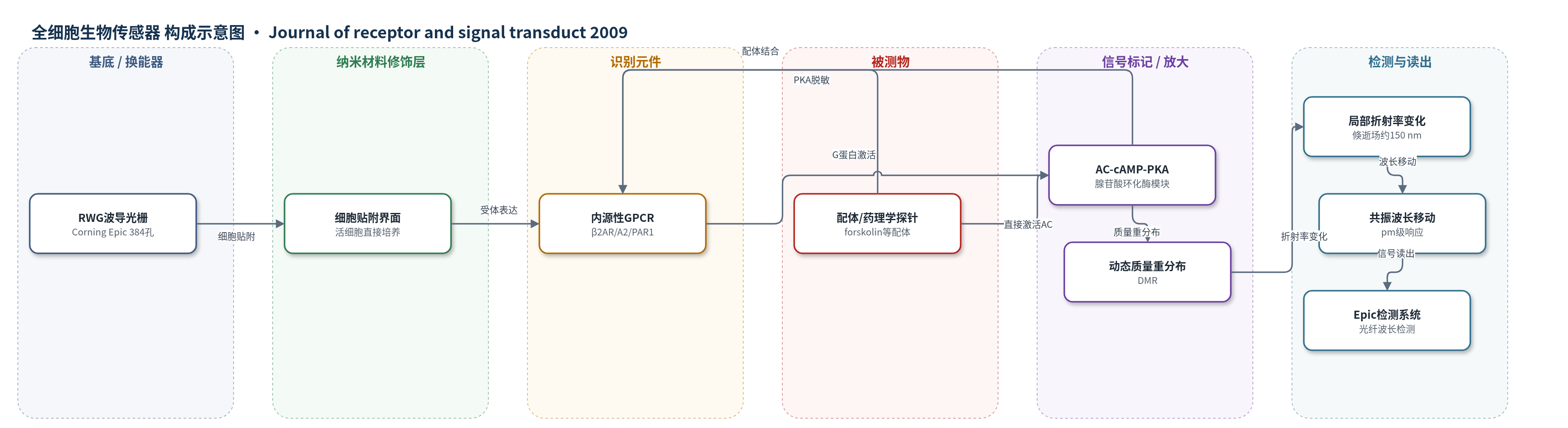
点击图片查看大图 · 依据论文自动绘制
传感器类型
全细胞生物传感器
检测对象
GPCR信号整合/腺苷酸环化酶-cAMP-PKA模块响应(forskolin、epinephrine、dopamine、NECA、VIP、ATP、SFLLR-amide、histamine、DPA诱导的DMR);样品基质:贴壁活细胞(A431、A549、HepG2C3A、HT29、HEK293、CHO-K1、RMS13)
检测原理
配体结合细胞膜内源性GPCR,或forskolin直接激活腺苷酸环化酶(AC),使cAMP生成并激活蛋白激酶A(PKA)等下游通路。受体激活与AC-cAMP-PKA模块引起细胞内蛋白、分子复合物和细胞骨架相关组分发生时空重分布,改变细胞近表面局部质量密度与折射率。RWG波导光栅的倏逝场仅感知表面约150 nm范围内的折射率变化,折射率变化使共振波长发生pm级移动,被Epic系统连续记录为动态质量重分布(DMR)信号。响应随forskolin或激动剂浓度呈剂量依赖并饱和,可用EC50/IC50描述;无外源标记,信号反映整体细胞响应。
检测灵敏度
原文未报告LOD、线性范围、灵敏度斜率或相关系数;报告药理学EC50/IC50:forskolin在A431 P-DMR EC50 117±11 nM;forskolin对epinephrine异源脱敏IC50 188±37 nM;ATP、SFLLR-amide、histamine的IC50分别为148±45、317±78、150±32 nM;DPA P-DMR EC50 300±73 nM、终点响应EC50 564±121 nM、N-DMR IC50 810±271 nM。
效应效果
该无标记RWG细胞检测可连续监测活细胞动力学响应,检测温度28°C,至少两组独立实验且每组至少三次重复,检测变异系数<10%。激酶抑制剂筛选中Z′因子为0.75,阳性对照响应134±12 pm(n=32),阴性对照6±4 pm(n=32)。forskolin在七种细胞系中产生不同DMR,提示AC亚型表达/组织差异;在A431中可被PKA、Rho激酶、MAP激酶、PI3K-Akt及PDE4相关抑制剂调节。方法无需标记和细胞操作,能区分Gs、Gq、Gi信号并用于药物发现中的受体功能筛选与机制解析。
传感器的构成
- 基底/换能器:Corning Epic 384孔RWG生物传感器微孔板,集成共振波导光栅,利用倏逝场感知表面附近折射率变化
- 光学读出:Corning Epic wavelength interrogation system,含集成光纤、温控单元和液体处理单元,记录共振波长变化
- 样品/识别层:贴壁活细胞(A431、A549、HepG2C3A、HT29、HEK293、CHO-K1、RMS13),内源性GPCR作为识别元件
- 信号转导模块:腺苷酸环化酶(AC)-cAMP-PKA通路,将受体激活或forskolin刺激转化为细胞内质量重分布
- 药理学探针/刺激物:forskolin、epinephrine、dopamine、NECA、VIP、ATP、SFLLR-amide、histamine、DPA,用于激活AC或不同GPCR
- 缓冲介质:HBSS(1×Hank’s balanced salt solution,20 mM Hepes,pH 7.1),用于细胞洗涤和化合物稀释
- 培养/检测条件:37°C培养约1天,检测温度28°C,细胞密度约1–2×10^4/孔,汇合度95%–100%
中文摘要
腺苷酸环化酶(AC)被认为是受体信号整合的关键节点,但其整合作用多在复杂通路中的单点接触层面研究。本研究以forskolin为药理学探针,采用共振波导光栅(RWG)生物传感器,在AC-cAMP-PKA模块层面考察G蛋白偶联受体(GPCR)的信号整合。该传感器为折射率敏感型光学生物传感器,可无标记、无细胞操作地检测配体诱导的细胞内动态质量重分布(DMR)。forskolin刺激七种细胞系产生不同光学响应,提示各细胞系AC亚型表达和/或组织方式不同。在A431细胞中,forskolin响应受蛋白激酶A(PKA)、Rho激酶和MAP激酶活性影响。脱敏实验显示,forskolin预处理可异源脱敏Gs信号,部分减弱Gq信号,并对Gi信号产生复杂影响。该研究记录了AC在GPCR信号中的整合作用,并展示了利用无标记生物传感器细胞检测区分受体信号的能力。
英文摘要
Adenylyl cyclase is considered as an integrator for receptor signaling. However, its integrative role in receptor signaling is largely studied at the level of point of contacts in complex pathways. Here we used forskolin as a pharmacological probe and the resonant waveguide grating (RWG) biosensor to examine the signal integration of G protein-coupled receptors (GPCRs) at the cyclase-cyclic AMP-PKA module. The biosensor is a refractive index sensitive optical biosensor that is capable of detecting ligand-induced dynamic mass redistribution in cells without labels and cellular manipulations. Stimulation of seven cell lines with forskolin led to distinct optical responses, indicative of distinct expressions and/or organization of cyclase isoforms. The forskolin response in A431 was sensitive to the activities of protein kinase A, Rho kinase, and MAP kinases. Desensitization assays showed that the forskolin pretreatment heterologously desensitized G(s) signaling, partially attenuated G(q) signaling, but had complicate impacts on G(i) signaling. This study documents the integrative role of adenylyl cyclase in GPCR signaling and the power of forskolin as a pharmacological probe to differentiate receptor signaling using the label-free biosensor cellular assays.