组成图示
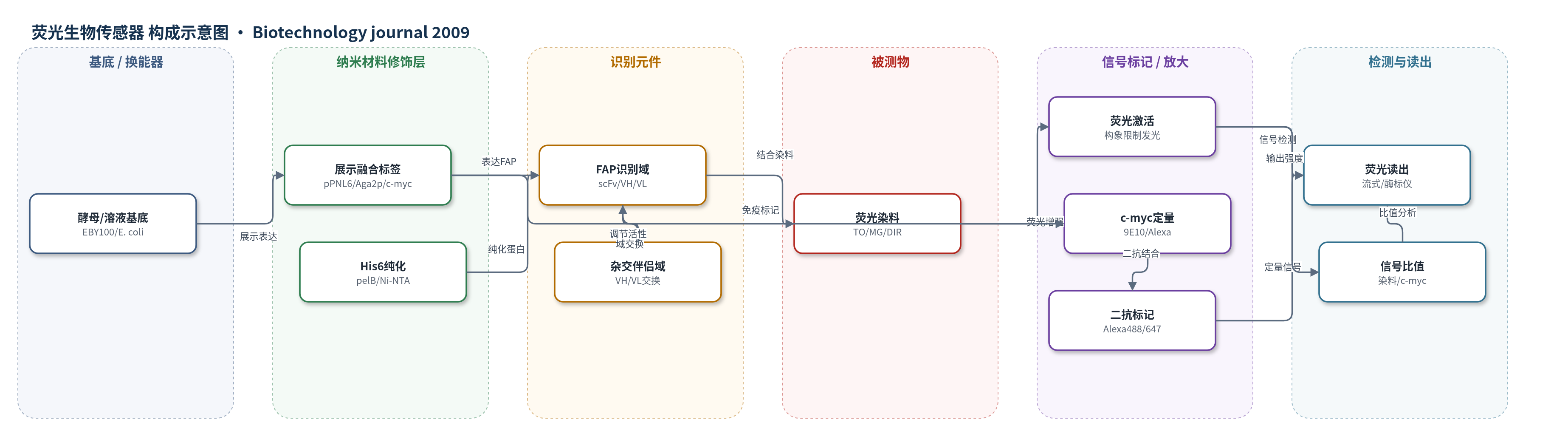
点击图片查看大图 · 依据论文自动绘制
传感器类型
荧光生物传感器
检测对象
环境敏感荧光染料:thiazole orange (TO)、malachite green (MG)、dimethylindole red (DIR);样品基质:PBS/Tris 缓冲液、酵母细胞悬液、大肠杆菌周质可溶蛋白溶液
检测原理
scFv 或其单个 VH/VL 域作为识别元件,特异性结合环境敏感荧光染料 TO、MG 或 DIR。游离染料在溶液中可绕环间键旋转或扭转,激发后主要通过非辐射途径回到基态,因此荧光很弱。当染料进入 FAP 结合口袋后,其构象运动受到限制,扭转受阻,辐射跃迁概率增加,荧光强度显著增强,形成“结合即点亮”的荧光信号。杂交 scFv 中,伴侣 VH/VL 域可通过 CDR 环重排、VH/VL 界面遮蔽或干扰单域二聚化等方式抑制或增强活性域对染料的结合与激活。信号通过流式细胞仪或荧光酶标仪读出:染料通道荧光随染料结合量增加而升高,并用 c-myc 通道归一化表面表达量;染料滴定曲线可反映亲和力,抑制型杂交蛋白表观 Kd 升高,荧光响应下降。
检测灵敏度
Kd: 50 nM;表观 Kd: 至少 4.9 µM
效应效果
研究通过酵母表面展示和流式细胞术比较全长 scFv、单域及杂交域活性,发现 5 个 scFv 需 VH 和 VL 共同作用,4 个可由单个 VL 域激活染料。杂交域可显著调节活性:H6-MG VH 与 HL1-TO1 VL 配对后活性降至 0.7%,HL7-MG VL 与 HL4-MG VH 配对后为 4.3%,HL-M8-DIR VL 与 HL4-MG VH 配对后为 3.1%;L5.1-MG VL 与 HL1-TO1 或 HL7-MG VH 配对后升至 130.1% 和 125.2%。可溶蛋白染料滴定证实抑制非表面展示假象,H6-MG Kd 为 50 nM,抑制型杂交蛋白表观 Kd 至少 4.9 µM。作者主张低活性杂交 scFv 可作为遗传编码“light-up”荧光传感器平台,用于蛋白酶或翻译后修饰检测。
传感器的构成
- 识别元件:scFv 或单域 VH/VL 荧光激活蛋白(FAP),如 H6-MG、HL7-MG VL、HL9-MG VL、L5.1-MG VL、HL-M8-DIR VL,特异性结合并激活荧光染料
- 信号标记物:环境敏感荧光染料 thiazole orange (TO)、malachite green (MG)、dimethylindole red (DIR),结合后由弱荧光转为强荧光
- 展示/表达基底:酿酒酵母 EBY100 细胞表面展示系统,pPNL6 载体,Aga2p 融合蛋白,将 FAP 展示于酵母表面
- 定量标记层:小鼠抗 c-myc 单抗(clone 9E10)与 Alexa Fluor 488/647 标记山羊抗鼠二抗,用于测定表面 FAP 表达量并归一化荧光
- 可溶表达/纯化层:大肠杆菌 pAK400 周质分泌表达,pelB 前导序列与 C 端 His6 标签,Ni-NTA 亲和层析纯化
- 读出装置:Becton Dickinson FACSVantage SE 流式细胞仪或 TECAN Safire2 荧光酶标仪,检测染料荧光与 c-myc 荧光比值/荧光强度
中文摘要
单链抗体(scFv)是由免疫球蛋白重链可变区(VH)和轻链可变区(VL)通过柔性肽链连接子连接而成的工程蛋白。本研究对从酵母表面展示文库中分离的多个 scFv 荧光激活蛋白(FAP)的单个 VH 或 VL 域活性进行了表征,考察其结合环境敏感荧光染料并使其发荧光的能力。结果显示,许多 scFv 需要 VH 和 VL 两个域共同作用才能结合染料并产生荧光;但另一些 scFv 仅靠 VH 或 VL 单个域即可激活染料。进一步发现,原始 scFv 中不活跃的互补域对活性单域既无贡献,甚至可能抑制其活性。作者通过体外基因操作进行广泛的可变域交换,构建杂交 scFv,证明活性 VH 或 VL 域与不同互补域配对时,其荧光染料激活能力可发生显著改变。某些杂交 scFv 的荧光激活域可被其他域完全抑制,因此可作为开发多种遗传编码、荧光产生型生物传感器的平台。
英文摘要
Single chain antibodies (scFvs) are engineered proteins composed of IgG variable heavy (V(H)) and variable light (V(L)) domains tethered together by a flexible peptide linker. We have characterized the individual V(H) or V(L) domain activities of several scFvs isolated from a yeast surface-display library for their ability to bind environmentally sensitive fluorogenic dyes causing them to fluoresce. For many of the scFvs, both V(H) and V(L) domains are required for dye binding and fluorescence. The analysis of other scFvs, however, revealed that either the V(H) or the V(L) domain alone is sufficient to cause the fluorogenic dye activation. Furthermore, the inactive complementary domains in the original scFvs either contribute nothing to, or actually inhibit the activity of these active single domains. We have explored the interactions between active variable domains and inactive complementary domains by extensive variable domain swapping through in vitro gene manipulations to create hybrid scFvs. In this study, we demonstrate that significant alteration of the fluorogenic dye activation by the active V(H) or V(L) domains can occur by partnering with different V(H) or V(L) complementary domains in the scFv format. Hybrid scFvs can be generated that have fluorogen-activating domains that are completely inhibited by interactions with other domains. Such hybrid scFvs are excellent platforms for the development of several types of genetically encoded, fluorescence-generating biosensors.