组成图示
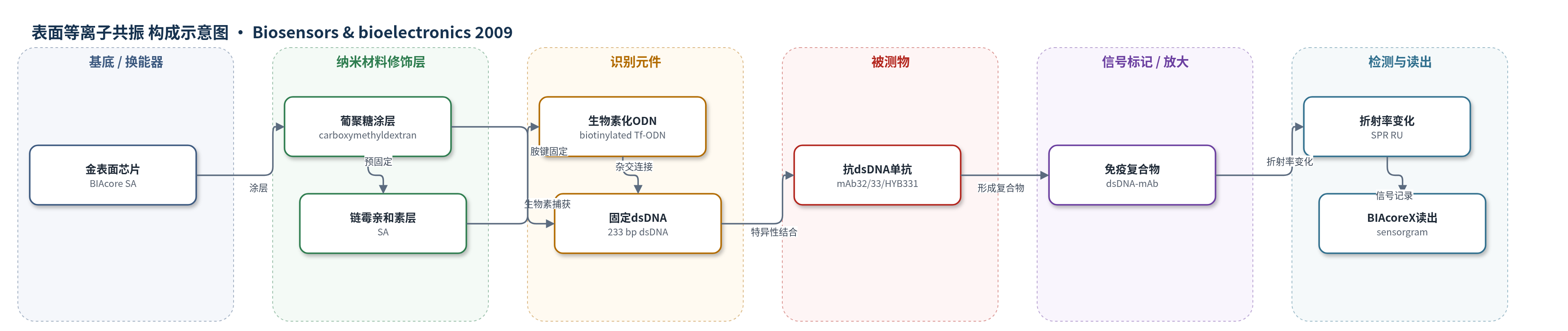
点击图片查看大图 · 依据论文自动绘制
传感器类型
表面等离子共振(SPR)生物传感器
检测对象
抗双链DNA自身抗体(anti-dsDNA autoantibodies,含抗dsDNA单克隆抗体 mAbs);样品基质:血清(阴性对照血清加标/临床血清)
检测原理
该传感器以金表面SPR芯片为换能器,表面经羧甲基葡聚糖和链霉亲和素修饰。生物素化转铁素-ODN偶联物经SA捕获,与互补链杂交并连接233 bp人重组dsDNA片段,再经胺键共价固定,形成表面dsDNA识别层。样品中抗dsDNA单抗与表面dsDNA结合,使界面质量浓度增加,引起局部折射率变化;SPR共振角位移实时转换为共振单位(RU)。通过连续监测结合相和解离相,可拟合ka、kd并计算KD,表征抗体功能亲和力。竞争实验中,不同长度/组成的ss/dsODN与表面dsDNA竞争结合单抗,抑制信号反映抗体对不同DNA种类的反应性。
检测灵敏度
—
效应效果
三种单抗KDobs均处低纳摩尔:mAb32 2.28±1.11 nM、mAb33 1.99±0.711 nM、HYB331-01 2.67±1.01 nM,三芯片重复性良好。mAb32结合/解离最慢,是唯一Farr RIA阳性者(4.3 µg/mL时39.6×10^3 IU/L,SD 0.63×10^3;0.43 µg/mL时11.1×10^3 IU/L,SD 0.39×10^3),低于ELISA标称值。EMSA验证50%迁移变化浓度(1.4–14、2.5–25、5–20 nM)与SPR一致。竞争实验显示mAb32主要被dsODN抑制(255 bp中点6.84 µg/L,42 bp 3.40 µg/L),mAb33对ss/ds反应较均一,HYB331-01偏好ds和较长DNA。作者认为SPR可表征单抗标准并改善抗dsDNA检测可比性。
传感器的构成
- 基底/换能器:金表面BIAcore SA芯片,提供SPR光学换能界面
- 界面修饰层:羧甲基葡聚糖(carboxymethyldextran)涂层,提供羧基用于共价偶联
- 捕获层:预固定链霉亲和素(SA),通过生物素-亲和素作用捕获抗原偶联物
- 识别/抗原固定层:生物素化转铁素偶联ssODN,杂交互补链并连接233 bp人重组dsDNA片段,形成表面dsDNA抗原
- 稳定化层:催化胺键偶联(covalent amine coupling),将dsDNA抗原共价固定于芯片表面
- 运行缓冲液:0.01 M HEPES pH 7.4、0.15 M NaCl、0.1% BSA、0.005%辛基-β-D-吡喃葡萄糖苷,维持流动并减少非特异吸附
- 信号读出:SPR共振单位(RU)随界面质量/折射率变化实时记录
中文摘要
血清中循环抗双链DNA(dsDNA)自身抗体的检测是系统性红斑狼疮(SLE)实验室诊断的常规项目。由于现有检测方法差异较大且缺乏可行校准物,本研究评估一种基于表面等离子共振(SPR)的生物传感器芯片,用于研究dsDNA与抗dsDNA自身抗体的结合,并展示其在表征新型单克隆抗体(mAb)标准和检测方法标准化中的价值。作者通过测量结合与解离动力学速率,计算功能亲和力(avidity),表征了两个人源和一个鼠源抗dsDNA单抗。所得平衡解离常数经独立方法验证,并通过抑制实验确定其对不同长度和组成DNA的反应性。结果显示三种单抗具有相近的avidity,凝胶迁移实验予以证实;其中一种结合与解离动力学较慢,且是唯一在Farr放射免疫分析中呈阳性的单抗。在10、24和42 bp单链/双链寡核苷酸抑制实验中,三种单抗行为显著不同。研究证明SPR生物传感器可用于表征潜在抗dsDNA标准,动力学速率常数对解释单抗在不同实验室检测中的行为具有关键意义,且不同DNA来源应被纳入检测标准化考虑。
英文摘要
The serum determination of circulating anti-double-stranded (ds)DNA autoantibodies is a routine measure for the laboratory diagnosis of systemic lupus erythematosus. Since available assays differ substantially and no feasible calibrator is available, the aim of this study was to evaluate a recently introduced surface plasmon resonance (SPR) biosensor chip for binding studies between dsDNA and anti-dsDNA autoantibodies and to demonstrate its usefulness for the characterization of new monoclonal antibody (mAb) standards and standardization of assays. We characterized two human and one murine monoclonal anti-dsDNA antibodies by measuring the kinetic on- and off-rates using the biosensor and calculating functional affinity (avidity) as the ratio of these. Obtained equilibrium dissociation constants were verified by an independent method and inhibition experiments were performed to determine reactivities to DNA of various length and composition. While all mAbs exhibited comparable avidities, which could be confirmed by gel shift experiments, one of them proved to have slower association and dissociation kinetics. This was the only mAb providing positive results in the Farr RIA. In inhibition experiments with ss- and ds-oligonucleotides 10, 24 and 42 bp in length, the mAbs acted substantially different. The study demonstrates how putative standards for the anti-dsDNA determination can be characterized using SPR biosensor technology. Our results suggest that kinetic rate constants seem to be decisive in explaining the behaviour of mAbs. Different reactivities to various DNA species should be taken into account with respect to varying DNA sources in commonly used laboratory assays.