组成图示
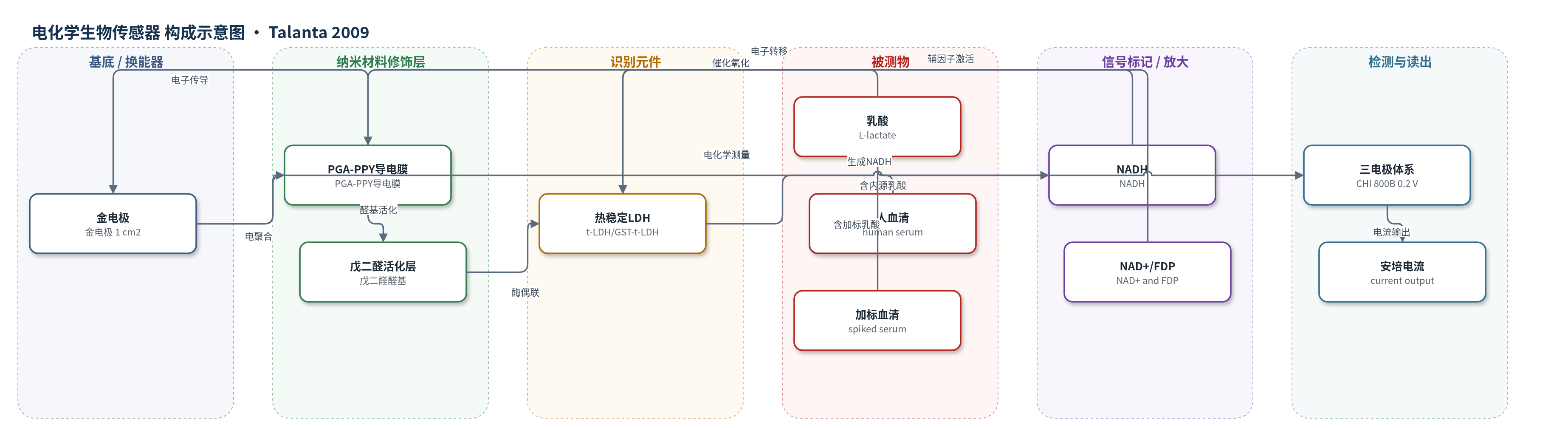
点击图片查看大图 · 依据论文自动绘制
传感器类型
电化学生物传感器
检测对象
乳酸(L-lactate/lactate);样品基质:CHES 缓冲液、人血清、加标人血清
检测原理
t-LDH 催化 L-乳酸氧化为丙酮酸,同时 NAD+ 还原为 NADH;FDP 作为变构激活剂增强乳酸氧化。生成的 NADH 作为电子供体,将电子传递给 PGA-PPY 导电共聚物,导电膜再将电子传导至金电极。在三电极体系中,工作电极施加固定偏压 0.2 V,NADH 氧化产生安培电流。乳酸浓度越高,单位时间内生成 NADH 越多,氧化电流越大。热稳定酶使电极可在 25–60 °C 工作,高温下酶活性和扩散增强,灵敏度提高,并可减少血清中嗜中温酶/蛋白干扰。无 HCR/RCA 等核酸放大,主要依靠酶催化和导电聚合物电子传递。
检测灵敏度
LOD: 0.155 mM (t-LDHE);LOD: 1.16 mM (m-LDHE);线性范围: 1–17.5 mM (t-LDHE);线性范围: 1–13 mM (m-LDHE);灵敏度: 0.3 nA/μM (t-LDHE, room temperature);灵敏度: 0.04 nA/μM (m-LDHE, room temperature);灵敏度: 2 nA/μM (t-LDHE, 60 °C);线性范围: 2–14 mM (t-LDHE, 60 °C);r = 0.99 (t-LDHE, 60 °C);灵敏度: 0.03 nA/μM (t-LDHE, 25 °C);线性范围: 2–10 mM (t-LDHE, 25 °C);线性范围: 2–22 mM (t-LDHE, 50 °C)
效应效果
t-LDHE 在室温下灵敏度为 0.3 nA/μM,约为商品兔肌肉 LDH 电极(m-LDHE,0.04 nA/μM)的 8 倍,LOD 为 0.155 mM,低于 m-LDHE 的 1.16 mM。电极在 5 °C 保存一周仍保持活性,而 m-LDHE 7 天后几乎无电流;在 10 mM 乳酸下连续 8 次测量,标准偏差为 15.5 nA,显示较好重现性。在人血清中 50 °C 检测时,电流随血清乳酸量增加而增大,加标血清可检出低于检测限的低水平乳酸;作者认为高温检测可消除血清中嗜中温酶或蛋白造成的假阳性,并主张该传感器可用于血乳酸快速检测。文中未报告与 ELISA/HPLC/qPCR 的回收率或方法学对比。
传感器的构成
- 基底/换能器电极:金电极(gold electrode, 1 cm2),作为工作电极并传导电子。
- 导电聚合物修饰层:聚戊二醛-吡咯共聚物(PGA-PPY),电聚合形成导电膜,连接酶与电极并传递电子。
- 交联/活化层:戊二醛(glutaraldehyde)处理,增加醛基以共价偶联酶。
- 识别元件:热稳定 L-乳酸脱氢酶(t-LDH,Clostridium thermocellum L-LDH/GST-t-LDH),催化乳酸氧化并还原 NAD+。
- 辅因子/激活剂:NAD+ 与果糖-1,6-二磷酸(FDP),NAD+ 生成 NADH,FDP 激活变构酶。
- 电子供体/信号产物:NADH,乳酸氧化反应生成,向 PGA-PPY 提供电子形成安培电流。
- 工作介质:50 mM CHES 缓冲液(pH 7.5),维持反应环境并溶解 NAD+、FDP。
中文摘要
本研究将热纤梭菌(Clostridium thermocellum)L-乳酸脱氢酶(LDH)基因克隆至 pGEX-4T-2 纯化载体,以获得热稳定酶源,用于构建可在较高温度下稳定工作的乳酸生物传感器。纯化后的热稳定酶(t-LDH)通过聚戊二醛(PGA)与吡咯(PPY)共聚形成导电共聚物,固定于金电极表面,制备 t-LDH 工作电极(t-LDHE)。在三电极体系中,于固定偏压 200 mV 下测定电极对 CHES 缓冲液中乳酸的安培响应,并考察 25–60 °C 不同温度下的线性范围与灵敏度。结果表明,t-LDHE 的灵敏度随温度升高而增大,在 60 °C 达到最高,约为 25 °C 时的 70 倍。与商品兔肌肉 LDH(m-LDH)电极相比,t-LDHE 灵敏度约为其 8 倍;在 5 °C 冰箱保存一周后仍保持活性,而 m-LDHE 在此期间失去活性。t-LDHE 还在人血清存在下进行了乳酸检测,电流随血清中乳酸浓度增加而增大,且对血清乳酸及溶于血清的商品乳酸比溶于 CHES 缓冲液的商品乳酸更敏感。
英文摘要
The gene for Clostridium thermocellum L-lactate dehydrogenase enzyme was cloned into pGEX-4T-2 purification vector to supply a source for a thermostable enzyme in order to produce a stable lactate biosensor working at relatively high temperatures. The purified thermostable enzyme (t-LDH) was then immobilized on a gold electrode via polymerization of polygluteraldehyde and pyrrol resulting in a conductive co-polymer. t-LDH working electrode (t-LDHE) was used for determination of lactate in CHES buffer. Amperometric response of the produced electrodes was measured as a function of lactate concentration, at a fixed bias voltage of 200 mV in a three-electrode system. The linear range and sensitivity of the biosensor was investigated at various temperatures in the range of 25-60 degrees C. The sensitivity t-LDHE increased with increasing the temperature and reached its highest value at 60 degrees C. The calculated value was nearly 70 times higher as compared to the sensitivity value of the same electrode tested at 25 degrees C. The sensing parameters of t-LDHE were compared with the electrodes produced by commercially available rabbit muscle LDH (m-LDH). The sensitivity of t-LDHE was nearly 8 times higher than that of m-LDHE. t-LDHE was found to retain its activity for a week incubation at refrigerator (+5 degrees C), while m-LDHE lost its activity in this period. t-LDHE was also tested in the presence of human blood serum. The results showed that the current increased with increasing concentrations of lactate in the human blood serum and the biosensor is more sensitive to serum lactate as well as the commercial lactate dissolved in serum as compared to the commercial lactate dissolved in CHES buffer.