组成图示
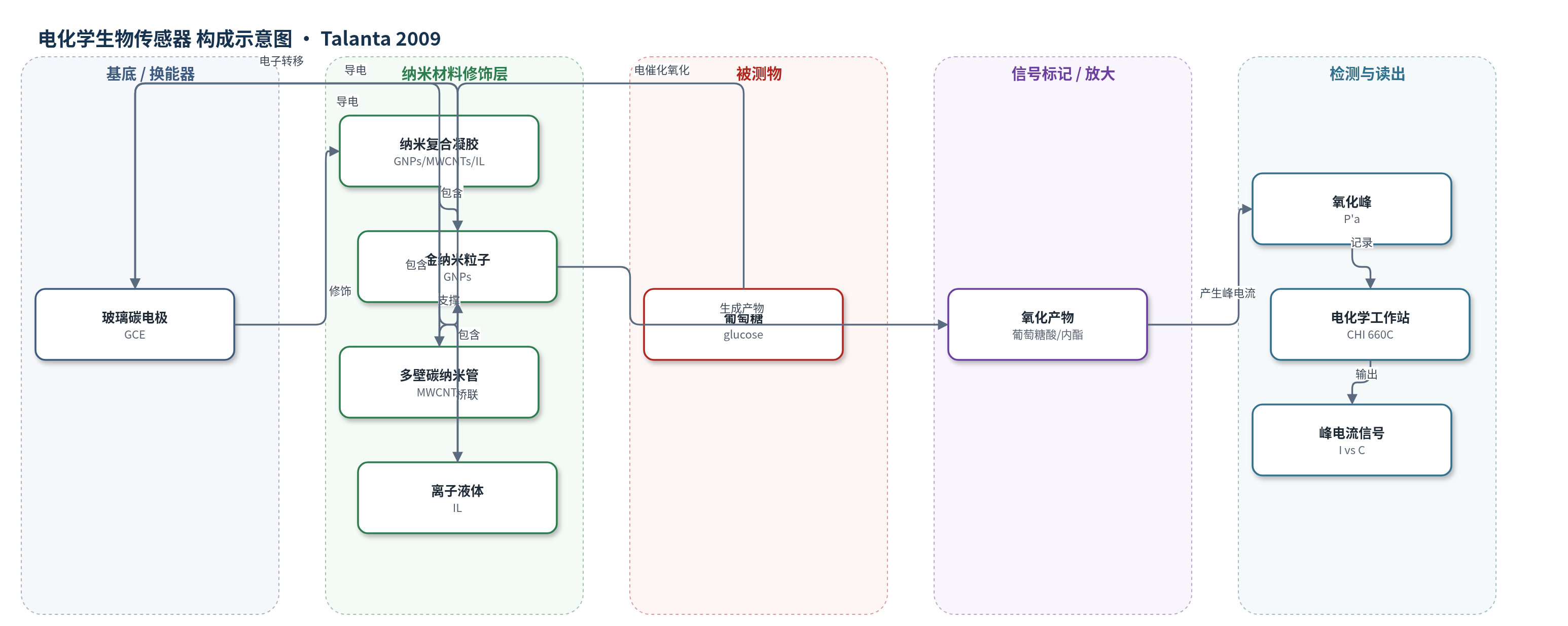
点击图片查看大图 · 依据论文自动绘制
传感器类型
电化学生物传感器
检测对象
葡萄糖(glucose, Glc);样品基质:人体血清/体液(human blood serum/body fluid)
检测原理
该传感器为非酶电化学体系,葡萄糖在GNPs表面发生直接电催化氧化。碱性介质中OH-参与反应,葡萄糖先在GNPs表面电吸附形成中间体;当电位正扫时部分中间体毒化活性位点,随后OHad生成促进中间体氧化并释放活性GNPs。在阴极扫描方向,金氧化物被还原,瞬间再生大量自由活性GNPs,使葡萄糖直接氧化电流急剧增强,形成尖锐氧化峰P'a。GNPs/MWCNTs/IL纳米复合结构起协同放大作用:MWCNTs支撑并分散GNPs,IL桥联GNPs/MWCNTs并改善导电与微环境,薄涂层暴露更多活性GNPs,强碱促进葡萄糖内酯水解以恢复活性位点。因此峰电流随葡萄糖浓度升高而线性增大。
检测灵敏度
LOD: 2.0 μM;线性范围: 5.0–120 μM;R^2 = 0.998;厚膜线性范围: 0.050–2.0 mM;R^2 = 0.996
效应效果
该传感器在0.1 M NaOH中表现出良好抗干扰性:70 μM抗坏血酸、20 μM尿酸和40 μM氯离子对40 μM葡萄糖检测的峰电流下降小于5%,且对氯离子中毒高度耐受。作者指出正常血清葡萄糖3–8 mM远高于抗坏血酸0.1 mM、尿酸0.02 mM和氯离子2.7 mM,有利于选择性。修饰电极在碱性介质中稳定性超过12 h。人体血清检测中,未加标样品测得5.4 mM;加标10.0 mM测得14.6 mM,回收率92%;加标20.0 mM测得24.0 mM,回收率93%。蛋白会吸附影响响应,需去除。作者认为该传感器简单、稳定、灵敏,适合体液葡萄糖检测。
传感器的构成
- 工作电极/换能器基底:玻璃碳电极(GCE),提供电子转导与伏安信号读出
- 纳米复合修饰层:金纳米粒子(GNPs)/多壁碳纳米管(MWCNTs)/离子液体(IL)纳米复合凝胶(bucky gel/solution),构建导电电催化微环境
- 催化活性组分:GNPs(平均直径约10 nm),作为葡萄糖直接电氧化活性位点
- 支撑/分散组分:MWCNTs(平均直径约30 nm),支撑并分散GNPs,提高导电性
- 桥联/分散介质:1-(4-磺基丁基)-3-甲基咪唑六氟磷酸盐(IL),连接GNPs/MWCNTs并形成bucky gel
- 识别元件:无(非酶体系,葡萄糖直接电催化氧化)
- 信号标记物:无
- 封闭剂:无
中文摘要
本文报道了一种基于金纳米粒子(GNPs)嵌入多壁碳纳米管(MWCNTs)/离子液体(IL)凝胶的新型非酶葡萄糖伏安传感器。通过X射线光电子能谱(XPS)、扫描电子显微镜(SEM)和透射电子显微镜(TEM)表征发现,由于GNPs与MWCNTs之间的吸引以及GNPs与IL之间的排斥,多数GNPs附着在MWCNTs外壁,部分GNPs经缺陷或管端插入MWCNTs内部。伏安法评价表明,该纳米复合传感器在碱性介质中对葡萄糖非酶氧化具有强而灵敏的电催化响应,归因于GNPs、MWCNTs和IL的协同效应。在最优条件下,基于阴极扫描方向观察到的氧化峰,葡萄糖检测线性范围为5.0–120 μM,相关系数为0.998。该传感器对氯离子中毒具有高度耐受性,并能在20 μM尿酸和70 μM抗坏血酸存在下感应葡萄糖氧化。该工作为体液中葡萄糖的高灵敏、高选择性检测提供了简便方法。
英文摘要
In this paper, a novel nonenzymatic glucose voltammetric sensor based on a kind of nanocomposite of gold nanoparticles (GNPs) embedded in multi-walled carbon nanotubes (MWCNTs)/ionic liquid (IL) gel was reported. The surface morphology of this nanocomposite was characterized using X-ray photoelectron spectrometer (XPS), scanning electron microscope (SEM) and transmission electron microscope (TEM), respectively. It can be found that most of GNPs lie close to the ektexine of MWCNTs and the others have obviously inserted the inner of MWCNTs through the defects or ends of MWCNTs, due to the attraction between GNPs and MWCNTs as well as the repulsion between GNPs and IL. Voltammetry was used to evaluate the electrocatalytic activities of the nanocomposite biosensor toward nonenzymatic glucose oxidation in alkaline media. The GNPs embedded in MWCNTs/IL gel have strong and sensitive voltammetric responses to glucose, owing to a possible synergistic effect among GNPs, MWCNTs and IL. Under the optimal condition, the linear range for the detection of the glucose is 5.0-120 microM with the correlation coefficient of 0.998, based on the oxidation peak observed during cathodic direction of the potential sweep. The kinetics and mechanism of glucose electro-oxidation were intensively investigated in this system. This kind of nanocomposite biosensor is also highly resistant toward poisoning by chloride ions and capable of sensing glucose oxidation in the presence of 20 microM uric acid and 70 microM ascorbic acid. This work provides a simple and easy approach to the detection of glucose in body fluid with high sensitivity and excellent selectivity.