组成图示
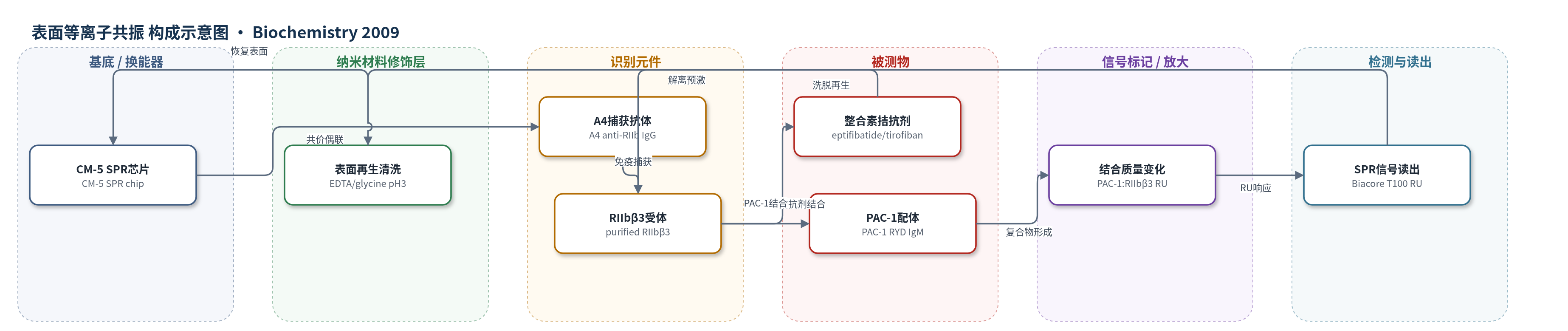
点击图片查看大图 · 依据论文自动绘制
传感器类型
表面等离子共振(SPR)生物传感器
检测对象
PAC-1(激活依赖抗 RIIbβ3 IgM,PAC-1)与 RIIbβ3 整合素(RIIbβ3)的结合/预激状态;样品基质:纯化血小板 RIIbβ3 溶液、HSCM-T 缓冲液(含 0.01% Tween-20)
检测原理
SPR 传感器以 CM-5 表面为基底,共价固定 A4 抗 RIIb 胞质域 IgG,再捕获纯化 RIIbβ3。eptifibatide 等 RGD 型拮抗剂结合 RIIbβ3 后诱导其由弯曲低亲和态转为开放高亲和态(priming),洗脱后仍短暂保持。PAC-1 是含 RYD 位点的五聚体 IgM,仅识别预激 RIIbβ3;其结合使芯片表面质量/折射率增加,产生 RU 信号。PAC-1 浓度越高,结合 RU 越大;因五聚体多价接触,采用双价分析物模型拟合,得到 ka1、kd1 和 Kd。温度升高提高 ka1 并降低 Kd。无化学放大,主要依靠多价 avidity 增强信号。
检测灵敏度
R^2 = 0.99;r = 0.34
效应效果
SPR 显示 PAC-1 对静息 RIIbβ3 信号比预激低约 15 倍,体现激活态选择性。拮抗剂预激能力 eptifibatide>tirofiban>roxifiban;tirofiban 信号约为 eptifibatide 的 40–45%,roxifiban 代谢物 XP-280 产生负 RU。预激后 2–90 min 仍快速结合 PAC-1,ka1 不随稳定时间变化(1.23±0.39×10^6 L/mol·s),kd1 随时间增加,松弛时间约 4.9 min。37℃下 ka1=9.93±0.04×10^5 L/mol·s,kd1=3.71±0.04×10^-3 s^-1,Kd1=3.7 nM;Kd 由 3.40 nM(15℃)降至 0.48 nM(37℃)。重复 10 min 曲线几乎重叠。作者认为该机制可解释拮抗剂促血小板激活/血栓风险。
传感器的构成
- 基底/换能器:CM-5 SPR 芯片,提供表面等离子共振换能与固定化表面
- 捕获抗体层:A4 IgG(抗 RIIb 胞质域 C 端肽段抗体),共价偶联至 CM-5,用于捕获 RIIbβ3
- 识别受体:RIIbβ3 整合素(纯化血小板来源),被 A4 捕获后作为 PAC-1 结合位点
- 预激配体:eptifibatide/tirofiban/roxifiban(RGD 型整合素拮抗剂),结合后诱导开放构象并洗脱
- 被测配体:PAC-1(激活依赖 RYD IgM),与预激 RIIbβ3 多价结合,引起 SPR 响应
- 封闭剂:ethanolamine,封闭 CM-5 未反应位点,降低非特异结合
- 再生剂:20 mM EDTA 与 pH 3 glycine buffer,洗脱 PAC-1 和 RIIbβ3,恢复芯片表面
- 读出方式:无标记 SPR 质量/折射率变化,以响应单位 RU 表示 PAC-1 结合量
中文摘要
本研究探讨小分子 RGD 配体可结合静息 RIIbβ3,而大分子配体需受体预激的矛盾。三种结构相似的药用整合素拮抗剂 eptifibatide、tirofiban 和 roxifiban 与静息 RIIbβ3 孵育并洗脱后,检测其识别激活依赖型 IgM PAC-1 的能力。固相结合显示促进 PAC-1:RIIbβ3 结合的顺序为 eptifibatide>tirofiban>roxifiban,并与分析超速离心测得的开放构象转变相关。SPR 表明 PAC-1 快速(kon≈5×10^5 L/mol·s,25℃)且紧密(Kd≈1 nM)结合由抗 RIIb 胞质域 IgG 捕获的 eptifibatide 预激整合素。改变捕获与拮抗剂解离间隔显示,预激 RIIbβ3 在 2–90 min 内仍快速结合 PAC-1,但后期解离率增加。荧光各向异性显示 eptifibatide 快速解离(半衰期<2 min)。van’t Hoff 与 Eyring 分析显示结合存在熵/焓补偿,ΔG‡≈10 kcal/mol,较 echistatin 低约 3 kcal/mol。结果提示预激降低过渡态能垒,促进大分子配体结合,并可能解释拮抗剂的血小板激活效应。
英文摘要
This investigation addressed the paradox that disintegrins and small RGD-ligands readily bind to the resting alphaIIbbeta3 integrin, while macromolecules with similar integrin recognition motifs require an activated, or primed, receptor. Three structurally similar pharmaceutical integrin antagonists (eptifibatide, tirofiban, and roxifiban) were each incubated with resting alphaIIbbeta3; after drug wash-out, the receptor's ability to recognize PAC-1, an activation-dependent IgM with an RYD integrin-targeting site was measured. Their promotion of PAC-1:alphaIIbbeta3 binding (solid phase assay), eptifibatide > tirofiban > roxifiban, correlated with their ability to shift the receptor to an open conformer, as measured by analytical ultracentrifugation. Surface plasmon resonance (SPR) demonstrated that PAC-1 bound rapidly (k(on) approximately 5 x 10(5) l/mol-s, 25 degrees C) and tightly (Kd approximately 1 nM) to eptifibatide-primed integrins, captured on a biosensor using an IgG specific for alphaIIb's cytoplasmic domain. Varying the interval between integrin capture and antagonist dissociation indicated that transiently primed alphaIIbbeta3 retains the ability to rapidly bind PAC-1 from 2-90 min, although the dissociation rate increased at later times, indicative of a weakening of the complex. Fluorescence anisotropy (fluorophore-tagged analogue exchange assay) demonstrated that eptifibatide dissociates rapidly from alphaIIbbeta3 (half-time <2 min), consistent with the priming window determined by SPR. van't Hoff analysis of alphaIIbbeta3:PAC-1's temperature-dependent Kd indicated entropy/enthalpy compensation, similar to (resting) integrin binding to the disintegrin echistatin. Eyring analysis of k(on) yielded DeltaG degrees approximately 10 kcal/mol for PAC-1 binding to primed alphaIIbbeta3, 3 kcal/mol lower than that of echistatin. These observations suggest that priming lowers the transition-state energy barrier, enabling rapid macromolecular ligand binding to activated integrins. Recognizing the limitations in extrapolating from laboratory to pathophysiological conditions, we propose that similar priming mechanisms may contribute to the unexpected platelet-activating effects of pharmaceutical integrin antagonists.