组成图示
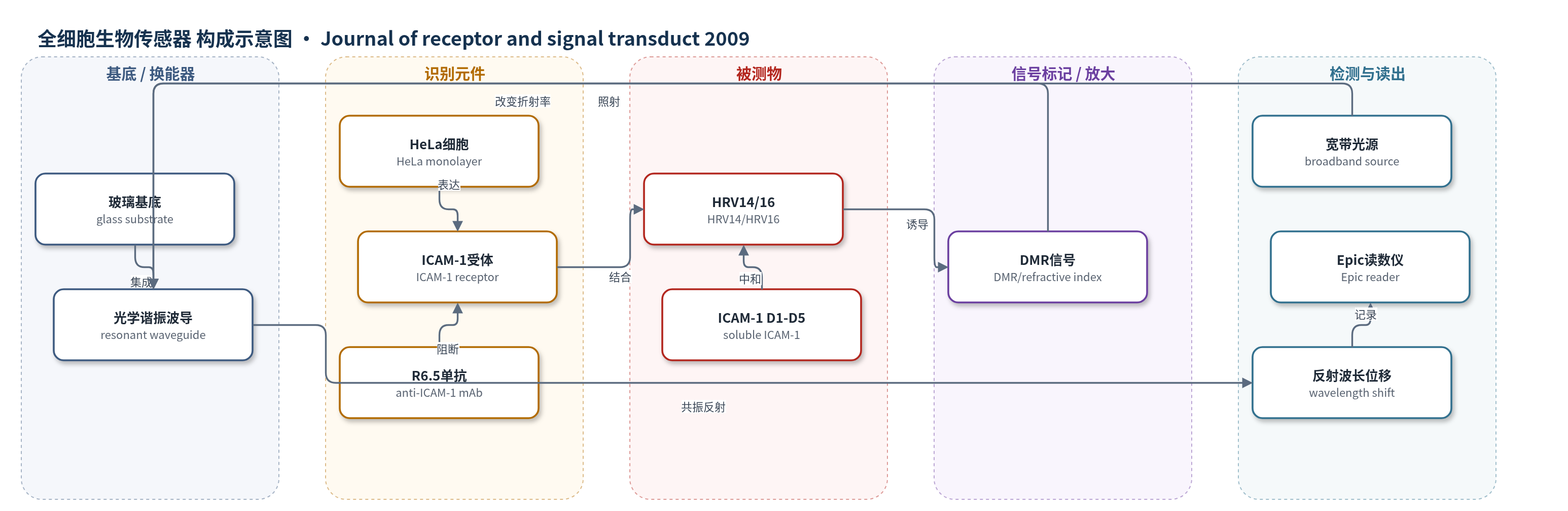
点击图片查看大图 · 依据论文自动绘制
传感器类型
全细胞生物传感器
检测对象
人鼻病毒(human rhinovirus, HRV;HRV14、HRV16);样品基质:HeLa细胞单层培养体系(384孔Epic传感微孔板)
检测原理
HRV14/HRV16通过HeLa细胞表面ICAM-1受体识别并进入细胞,随后在胞内复制、组装并释放子代病毒。感染过程引起细胞圆缩、内容物在传感器表面约150 nm传感体积内发生动态质量重分布(DMR),并可能伴随细胞脱落或裂解。DMR改变局部光学折射率,使集成在玻璃基底上的光学谐振波导的共振反射波长发生位移。Epic读数仪实时记录该波长位移(以pm表示)。病毒浓度越高,负向波长位移出现越早、幅度越大;加入R6.5单抗阻断ICAM-1或ICAM-1 D1-D5中和病毒时,位移被抑制或延迟,从而定量反映病毒复制与抑制剂效力。
检测灵敏度
—
效应效果
与传统CPE/PFU法需24–72 h且灵敏度有限相比,Epic在28 °C下可实时、无标记、高通量监测病毒复制。HRV14剂量响应中,10 PFU/cell约11 h达最大DMR下降的50%,0.1 PFU/cell在22 h仍有约30%下降;HRV16相似。CPE对照中100 pg/cell病毒8 h即致细胞脱落,2 pg/cell约需48 h,相当于约20–200 PFU/cell。固定5 PFU/cell HRV16时,R6.5在8.5 µg/mL完全抑制,0.9 µg/mL仍有明显抑制;ICAM-1 D1-D5在7 µg/mL完全抑制,低于2.3 µg/mL无效。CPE中ICAM-1 D1-D5在0.05–10 µg/mL呈剂量依赖抑制,BSA无抑制。作者认为其适用于鼻病毒及其他病毒抑制剂筛选。
传感器的构成
- 基底/换能器:玻璃基底(glass substrate)与集成光学谐振波导(optical resonant waveguide),构成384孔Epic传感微孔板,提供共振波长检测
- 光学激励:宽带光源(broadband source)照射波导,产生共振反射波长
- 识别/响应元件:HeLa细胞单层(HeLa monolayer),表面表达ICAM-1受体,作为HRV主要受体并发生感染复制
- 被测物:人鼻病毒HRV14/HRV16(HRV14/HRV16),结合ICAM-1并进入细胞
- 信号产生:无标记细胞动态质量重分布(DMR),病毒复制引起细胞圆缩和内容物在约150 nm传感区内重分布,改变局部折射率
- 抑制剂/调节元件:R6.5单抗(R6.5 mAb)结合ICAM-1 D1-D2阻断病毒附着;可溶性ICAM-1 D1-D5(ICAM-1 D1-D5)中和病毒
- 信号读出:Epic微孔板读数仪(Epic reader)实时记录反射波长位移(wavelength shift, pm)
中文摘要
实时检测细胞内病毒复制仍是研究难点。Epic系统是一种高通量、无标记光学检测平台,既能用于生化分析中的分子相互作用测量,也能通过细胞动态质量重分布(DMR)测量细胞整体响应。DMR此前已用于受体刺激后的细胞信号研究。本文首次报道利用Epic系统测量病毒复制诱导的细胞响应,证明该平台不仅能灵敏、定量地检测细胞内病毒复制,还可用于病毒抑制剂筛选。与传统病毒复制检测相比,Epic响应具有灵敏度高、通量大、可实时定量且无需标记等优势。作者提出,基于Epic系统的细胞整体响应测量将成为阐明病毒复制步骤以及高通量筛选鼻病毒和其他病毒抑制剂的重要方法。
英文摘要
Real-time detection of viral replication inside cells remains a challenge to researchers. The Epic System is a high-throughput, label-free optical detection platform capable of measuring molecular interaction in a biochemical assay, as well as integrated cellular response from measurement of cellular dynamic mass redistribution (DMR) in a cell-based assay. DMR has previously been used to measure cell signaling upon receptor stimulation. In this report, we present the first example of Epic measurement of viral replication-induced cellular response and demonstrate that this system is extremely powerful not only for the sensitive and quantitative detection of viral replication inside cells but also for screening of viral inhibitors. By comparing with conventional assays used for the measurement of viral replication, we show that the Epic response has many advantages including sensitivity, high throughput, real-time quantification and label-free detection. We propose that the Epic system for measurement of integrated cellular response will be an excellent method for elucidating steps in viral replication as well as for the high-throughput screening of inhibitors of rhinovirus and other viruses.