组成图示
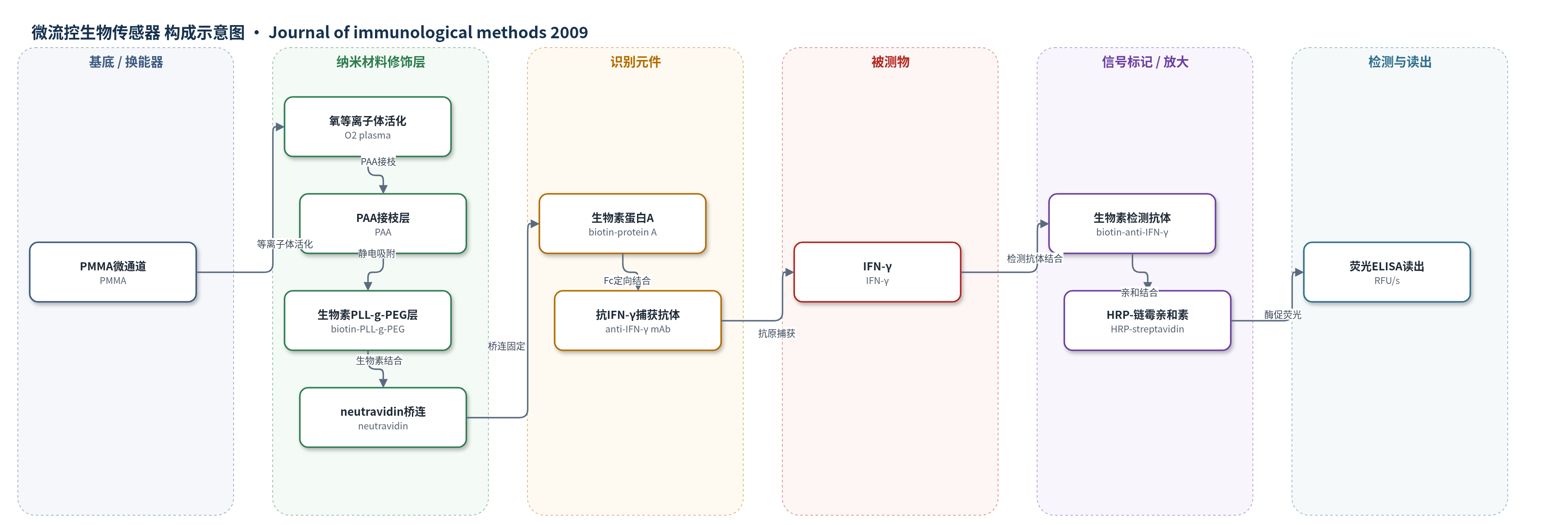
点击图片查看大图 · 依据论文自动绘制
传感器类型
微流控生物传感器
检测对象
人干扰素-γ(human interferon-gamma, IFN-γ);样品基质:重组IFN-γ标准品/缓冲液(文中未明确血清等临床基质)
检测原理
PMMA微通道经氧等离子体活化后,通过光聚合接枝PAA形成带羧基的负电荷表面。带正电的biotin-PLL-g-PEG与PLL-g-PEG混合层依靠静电作用吸附于PAA,PEG长链提供空间间隔,降低抗体与表面间的空间位阻和非特异吸附。neutravidin与表面生物素高亲和结合,再桥连biotinylated protein A;protein A特异性结合IgG的Fc区,使捕获抗体以有利取向固定。IFN-γ进入微通道后被捕获抗体识别并结合,随后生物素化检测抗体结合抗原,HRP-链霉亲和素结合生物素,酶催化底物产生荧光信号。IFN-γ浓度越高,形成的免疫复合物越多,酶促荧光强度(RFU/s)越强。
检测灵敏度
原文未报告LOD、线性范围、灵敏度斜率或相关系数。
效应效果
该策略显著提高了抗体固定量和抗原捕获效率。与PAA-biotin-PLL-g-PEG-protein A法相比,plasma-PAA-biotin-PLL-g-PEG-protein A法使抗IFN-γ固定量提高约5倍,IFN-γ荧光信号提高约3倍;与plasma-PEI-TR-protein A法相比,抗体和抗原荧光强度分别提高约40%和25%。ELISA酶反应速率由plasma-PEI的1.40 RFU/s、plasma-PEI-TR-protein A的28.41 RFU/s提高到53.1 RFU/s;无PAA的plasma法为39.80 RFU/s,无plasma的PAA法为10.91 RFU/s。蛋白A定向固定和PEG间隔层增强特异性并降低非特异吸附,作者认为可用于微流控免疫检测、生物传感器和靶向给药。
传感器的构成
- 基底:PMMA微通道(140 μm宽、125 μm深),作为微流控反应腔与芯片基底。
- 活化层:氧等离子体处理,提高PMMA亲水性和表面能,便于后续接枝。
- 功能接枝层:聚丙烯酸(PAA)光聚合接枝,引入羧基并形成负电荷表面。
- 间隔抗污层:biotin-PLL-g-PEG与PLL-g-PEG混合层,PLL正电荷静电吸附于PAA,PEG分支提供空间间隔并降低非特异吸附。
- 桥连层:neutravidin,与生物素高亲和结合,连接生物素化蛋白A。
- 定向固定元件:biotinylated protein A,通过Fc区结合IgG抗体,控制抗体取向。
- 识别元件:抗IFN-γ捕获单克隆抗体(anti-IFN-γ mAb),特异性捕获IFN-γ。
- 封闭剂:BSA,减少非特异性结合。
- 信号标记物:生物素化抗IFN-γ检测抗体与HRP-链霉亲和素,用于ELISA酶标信号;FITC标记用于荧光表征。
中文摘要
高效抗体固定是微阵列和微流控生物芯片开展酶联免疫吸附试验(ELISA)等高性能免疫检测的关键。本研究开发了一种基于生物素-聚(L-赖氨酸)-g-聚乙二醇(biotin-PLL-g-PEG)和蛋白A的抗体固定技术,用于聚甲基丙烯酸甲酯(PMMA)微通道表面。首先用氧等离子体活化PMMA,再接枝聚丙烯酸(PAA)引入羧基;biotin-PLL-g-PEG通过静电作用与羧基结合,随后生物素化蛋白A经链霉亲和素(neutravidin)桥连固定。以人干扰素-γ(IFN-γ)为模型蛋白,蛋白A可控制抗体取向,biotin-PLL-g-PEG与PLL-g-PEG组合可调节抗体构象,从而显著提高微芯片上的抗原捕获效率和检测信号。实验确定最优条件为PLL-g-PEG中生物素接枝比0.189、biotin-PLL-g-PEG与PLL-g-PEG混合比85%。该表面修饰可用于靶向给药、生物传感器及其他免疫检测。
英文摘要
Highly efficient antibody immobilization is crucial for conducting high-performance immunoassays such as enzyme-linked immunosorbent assay (ELISA) in microarray and microfluidic biochips. In this study, a biotin-poly(L-lysine)-g-poly(ethylene glycol) (biotin-PLL-g-PEG) and protein A-based technique was developed to immobilize antibody on the surface of poly(methyl methacrylate) (PMMA) microchannels. First, PMMA surface was activated by oxygen plasma, followed by poly(acrylic acid) (PAA) grafting to add functional carboxyl group for subsequent binding. After the biotin-PLL-g-PEG molecules reacted with carboxyl groups through the electrostatic interactions, biotinylated protein A was immobilized on the surface through a linking molecule, neutravidin. To evaluate the applicability of this novel immobilization strategy, human interferon-gamma (IFN-gamma) was used as a model protein. Since protein A could better control the immobilization orientation, and the combination of biotin-PLL-g-PEG and PLL-g-PEG could adjust the conformation of antibodies, antigen capture efficiency and detection signals were significantly improved on the microchips by using this strategy. The optimal grafting conditions were also experimentally determined: the biotin grafting ratio of 0.189 in the PLL-g-PEG molecule and the mixture ratio of 85% (biotin-PLL-g-PEG to PLL-g-PEG). This surface modification can be applied for targeted drug delivery, biosensor and other immunoassay applications.