组成图示
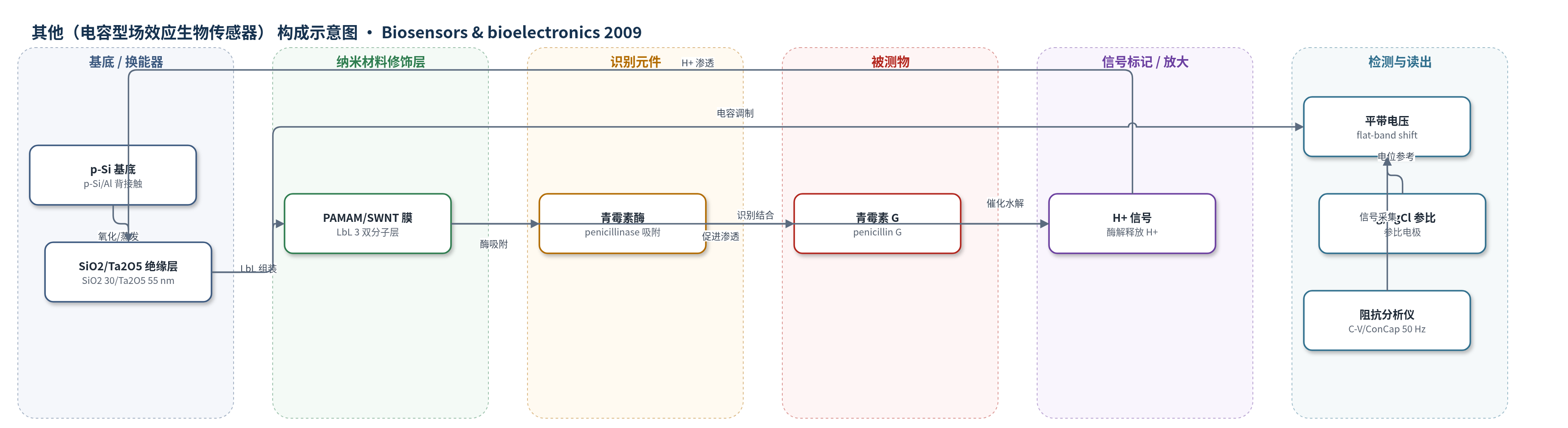
点击图片查看大图 · 依据论文自动绘制
传感器类型
其他(电容型场效应生物传感器)
检测对象
青霉素 G(penicillin G,benzyl penicillin);样品基质:pH 8 polymix 缓冲液(含 0.1 M KCl)
检测原理
该传感器以电容型 EIS 结构为换能器。青霉素 G 进入溶液后,被吸附固定的青霉素酶识别并催化水解为青霉酸,同时释放 H+。PAMAM/SWNT 逐层组装膜具有纳米多孔结构,可促进 H+ 快速渗透至 Ta2O5 表面,同时增加酶负载并限制缓冲分子对 H+ 的补偿。H+ 在 Ta2O5/溶液界面改变表面电荷,调制 EIS 电容和平带电压。在恒容(ConCap)模式下,反馈电路保持电容恒定,直接读出电位变化;青霉素浓度越高,酶解产生的 H+ 越多,平带电压向低电位移动越大,从而实现定量检测。
检测灵敏度
线性范围: 5.0 μM–25 mM(动态响应);最佳线性范围: 0.5 mM–10 mM;灵敏度斜率: ca. 116 mV/decade(0.5–10 mM);100 mV/decade(250 μM–25 mM);pH 灵敏度: ca. 55 mV/pH
效应效果
EIS-NT 在 5.0 μM–25 mM 无饱和,响应时间低于 5 min,漂移小;裸 EIS 2.5 mM 后、PSS 10 mM 后漂移增大并饱和。最佳线性范围 0.5–10 mM 斜率 116 mV/decade,250 μM–25 mM 为 100 mV/decade,优于裸 EIS 83 和 PSS 81 mV/decade。25 μM 即可响应。50 mM 葡萄糖与 polymix 缓冲液无干扰。两周仍高敏感,一个月灵敏度减半。作者认为其灵敏度与稳定性优于文献 EDIS 及安培/EnFET 传感器。
传感器的构成
- 基底/换能器:p-Si 半导体衬底与背面 Al 接触层(300 nm),构成 EIS 电容结构的半导体侧与电极接触。
- 绝缘层:30 nm SiO2 热氧化层与 55 nm Ta2O5 电子束蒸发氧化层,形成电解质–绝缘体–半导体电容,Ta2O5 提供 pH 敏感表面。
- 纳米材料修饰层:PAMAM/SWNT 逐层组装(LbL)多层膜(约 3 个双分子层),由第四代 PAMAM 树枝状分子与羧基化 SWNT 交替沉积,形成高孔隙纳米膜。
- 识别元件:青霉素酶(penicillinase,Bacillus cereus),吸附固定于 PAMAM/SWNT 或 Ta2O5 表面,催化青霉素 G 水解。
- 信号产生层:青霉素酶催化青霉素 G 水解生成青霉酸并释放 H+,无需外加标记物,H+ 改变 Ta2O5 表面电荷。
- 电解液/参比电极:pH 8 polymix 缓冲液(含 0.1 M KCl)与 Ag/AgCl 参比电极,提供离子通路和电位参考。
中文摘要
本研究报道了一种基于电容型电解质–绝缘体–半导体(EIS)场效应结构的青霉素生物传感器。该器件以 p-Si–SiO2–Ta2O5 为敏感电容结构,并在 Ta2O5 表面通过逐层组装(LbL)技术构建聚酰胺胺(PAMAM)树枝状分子与羧基化单壁碳纳米管(SWNT)的多层膜,再吸附固定青霉素酶。原子力显微镜和场发射扫描电镜显示,SWNT 渗入 PAMAM 层形成高度多孔膜,有利于 H+ 渗透和酶负载。电容–电压测量表明 EIS-NT 结构具有约 55 mV/pH 的 pH 灵敏度。在青霉素酶催化下,青霉素 G 水解释放 H+,使平带电压随浓度升高向低电位移动。恒容(ConCap)测量在 5.0 μM–25 mM 范围内获得约 116 mV/decade 的灵敏度,表明 PAMAM/SWNT 纳米结构显著提高了传感器性能。
英文摘要
Silicon-based sensors incorporating biomolecules are advantageous for processing and possible biological recognition in a small, reliable and rugged manufactured device. In this study, we report on the functionalization of field-effect (bio-)chemical sensors with layer-by-layer (LbL) films containing single-walled carbon nanotubes (SWNTs) and polyamidoamine (PAMAM) dendrimers. A capacitive electrolyte-insulator-semiconductor (EIS) structure modified with carbon nanotubes (EIS-NT) was built, which could be used as a penicillin biosensor. From atomic force microscopy (AFM) and field-emission scanning electron microscopy (FESEM) images, the LbL films were shown to be highly porous due to interpenetration of SWNTs into the dendrimer layers. Capacitance-voltage (C/V) measurements pointed to a high pH sensitivity of ca. 55 mV/pH for the EIS-NT structures. The biosensing ability towards penicillin of an EIS-NT-penicillinase biosensor was also observed as the flat-band voltage shifted to lower potentials at different penicillin concentrations. A dynamic response of penicillin concentrations, ranging from 5.0 microM to 25 mM, was evaluated for an EIS-NT with the penicillinase enzyme immobilized onto the surfaces, via constant-capacitance (ConCap) measurements, achieving a sensitivity of ca. 116 mV/decade. The presence of the nanostructured PAMAM/SWNT LbL film led to sensors with higher sensitivity and better performance.