组成图示
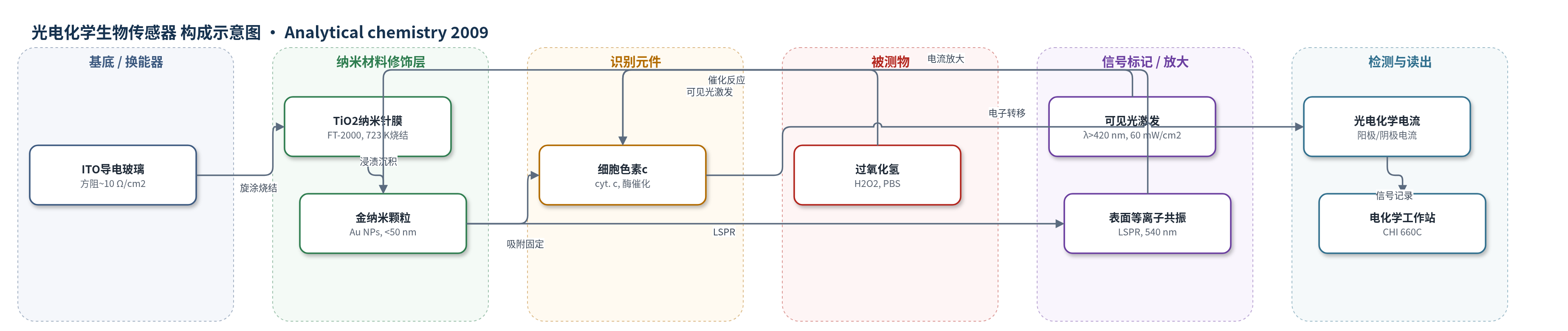
点击图片查看大图 · 依据论文自动绘制
传感器类型
光电化学生物传感器
检测对象
过氧化氢(hydrogen peroxide, H2O2),样品基质为25 mM PBS(pH 7.2,氮饱和)
检测原理
该传感器以固定于Au/TiO2膜上的cyt. c为识别/催化元件。H2O2与cyt. c发生酶促反应,改变其氧化还原状态,在0 V下通过直接电子转移产生安培电流。可见光(λ>420 nm)激发Au NPs的局域表面等离子共振(LSPR),光生电子从Au NPs注入TiO2导带,提高Au/TiO2界面的电荷分离效率,使cyt. c的阳极和阴极氧化还原电流同时放大。H2O2浓度越高,催化反应产生的可氧化/还原cyt. c越多,光电化学电流越大,从而实现定量检测。
检测灵敏度
LOD: 4.5 × 10⁻⁸ M;线性范围: 1 × 10⁻⁷ M–1.2 × 10⁻² M;灵敏度: 49.4 mA cm-2 M-1
效应效果
控制实验表明,裸TiO2膜、Au/TiO2膜以及TiO2/cyt. c膜在可见光下均无明显光电流或H2O2响应,说明增强信号依赖Au NPs与cyt. c协同。连续可见光照射3 h未使cyt. c失活,循环伏安扫描300次后响应基本不变;电极3 °C避光保存,每天三次测试,至少半个月响应几乎无变化。与无光激发相比,H2O2灵敏度提高4倍,达49.4 mA cm-2 M-1;线性范围1×10⁻⁷–1.2×10⁻² M,宽于此前基于金属氧化物表面酶直接电子转移的H2O2传感器;LOD 4.5×10⁻⁸ M(S/N=3),低于先前报道。作者认为该策略可作为增强酶氧化还原电流的模型,并可扩展至铂、铜等其他金属纳米颗粒。
传感器的构成
- 基底电极:ITO导电玻璃(indium tin oxide, ITO),方阻约10 Ω/cm2,作为导电基底与工作电极。
- 半导体修饰层:TiO2纳米针膜(TiO2 nanoneedle film, FT-2000),由TiO2纳米针溶胶旋涂并在723 K烧结1 h,形成纳米结构半导体膜。
- 等离子体修饰层:金纳米颗粒(Au NPs,直径<50 nm),浸渍Au NPs悬浮液12–15 h沉积于TiO2表面,提供LSPR与电子转移微环境。
- 识别/催化元件:细胞色素c(cytochrome c, cyt. c),在25 mM PBS(pH 7.2)中0.2 mM吸附约30 min,实现直接电子转移并催化H2O2。
- 电解质介质:25 mM PBS(pH 7.2),氮饱和,提供离子导电与反应环境。
中文摘要
本文报道了一种基于二氧化钛(TiO2)纳米针膜上沉积金纳米颗粒(Au NPs)的新型光电化学生物传感器,以过氧化氢(H2O2)为模型分析物。在Au/TiO2膜上实现了细胞色素c(cyt. c)的直接电子转移,并在可见光照射下同时放大其氧化和还原电流。当存在氧化态或还原态cyt. c时,Au/TiO2膜分别产生阴极或阳极光电流,表明放大的电流源于可见光激发。Au/TiO2膜在cyt. c存在下的光电流作用光谱与Au NPs的表面等离子吸收光谱一致,最大光电流与Au NPs等离子吸收峰相符,说明增强光电流归因于Au NPs的表面等离子共振。实验表明,cyt. c可稳定固定于Au/TiO2膜,并在连续可见光照射下保持对H2O2的酶活性。Au NPs表面等离子共振放大的cyt. c氧化还原电流与cyt. c的稳定性和酶活性相结合,提高了H2O2检测性能。该传感器对H2O2的灵敏度比无可见光照射时高4倍,检出限为4.5×10^-8 M,动态线性范围为1×10^-7 M至1.2×10^-2 M。
英文摘要
This paper demonstrates a novel approach for developing the analytical performance of electrochemical biosensors in which hydrogen peroxide (H(2)O(2)) is selected as a model target, based on surface plasmon resonance of gold nanoparticles (Au NPs) deposited onto a TiO(2) nanoneedle film. Direct electron transfer of cytochrome c (cyt. c) is realized at Au NPs deposited onto a TiO(2) nanoneedle film (Au/TiO(2) film), and both anodic and cathodic currents of the redox reaction at the Au/TiO(2) film upon visible-light irradiation are amplified. Meanwhile, in the presence of oxidized or reduced states of cyt. c, cathodic or anodic photocurrents are generated respectively by the Au/TiO(2) film, suggesting that the amplified anodic and cathodic currents are ascribed to the visible-light excitation. The photocurrent action spectrum obtained at the Au/TiO(2) film in the presence of cyt. c is in a good agreement with the surface plasmon absorption spectrum of Au NPs deposited onto the TiO(2) film, and maximum photocurrent is also consistent with the plasmon absorption peak of Au NPs themselves. It indicates that the enhanced photocurrents generated by visible-light irradiation are attributed to the surface plasmon resonance of Au NPs. On the other hand, experimental results reveal that cyt. c is stably immobilized onto the Au/TiO(2) film and maintains inherent enzymatic activity toward H(2)O(2) even under continuous visible-light illumination. The amplified redox currents of cyt. c produced by surface plasmon resonance of Au NPs, combined with the stability and enzymatic activity of cyt. c confined on the Au/TiO(2) film even after continuous visible-light illumination, subsequently provide the enhanced analytical performance in determination of H(2)O(2). The sensitivity of the present biosensor for H(2)O(2) is 4-fold larger than that obtained without visible-light irradiation, the detection limit is achieved to be 4.5 x 10(-8) M and the dynamic detection linear range extends from 1 x 10(-7) M to 1.2 x 10(-2) M.