组成图示
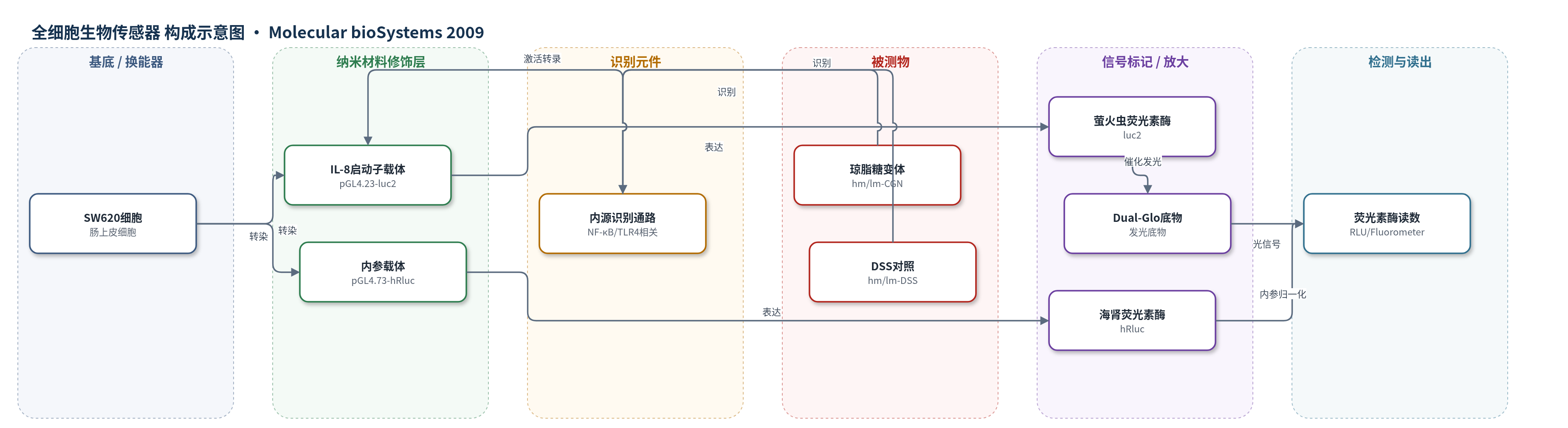
点击图片查看大图 · 依据论文自动绘制
传感器类型
全细胞生物传感器
检测对象
高/低分子量琼脂糖(high/low molecular weight carrageenan, hm/lm-CGN)、硫酸葡聚糖(dextran sodium sulfate, DSS),样品基质为细胞培养液/体外细胞暴露体系。
检测原理
该全细胞生物传感器以 SW620 肠上皮细胞为识别与信号平台。hm 硫酸化多糖(如 hm-CGN、hm-DSS)进入细胞培养体系后,被细胞内源模式识别/信号通路识别,并激活 NF-κB 等转录调控通路;该通路结合 IL-8 启动子中的响应元件,驱动 pGL4.23 载体中萤火虫荧光素酶 luc2 的转录表达。加入 Dual-Glo 底物后,luc2 催化底物氧化发光,荧光素酶活性以相对光单位 RLU 读出。pGL4.73 内参 hRluc 用于校正转染效率。被测物浓度或分子结构越强,NF-κB 激活越强,luc2 表达和发光信号越高;lm-CGN 响应弱,hm-CGN/hm-DSS 响应强,因此可区分不同病理生理潜力的硫酸化多糖。
检测灵敏度
原文未报告LOD、线性范围、灵敏度斜率或相关系数。
效应效果
IL-8 报告系统选择性响应 hm-CGN 和 hm-DSS,不响应 lm-CGN、lm-DSS、非硫酸化多糖及血红素、岩藻糖、支链淀粉、藻酸盐、铜离子等。与商业 NF-κB 报告系统相比,其对 hm-CGN/hm-DSS 读数高约 2 倍。全基因组谱显示 hm-CGN 改变 824 个基因,lm-CGN 仅 91 个;变化范围分别为 -6.64 至 22.33 倍和 -2.65 至 2.96 倍。细胞毒性试验中 lm-CGN 毒性高于 hm-CGN,符合体内趋势,但 hm-DSS 毒性高于 lm-DSS,与体内相反。未报告稳定性、RSD 或实际样品回收率;实验以重复孔计算标准差。作者认为其比细胞毒性试验更接近体内效应,可用于高通量筛查营养添加剂安全性。
传感器的构成
- 细胞基底:SW620 肠上皮细胞(RPMI 1640、10% FCS),提供 CGN 响应细胞背景与内源信号通路。
- 报告基因修饰层:pGL4.23[luc2/minP] 质粒,含 IL-8 启动子片段(1/2/3 kb)驱动萤火虫荧光素酶 luc2。
- 内参修饰层:pGL4.73[hRluc/SV40] 质粒,SV40 启动子驱动海肾荧光素酶 hRluc,用于转染效率归一化。
- 识别元件:SW620 细胞内源 CGN 响应通路(NF-κB;TLR4 为候选受体),识别 hm 硫酸化多糖。
- 信号标记物:萤火虫荧光素酶 luc2 与 Dual-Glo 底物,催化氧化发光产生 RLU。
- 递送层:Effectene 转染试剂(QIAGEN),将报告质粒导入 SW620 细胞。
- 读出装置:Fluorometer Fusion(Packard Biosciences),测量相对光单位 RLU。
中文摘要
体外监测营养添加剂安全性的系统可用于高通量筛查并替代动物模型。琼脂糖(CGN)是广泛用于食品增稠和质构调节的硫酸化多糖,其病理生理潜力存在争议;低分子量(lm)变体在体内通常比高分子量(hm)变体产生更强病理效应。本文采用系统方法构建报告系统,以区分不同病理生理潜力的 CGN 变体。利用 CGN 响应基因 DMBT1 启动子片段构建的报告系统在肠上皮来源 SW620 细胞中未显示显著活性。全基因组表达谱分析显示,hm-CGN 引起的全局基因活性变化在质和量上均强于 lm-CGN(824 个基因对 91 个基因;hm-CGN 变化范围 -6.64 至 22.33 倍,lm-CGN 为 -2.65 至 2.96 倍)。基于 IL-8 启动子片段的报告系统对 hm 硫酸化多糖表现出特异性激活,而 hm 硫酸化多糖在体内病理生理潜力较低;该系统对 CGN 变体的分类优于体外细胞毒性试验。IL-8 报告系统可用于区分硫酸化多糖的体内效应,数据也提供了 CGN 不同变体效应差异可能涉及的分子机制初步线索。
英文摘要
In vitro systems for monitoring safety of nutritional additives are desirable for high-throughput screenings and as a substitute for animal models. Carrageenan (CGN) is a sulfated polysaccharide widely used as a thickener and texturizer in human nutrition and is intensely discussed regarding its pathophysiological potential. Low molecular weight (lm) variants of CGN are considered to exert more profound pathophysiological effects in vivo than high molecular weight (hm) variants. We used a systematic approach to construct reporter systems allowing distinction between CGN-variants with different pathophysiological potential. Reporter systems utilizing segments of the CGN-responsive DMBT1 promoter did not display substantial activity in SW620 cells of intestinal epithelial origin. Genome-wide profiling revealed stronger qualitative and quantitative changes in global gene activities for hm-CGN than for lm-CGN (824 versus 91 genes; -6.64 to 22.33-fold for hm-CGN versus the range of -2.65 to 2.96-fold for lm-CGN). Reporter systems with segments of the IL-8 promoter showed a specific activation in response to hm-sulfated polysaccharides with lower pathophysiological potential in vivo and provided a better classification of CGN-variants than cytotoxicity assays in vitro. IL-8 reporter systems can be used for discerning between the effects of sulfated polysaccharides in vivo. Our data further provide initial insights into the molecular mechanisms that may play a role in the different effects of CGN-variants.