组成图示
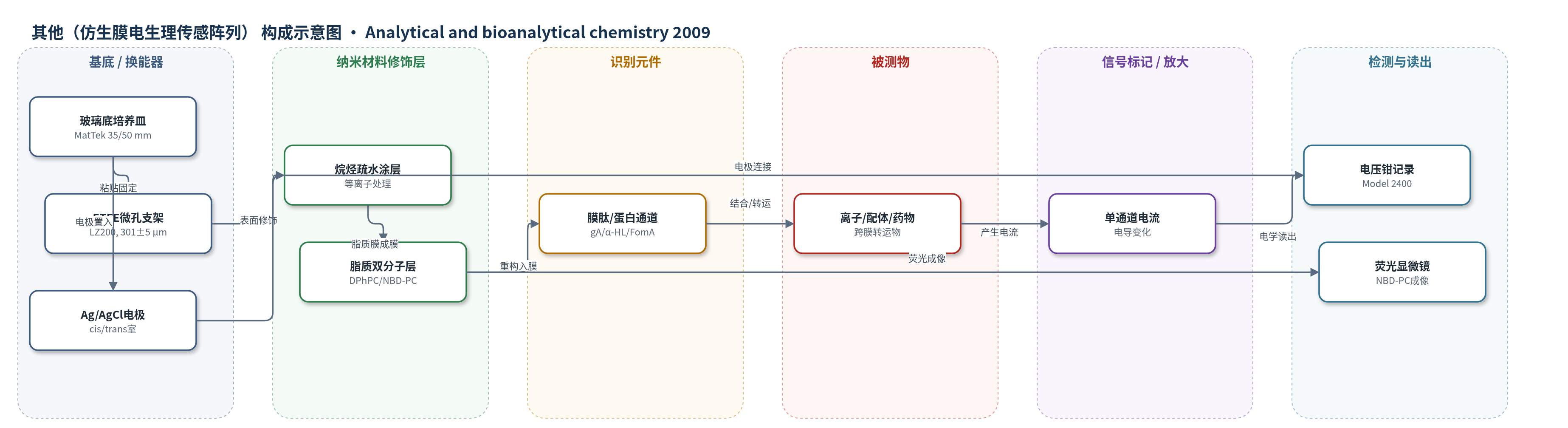
点击图片查看大图 · 依据论文自动绘制
传感器类型
其他(仿生膜电生理传感阵列)
检测对象
未明确具体分析物;功能验证对象为 K+(valinomycin)、阳离子(gA)、膜蛋白配体/药物(α-HL、FomA);样品基质为 KCl、HCl 及生理盐水
检测原理
该装置以 CO2 激光微结构 ETFE LZ200 薄膜作为多孔支架,表面经烷烃等离子处理形成疏水锚定层,再用 DPhPC/NBD-PC 脂质溶液涂布并刮薄形成平面黑脂质双分子层。将 valinomycin、gA、α-HL 或 FomA 等膜肽/蛋白重构入膜后,它们形成跨膜离子通道或配体结合位点。当 K+、阳离子或其他配体/药物与通道相互作用并发生跨膜转运时,通道开放概率、电导或电流发生变化。Ag/AgCl 电极在电压钳下施加固定偏压,记录跨膜电流、电导和电容;NBD-PC 荧光成像用于确认膜完整性。信号大小随通道数量、开放状态及离子/配体浓度变化,从而支持低电流电生理检测。
检测灵敏度
未报告LOD、线性范围、灵敏度斜率或相关系数
效应效果
8×8 阵列成功率≥98%,寿命约 1 h,电容 9750±515 pF、电导 61±11 nS;未穿孔 ETFE 基线 132±13 pF、2.5±0.5 nS。噪声 3–5 pA,可分辨 gA 约 20 pA、α-HL 约 35 pA、FomA 约 15 pA 单通道事件。大阵列寿命约 16 h,电导 2000–5000 nS,24×24 最大电容约 50000 pF,噪声 10–20 pA。valinomycin 电流可被 TEA 阻断,α-HL 协同插入。作者认为可扩展至平方厘米级,适合开发仿生膜生物传感器。
传感器的构成
- 基底/换能器:MatTek 35/50 mm 玻璃底培养皿构成 cis/trans 腔室,Ag/AgCl 电极置于两室用于电压钳电学读出
- 微孔支架:CO2 激光微结构 ETFE LZ200 薄膜,孔径 301±5 μm、中心距 400 μm,形成 8×8、24×24、24×27 分区阵列
- 表面修饰:ETFE 表面经低碳烷烃(己烷)等离子处理形成疏水涂层,为脂质膜提供分子锚定
- 脂质双分子层:DPhPC 溶于正癸烷(25 mg/mL)并掺 1 mol% NBD-PC,涂布后手动刮薄形成 BLM
- 识别/功能元件:valinomycin、gramicidin A (gA)、α-hemolysin (α-HL)、FomA 重构入膜形成离子通道
- 信号标记/可视化:NBD-PC 荧光脂质用于荧光显微镜观察双分子层边界与完整性
- 密封/固定:Viton A 橡胶环分隔上下室,定制铝制样品夹持器固定腔室
中文摘要
为在大规模分区孔径阵列上建立平面仿生膜,作者设计了一种可一次性使用的水平腔室,支持光学与电学联合测量。利用 CO2 激光微结构 ETFE 薄膜制备的 8×8 分区阵列,平均孔径为 301±5 μm,可高效建立功能性脂质双分子层。通过可控重构具有生物技术及生理意义的膜肽和膜蛋白,研究了微结构支架上脂质双分子层的电物理性质。随后,在 24×24 矩形和 24×27 六角分区阵列中建立脂质双分子层,检验了该仿生膜设计的可扩展性。结果表明,该设计适合进一步开发高灵敏度生物传感器检测方案,并证明其可方便地放大至支持平方厘米级平面脂质双分子层阵列。
英文摘要
To establish planar biomimetic membranes across large scale partition aperture arrays, we created a disposable single-use horizontal chamber design that supports combined optical-electrical measurements. Functional lipid bilayers could easily and efficiently be established across CO(2) laser micro-structured 8 x 8 aperture partition arrays with average aperture diameters of 301 +/- 5 microm. We addressed the electro-physical properties of the lipid bilayers established across the micro-structured scaffold arrays by controllable reconstitution of biotechnological and physiological relevant membrane peptides and proteins. Next, we tested the scalability of the biomimetic membrane design by establishing lipid bilayers in rectangular 24 x 24 and hexagonal 24 x 27 aperture arrays, respectively. The results presented show that the design is suitable for further developments of sensitive biosensor assays, and furthermore demonstrate that the design can conveniently be scaled up to support planar lipid bilayers in large square-centimeter partition arrays.