组成图示
点击图片查看大图 · 依据论文自动绘制
传感器类型
综述或非传感器论文
检测对象
磷脂酰肌醇4,5-二磷酸(PtdIns(4,5)P2/PIP2)水解及肌醇1,4,5-三磷酸(IP3)产生;样品基质:皮层锥体神经元(器官型皮层切片)
检测原理
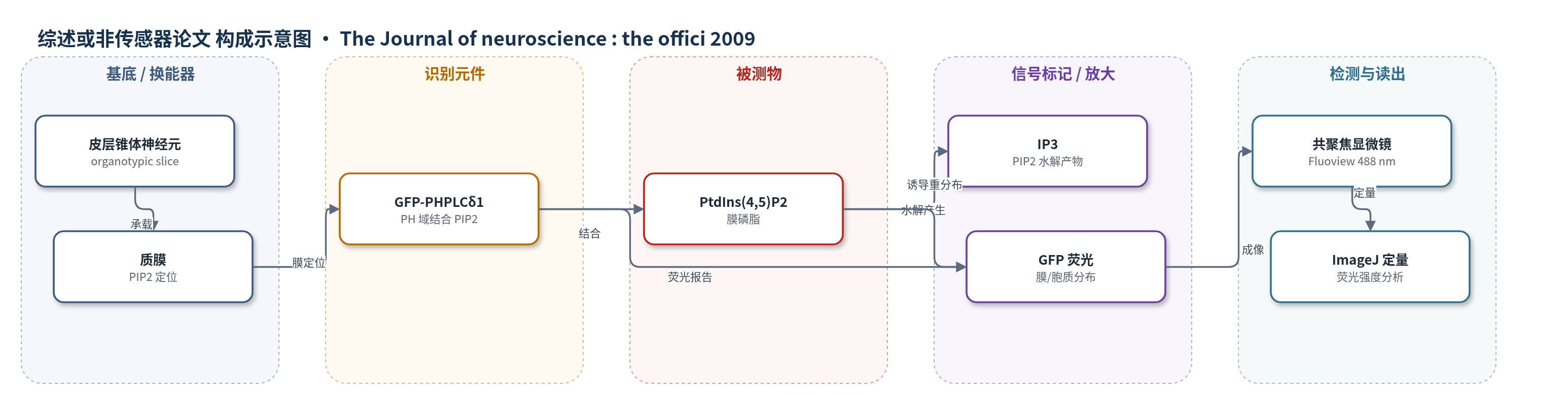
GFP–PHPLCδ1 的 PH 结构域在静息状态下结合质膜上的 PtdIns(4,5)P2,使 GFP 荧光主要定位于细胞膜。carbachol 激活 M1 毒蕈碱受体后,Gq/11 激活 PLCβ1,PLCβ1 水解 PtdIns(4,5)P2 生成 IP3,膜上 PIP2 减少,PH 结构域失去膜锚定,GFP–PHPLCδ1 由膜向胞质重分布。共聚焦显微镜检测膜区 GFP 荧光下降、胞质荧光上升,其变化幅度反映 PIP2 水解/IP3 产生程度。该过程可逆,撤除 carbachol 后膜定位恢复。
检测灵敏度
原文未报告 LOD、线性范围、灵敏度斜率或相关系数。
效应效果
作为机制研究,该文未提供传感器式定量性能。GFP–PHPLCδ1 在 carbachol 刺激下发生膜到胞质的可逆重分布,n=6 时膜荧光下降、胞质荧光上升显著(p<0.05)。选择性方面,M1 拮抗剂 pirenzepine 阻断 IsADP,而 PD102807 无影响;Gq/11 显性负性使 IsADP 由 -21.3±5.2 pA 降至 -6.7±3.9 pA,PLCβ1 敲除使 IsADP 由 -43±5.5 pA 降至 -9±3.2 pA(约 80% 降低)。TRPC5-DN 基本阻断 IsADP(n=14,p<0.01),TRPC5/TRPC6 过表达可增强至纳安级。
传感器的构成
- 细胞基底:皮层锥体神经元(organotypic cortical slices),承载毒蕈碱受体、Gq/11、PLCβ1 与 TRPC 通道。
- 识别元件:GFP–PHPLCδ1(PLCδ1 plectrin homology domain fused to GFP),其 PH 结构域结合 PtdIns(4,5)P2 并定位于质膜。
- 信号标记物:GFP 荧光(488 nm 激发),通过膜/胞质荧光强度变化报告 PtdIns(4,5)P2 水解。
- 刺激配体:carbachol(毒蕈碱受体激动剂),激活 M1 受体并触发 Gq/11–PLCβ1 信号。
- 读出装置:Olympus Fluoview 激光共聚焦显微镜与 ImageJ,采集并定量膜/胞质 GFP 荧光。
中文摘要
激活皮层锥体细胞毒蕈碱受体可诱导缓慢后去极化,使短暂刺激后维持自主放电,可能参与记忆痕迹短暂存储。本研究用电生理与分子生物学策略探究其机制。表达 Gq/11 显性负性蛋白抑制毒蕈碱受体诱导的内向后电流,PLCβ1 敲除小鼠中该电流显著降低。遗传编码荧光生物传感器 GFP–PHPLCδ1 显示毒蕈碱受体激活诱导锥体细胞磷脂酰肌醇4,5-二磷酸水解,提示 Gq/11–PLCβ1 级联关键作用。此前该后去极化由钙激活非选择性阳离子电流介导,可能涉及 TRPC 通道。TRPC 显性负性蛋白抑制、TRPC5 或 TRPC6 过表达增强毒蕈碱受体诱导内向后电流;TRPC5 与 T 型钙通道共表达可在 HEK-293 细胞重建该电流。结果支持 TRPC 通道介导皮层锥体细胞毒蕈碱受体诱导缓慢后去极化,并可能参与记忆过程。
英文摘要
Activation of muscarinic cholinergic receptors on pyramidal cells of the cerebral cortex induces the appearance of a slow afterdepolarization that can sustain autonomous spiking after a brief excitatory stimulus. Accordingly, this phenomenon has been hypothesized to allow for the transient storage of memory traces in neuronal networks. Here we investigated the molecular basis underlying the muscarinic receptor-induced afterdepolarization using molecular biological and electrophysiological strategies. We find that the ability of muscarinic receptors to induce the inward aftercurrent underlying the slow afterdepolarization is inhibited by expression of a Galpha(q-11) dominant negative and is also markedly reduced in a phospholipase C beta1 (PLCbeta1) knock-out mouse. Furthermore, we show, using a genetically encoded biosensor, that activation of muscarinic receptor induces the breakdown of phosphatidylinositol 4,5-bisphosphate in pyramidal cells. These results indicate that the Galpha(q-11)/PLCbeta1 cascade plays a key role in the ability of muscarinic receptors to signal the inward aftercurrent. We have shown previously that the muscarinic afterdepolarization is mediated by a calcium-activated nonselective cation current, suggesting the possible involvement of TRPC channels. We find that expression of a TRPC dominant negative inhibits, and overexpression of wild-type TRPC5 or TRPC6 enhances, the amplitude of the muscarinic receptor-induced inward aftercurrent. Furthermore, we find that coexpression of TRPC5 and T-type calcium channels is sufficient to reconstitute a muscarinic receptor-activated inward aftercurrent in human embryonic kidney HEK-293 cells. These results indicate that TRPC channels mediate the muscarinic receptor-induced slow afterdepolarization seen in pyramidal cells of the cerebral cortex and suggest a possible role for TRPC channels in mnemonic processes.