组成图示
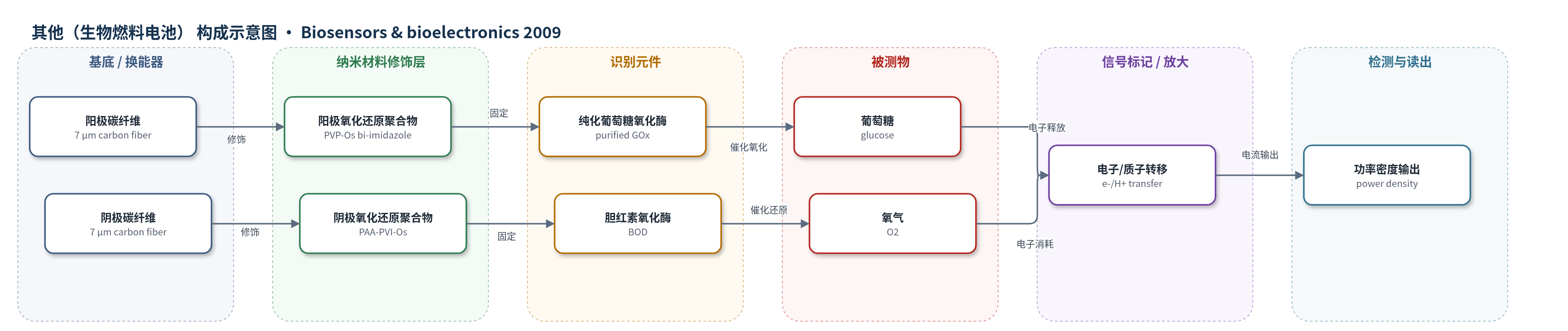
点击图片查看大图 · 依据论文自动绘制
传感器类型
其他(生物燃料电池)
检测对象
葡萄糖(glucose)、氧气(O2);样品基质:空气饱和生理磷酸盐缓冲液(PBS, pH 7.24, 0.14 M NaCl)
检测原理
该器件为无膜葡萄糖–O2 生物燃料电池。阳极上,纯化 GOx 催化葡萄糖氧化为葡萄糖内酯,并将 FADH2 的电子传递给阳离子氧化还原聚合物 PVP-[Os(bi-imidazole)]2+/3+;聚合物通过氧化还原中心碰撞电子转移将电子传导至碳纤维。阴极上,BOD 催化 O2 还原,电子经 PAA-PVI-Os 聚合物到达碳纤维。水、葡萄糖和 O2 可直接渗透水凝胶。纯化去除约 20% 非蛋白稳定剂,增强 GOx 与阳离子聚合物的静电结合,形成更均一的皮革样凝胶,提高电子转移并减少 O2 对电子的竞争。因此电流/功率随葡萄糖浓度升高而增大,低葡萄糖下受阳极限制。
检测灵敏度
原文未报告 LOD、线性范围、灵敏度斜率或相关系数。
效应效果
纯化 GOx 使 5 mM 葡萄糖、O2 下电流比非纯化高约 3 倍;argon 下 5 mM 电流高约 40%,45 mM 高约 19%。表观 Km 在 argon 下由 2.5±0.4 mM 降至 1.9±0.2 mM,O2 下由 11.9±3.3 mM 降至 4.9±0.3 mM。三次平行 RSD 约 4.3%。空气饱和生理液(15 mM 葡萄糖,37 °C)中,微型无膜生物燃料电池功率密度为 315 μW cm−2,约为非纯化 GOx 两倍;1 atm O2 下仅比空气低 14%,非纯化低 30%。连续运行 1 周、+0.52 V 下每天功率损失约 6%。作者认为可用于微型植入式葡萄糖–O2 生物燃料电池和葡萄糖传感器。
传感器的构成
- 基底/换能器电极:玻璃碳电极(glassy carbon, GC)或碳纤维(carbon fiber, CF),作导电基底
- 阳极修饰层:PVP-[Os(N,N′-dialkylated-2,2′-bi-imidazole)3]2+/3+ 氧化还原聚合物(67 wt%),作为电子导线
- 阳极识别元件:纯化葡萄糖氧化酶(purified GOx, 28 wt%),催化葡萄糖氧化
- 阳极交联层:聚乙二醇(400)二缩水甘油醚(PEGDGE, 5 wt%),化学交联稳定酶-聚合物复合物
- 阴极修饰层:PAA-PVI-[Os(4,4′-dichloro-2,2′-bipyridine)2Cl]+/2+ 氧化还原聚合物(77 wt%),作为电子导线
- 阴极识别元件:胆红素氧化酶(BOD, 15.5 wt%),催化氧气还原
- 阴极交联层:PEGDGE(7.5 wt%),化学交联稳定酶-聚合物复合物
- 燃料/氧化剂:葡萄糖(glucose)和氧气(O2),分别作为阳极电子供体和阴极电子受体
中文摘要
生物电化学系统的关键目标是提高电流密度并缓解质量传输限制。多数研究聚焦于增大电极比表面积或改善酶与电极间的电子转移,却很少比较纯化与非纯化酶对生物传感器效率的影响。为说明酶纯度的作用,作者研究了微型无膜生物燃料电池中常用的商业黑曲霉葡萄糖氧化酶(GOx)。结果表明,冻干酶粉中的附加化合物虽不干扰其固有催化性质,却可能阻碍酶与电极表面之间的有效电子转移。将纯化 GOx 引入固定在电极表面的生物电催化剂后,酶与氧化还原聚合物之间的相互作用增强,形成更均一的皮革样凝胶。在 5 mM 葡萄糖、氧气气氛下,使用纯化酶的电流比非纯化酶高约三倍。基于该新型阳极构建的微型可植入无膜葡萄糖–O2 生物燃料电池,在空气中产生的功率密度约为使用非纯化 GOx 时的两倍。
英文摘要
A key objective in any bioelectrochemical systems is to improve the current densities and mass transport limitation. Most of the work is focused on increasing the specific surface of the electrodes or improving the electron transfer between enzymes and electrodes. However, nothing is said about the comparison of purified and non-purified enzyme and their effects on the biosensor efficiency. To illustrate the effect of the enzyme purity, we studied the widely used commercial Glucose Oxidase (GOx) from Aspergillus niger that we are using in our miniature membrane-less biofuel cell. Our results indicate that even if additional compounds contained in the lyophilized enzyme powder do not interfere with its intrinsic catalytic properties, they could prevent a good electron transfer between the enzyme and the electrode surface. By introducing a purified glucose oxidase into a bioelectrocatalyst immobilized on an electrode surface, we show that we can increase the interaction between the enzyme and the redox polymer, forming a better homogenous, leather like gel. At 5mM glucose concentration and under oxygen atmosphere, the current is three-fold higher when using a purified enzyme than it is when using a non-purified enzyme. Built with this novel anode, we showed that a miniature implantable membrane-less glucose-O(2) biofuel cell could produce, under air, twice the power density that is usually obtained when using a non-purified GOx.