组成图示
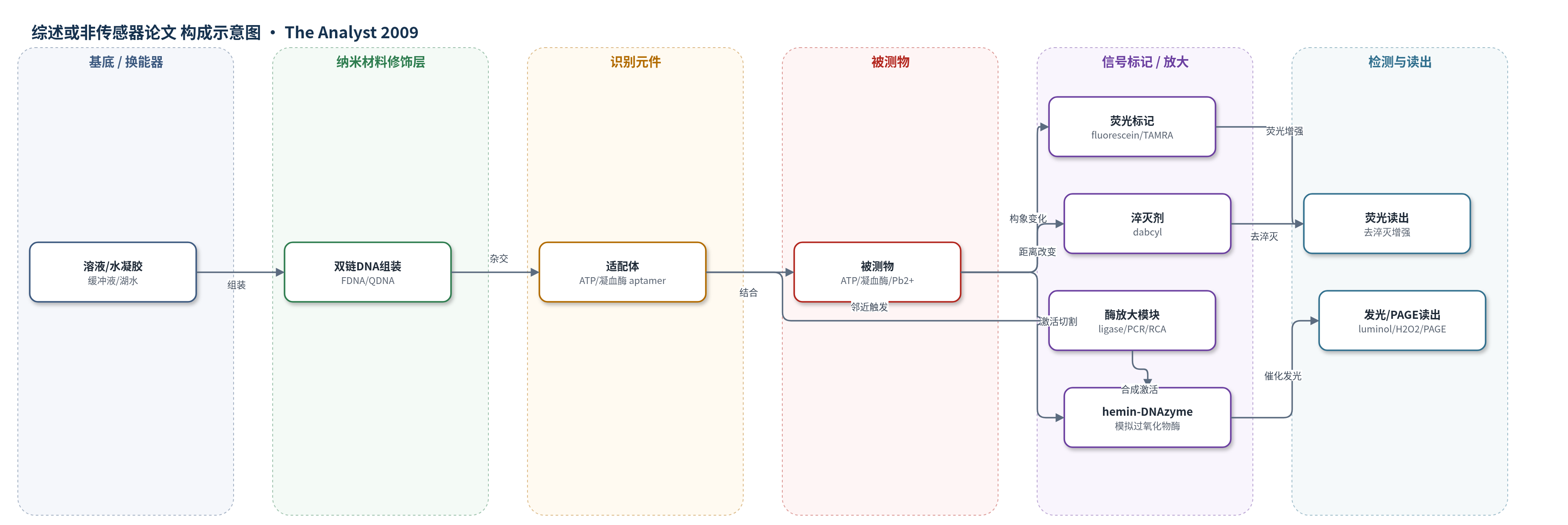
点击图片查看大图 · 依据论文自动绘制
传感器类型
综述或非传感器论文
检测对象
腺苷(adenosine)、ATP(ATP)、凝血酶(thrombin)、血小板源性生长因子BB(PDGF-BB)、M13噬菌体单链DNA(M13 phage ssDNA)、铅离子(Pb2+)、腺苷单磷酸(AMP)、溶菌酶(lysozyme);样品基质:缓冲液/溶液、湖水(Lake Michigan)、噬菌体DNA溶液
检测原理
本文综述的适配体传感器主要依赖三类信号转换机制。结构切换型中,适配体与靶标结合后发生构象重排,使互补链或淬灭链解离,荧光基团与淬灭剂距离增大,荧光去淬灭增强,信号随靶标浓度升高而增加。酶介导型中,两个适配体结合同一靶标后使末端靠近,触发连接酶连接、PCR 或滚环扩增(RCA),通过核酸扩增放大信号。适配酶型中,Pb2+ 激活催化 DNA 切割,释放荧光片段;或适配体-DNAzyme 在 hemin 存在下形成模拟过氧化物酶,催化 ABTS2+ 氧化或 luminol/H2O2 化学发光。上述过程将分子识别事件转化为荧光、发光或电泳/PCR 可读信号。
检测灵敏度
LOD: 4 mM(AMP 传感器);线性范围: 10 nM–4 mM(Pb2+ 传感器);灵敏度: zeptomolar range(PDGF-BB 邻近连接/PCR 检测)
效应效果
文中体系表现出良好选择性与应用潜力。结构切换传感器可区分 ATP/dATP 与 CTP、UTP、GTP,并实现实时检测;水凝胶体系在 2 mM 腺苷下释放金纳米颗粒,而胞苷、尿苷、鸟苷不引起释放,凝血酶响应较慢。邻近连接/PCR 检测 PDGF-BB 的灵敏度达 zeptomolar range,优于 ELISA,但高浓度样品需稀释以避免单标记假象。Pb2+ 传感器在密歇根湖真实水样中可定量检测加标 Pb2+,其他二价离子不降低灵敏度,TAMRA 荧光增强约 400%。AMP 传感器检出限 4 mM,较已报道溶菌酶电化学适配体传感器提高 100 倍。
传感器的构成
- 识别元件:DNA/RNA 适配体(aptamer),经 SELEX 筛选,特异性结合 ATP、凝血酶、PDGF-BB、Pb2+、AMP、溶菌酶等
- 竞争/信号链:互补 DNA(cDNA)、荧光标记链(FDNA)、淬灭标记链(QDNA),用于双链组装与结构切换
- 信号标记物:荧光素(fluorescein)、TAMRA 荧光基团、dabcyl 淬灭剂,用于荧光增强或去淬灭读出
- 酶/放大元件:DNA 连接酶(ligase)、DNA 聚合酶(DNA polymerase)、切口酶(nicking enzyme)、限制性内切酶,用于邻近连接、RCA 与 DNAzyme 合成
- 催化/模拟酶元件:hemin-DNAzyme,模拟过氧化物酶(HRPO-mimicking),催化 ABTS2+ 氧化或 luminol/H2O2 化学发光
- 纳米材料:水溶性金纳米颗粒(gold nanoparticles, Au NPs),负载于水凝胶中,用于红外吸收追踪与可控释放
- 水凝胶基质:聚丙烯酰胺水凝胶(polyacrylamide hydrogel)、丙烯酰胺(acrylamide)、丙烯酰基修饰寡核苷酸(acrydite-modified oligonucleotides),实现适配体响应凝胶-溶胶转变
中文摘要
寡核苷酸曾仅被视为遗传信息储存分子,但核酶与脱氧核酶的发现揭示了其在多种生物应用中的潜力。过去二十年间,系统进化指数富集(SELEX)技术通过多轮体外筛选产生适配体,这类寡核苷酸或肽分子可高亲和、高选择性地结合多种靶标,被视为抗体的互补工具。适配体已应用于生物技术、医学、药理学、微生物学和分析化学等领域,包括色谱分离与生物传感器。本综述聚焦适配体在生物传感器开发中的应用。由于寡核苷酸合成准确、储存稳定、温度适应范围宽且易于化学修饰,其非常适合传感器设计与工程化。文中重点讨论文献中最常见的三类设计范式:结构切换、酶介导和适配酶(aptazyme)设计,并阐述其分子工程原理与代表性实例。
英文摘要
Oligonucleotides were once considered only functional as molecules for the storage of genetic information. However, the discovery of RNAzymes, and later, DNAzymes, unravelled the innate potential of oligonucleotides in many other biological applications. In the last two decades, these applications have been further expanded through the introduction of Systematic Evolution of Ligands by EXponential enrichment (SELEX) which has generated, by repeated rounds of in vitro selection, a type of molecular probe termed aptamers. Aptamers are oligonucleic acid (or peptide) molecules that can bind to various molecular targets and are viewed as complements to antibodies. Aptamers have found applications in many areas, such as bio-technology, medicine, pharmacology, microbiology, and analytical chemistry, including chromatographic separation and biosensors. In this review, we focus on the use of aptamers in the development of biosensors. Coupled with their ability to bind a variety of targets, the robust nature of oligonucleotides, in terms of synthesis, storage, and wide range of temperature stability and chemical manipulation, makes them highly suitable for biosensor design and engineering. Among the many design strategies, we discuss three general paradigms that have appeared most frequently in the literature: structure-switching, enzyme-based, and aptazyme-based designs.