组成图示
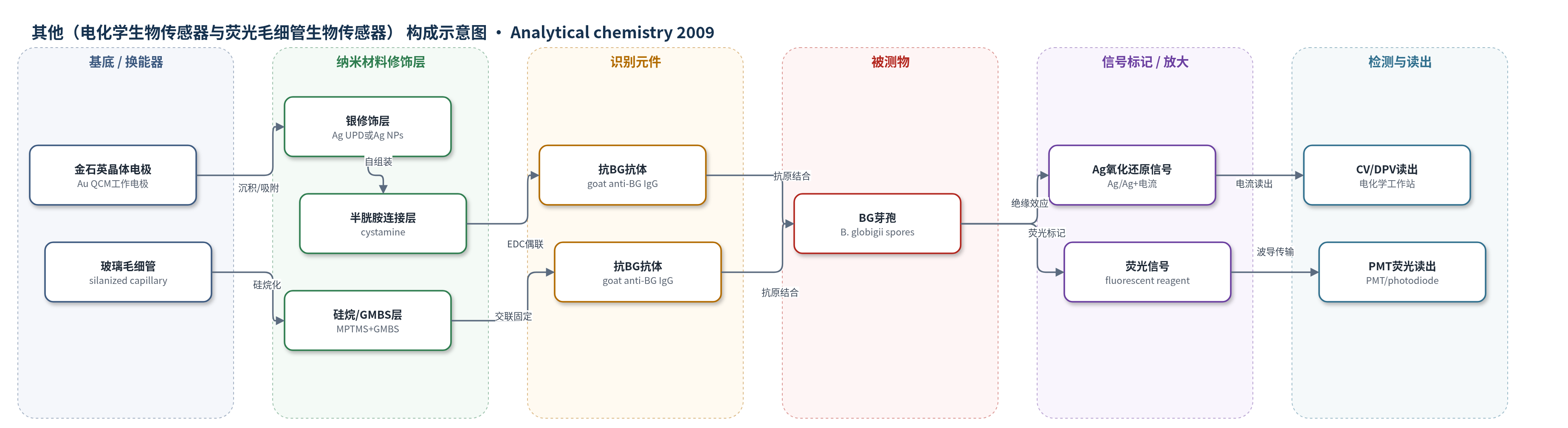
点击图片查看大图 · 依据论文自动绘制
传感器类型
其他(电化学生物传感器与荧光毛细管生物传感器)
检测对象
大孢芽孢杆菌芽孢(Bacillus globigii / B. atrophaeus spores);样品基质:缓冲液/水样(HEPES、PBS/PBSTB 芽孢悬液)
检测原理
MED:抗BG抗体经cystamine固定于Au/Ag电极,BG芽孢与抗体结合形成Ab-Ag复合物,增加界面电荷转移阻力,使Ag/Ag+氧化还原探针被绝缘,CV/DPV峰电流随芽孢浓度升高而下降;Ag UPD或Ag NPs提供金属增强氧化还原信号,QCM可同步验证质量增加。UPAC:抗BG抗体固定于硅化玻璃毛细管内壁,BG芽孢结合后与荧光试剂形成抗原-抗体-荧光团复合物,倏逝光激发产生荧光,毛细管作为波导将信号沿轴向积分并导向PMT,荧光强度随芽孢浓度增加而升高。两者均利用抗体特异性识别,无核酸扩增或酶催化沉积放大。
检测灵敏度
MED: LOD: 602 spores/mL;线性范围: 100-35000 spores/mL;CV LOD: 760 spores/mL;UPD LOD: 854 spores/mL。UPAC: LOD: 112 spores/mL;线性范围: up to 10,000 spores/mL。ELISA: LOD: 4269 spores/mL;饱和点: 4 × 10^5 spores/mL。
效应效果
选择性方面,用近缘菌Bacillus pumilus作干扰物,ELISA中其浓度达BG最低浓度5–10倍乃至20000 spores/mL时响应不显著,确认对BG的特异性。稳定性方面,SEM/EDS显示Ag岛在反复循环伏安后仍保留,抗体修饰电极可重复使用;QCM证实cystamine、抗体和芽孢逐步结合。UPAC三次重复误差棒显示良好精密度。MED响应约5 min,UPAC约30 min,样品处理少。LOD分别为602和112 spores/mL,均低于ELISA的4269 spores/mL;UPAC低于PCR的250 spores/mL,适合现场快速定量。
传感器的构成
- 基底/换能器(MED):金石英晶体电极(Au QCM,9 MHz)作电化学工作电极。
- 基底/换能器(UPAC):硅化玻璃毛细管(silanized glass capillary)作波导/流池。
- 金属修饰层:银亚电位沉积单分子层(Ag UPD)或油酸稳定银纳米粒子(Ag NPs)修饰Au电极,作氧化还原探针与金属增强层。
- 表面连接层:双(2-氨基乙基)二硫化物(cystamine)结合Au/Ag表面并提供氨基;N-(马来酰丁氧基)琥珀酰亚胺(GMBS)交联毛细管内壁巯基与抗体。
- 识别元件:山羊抗Bacillus globigii IgG(goat anti-BG IgG)经EDC偶联至cystamine或GMBS交联至毛细管内壁,识别BG芽孢。
- 封闭剂:牛血清白蛋白(BSA,PBSTB)封闭毛细管内壁,减少非特异吸附。
- 信号标记/探针:Ag/Ag+氧化还原对用于MED电流信号;荧光试剂(fluorescent reagent)用于UPAC荧光信号。
- 信号读出:CV/DPV读取Ag氧化还原峰电流;PMT/光电二极管读取毛细管集成荧光。
中文摘要
本文报道两种用于鉴定和定量检测大孢芽孢杆菌(Bacillus globigii,炭疽杆菌非致病模拟物)的策略。第一种是无标记金属增强电化学免疫传感器:抗BG抗体经半胱胺偶联自组装于金石英晶体电极,银亚电位沉积单分子层或吸附银纳米粒子作为氧化还原探针;BG芽孢与抗体结合后形成抗原-抗体复合物,使电极表面对银探针绝缘,氧化还原电流变化与芽孢浓度在1×10^2–3.5×10^4 spores/mL范围内成正比,检出限为602 spores/mL,低于炭疽芽孢感染剂量2.5×10^5 spores/mL。第二种是超灵敏便携毛细管生物传感器(UPAC),毛细管同时作为流池、波导和固相载体,倏逝激发产生抗原-抗体-荧光团复合物的荧光信号并导向检测器,检出限为112 spores/mL。两种方法均优于常规ELISA,并用Bacillus pumilus验证选择性,可支持现场快速检测。
英文摘要
Presented herein are two detection strategies for the identification and quantification of Bacillus globigii, a spore forming nonpathogenic simulant of Bacillus anthracis. The first strategy involves a label-free, metal-enhanced electrochemical immunosensor for the quantitative detection of Bacillus globigii (atrophaeus). The immunosensor comprises of antibacillus globigii (BG) antibody self-assembled onto a gold quartz crystal electrode via cystamine bond. A solid-phase monolayer of silver underpotentially deposited onto the cystamine modified-Au-electrode surface is used as the redox probe. The monolayer was also generated by adsorbing silver nanoparticles on the gold electrode. When the antibody-modified electrode is exposed to BG spores, the antibody-antigen (Ab-Ag) complex formed insulated the electrode surface toward the silver redox probe. The variation of redox current was found to be proportional to the concentration of the BG spores between 1 x 10(2)-3.5 x 10(4) spores/mL. A detection limit of 602 spores/mL was obtained, which is well-below the infectious dose of anthrax spores at 2.5 x 10(5) spores/mL. The second approach involves the use of ultrasensitive portable capillary biosensor (UPAC) to detect the spores. The capillary is an enclosed system that acts as the flow cell, the waveguide, and the solid support for immobilized bimolecular probes. An evanescent excitation generates a signal from an antigen-antibody-fluorophore complex, which propagates along the capillary and is guided to the detector. A limit of detection of 112 spores/mL was reported using the UPAC sensor. Both methods showed lower detection limits compared to the conventional ELISA. The effect of potential interferants tested using Bacillus pumilus confirmed the selectivity for the analyte. This work should allow the first responders to rapidly detect and quantify Bacillus globigii spores at concentrations that are well-below the infectious dose.