组成图示
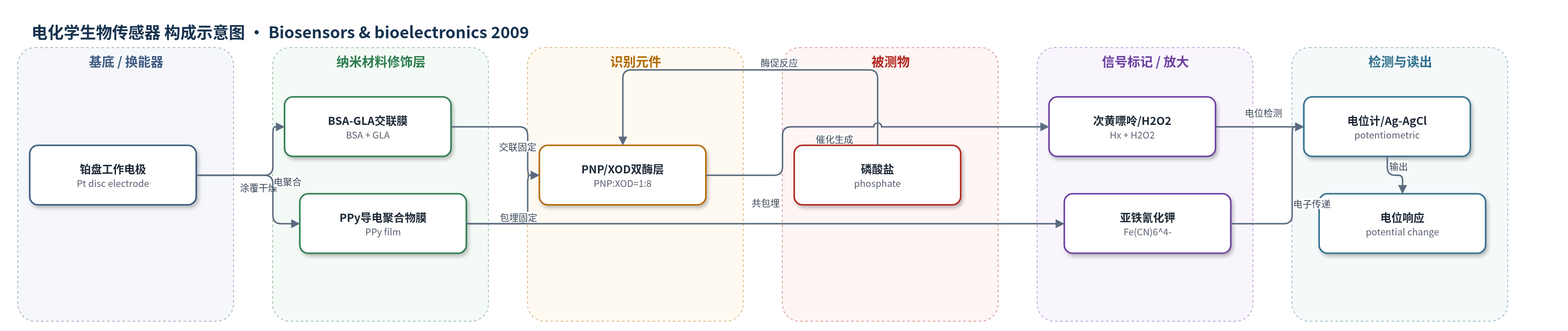
点击图片查看大图 · 依据论文自动绘制
传感器类型
电化学生物传感器
检测对象
磷酸盐(phosphate,PO4^3-);样品基质:水样/含次黄嘌呤核苷的巴比妥缓冲液
检测原理
该传感器采用双酶级联催化实现磷酸盐的电位检测。磷酸盐(PO4^3-)作为共底物,在嘌呤核苷磷酸化酶(PNP)催化下与次黄嘌呤核苷(inosine)反应生成次黄嘌呤(Hx)和核糖-1-磷酸;随后黄嘌呤氧化酶(XOD)在氧气存在下将 Hx 氧化为尿酸并产生过氧化氢(H2O2)。随着磷酸盐浓度升高,酶促循环生成的 H2O2 量增加,在铂电极界面引起氧化还原电位变化。PPy 膜中包埋的亚铁氰化钾(Fe(CN)6^4-)可改善电子传递并稳定电位响应,使 PPy 型传感器灵敏度高于 BSA-GLA 交联型。最终通过工作电极与 Ag/AgCl 参比电极之间的平衡电位差进行定量读出。
检测灵敏度
LOD(minimum detectable concentration): 0.1 mg/L(PPy-PNP-XOD-Fe(CN)6^4-);LOD(minimum detectable concentration): 2 mg/L(BSA-GLA-PNP-XOD);线性范围: 0.5–2.5 mg/L(5–25 μM,PPy-PNP-XOD-Fe(CN)6^4-);线性范围: 4–12 mg/L(40–120 μM,BSA-GLA-PNP-XOD);斜率: 46.5 ± 1.0 mV/decade(电位对磷酸盐浓度对数)
效应效果
在最优 XOD:PNP 比例下,传感器响应重现性较好,RSD 为 5.8%(n=4)。抗干扰方面,抗坏血酸(AA)≤1 mM 不干扰;5 mM AA 可使响应增强 28%,PPy 型在 AA>2.5 mM 时增强最高 42%。尿酸 1 mM 使响应抑制 4%,PPy 型在 2.5 mM 尿酸下抑制 17%;甘氨酸不干扰。PPy-PNP-XOD-Fe(CN)6^4- 传感器灵敏度明显优于 BSA-GLA 型,最低检测浓度 0.1 mg/L 低于文献报道的 0.32 mg/L 和 5 mg/L,线性范围位于较低浓度端。作者认为其稳定、特异,适用于水样磷酸盐现场检测,但灵敏度仍不足以直接测定饮用水中 0.046 mg/L 的限值。
传感器的构成
- 工作电极基底:铂盘电极(Pt disc electrode),经0.3 μm氧化铝抛光,作为电位换能器
- BSA-GLA固定层:牛血清白蛋白(BSA)与戊二醛(GLA)交联膜,用于化学交联固定PNP和XOD
- PPy固定层:聚吡咯(PPy)导电聚合物膜,由0.5 M吡咯恒流电聚合形成,用于包埋酶和亚铁氰化钾
- 识别/催化元件:嘌呤核苷磷酸化酶(PNP)与黄嘌呤氧化酶(XOD),摩尔比1:8,催化磷酸盐循环反应
- 电子媒介:亚铁氰化钾(K4Fe(CN)6,Fe(CN)6^4-),共包埋于PPy膜中,辅助电子传递与电位响应
中文摘要
本文报道并比较了两种用于电位法检测磷酸盐的酶生物传感器。嘌呤核苷磷酸化酶(PNP)与黄嘌呤氧化酶(XOD)分别通过牛血清白蛋白(BSA)-戊二醛(GLA)化学交联和聚吡咯(PPy)恒流电聚合包埋两种方法共固定于铂电极。BSA-GLA 膜采用 4.5% v/v GLA 和 6.8% w/v BSA,干燥 30 min;PPy 膜采用 0.5 M 吡咯,聚合 200 s;两种方法均使用 XOD:PNP 摩尔比 1:8(6.2 U/mL XOD 与 49.6 U/mL PNP)。以 BSA-GLA-PNP-XOD 传感器与 PPy-PNP-XOD-Fe(CN)6^4- 传感器比较,PPy 传感器最低可检测磷酸盐浓度为 0.1 mg/L,线性范围为 0.5–2.5 mg/L;BSA-GLA 传感器最低可检测浓度为 2 mg/L,线性范围为 4–12 mg/L。尿酸和抗坏血酸对 PPy 传感器影响较小,在水样中通常存在的水平下不影响两种传感器的磷酸盐测定。
英文摘要
The development of two phosphate biosensors is described and compared for potentiometric detection of phosphate. Purine nucleoside phosphorylase (PNP) and xanthine oxidase (XOD) were co-immobilised by chemical cross-linking with glutaraldehyde (GLA) and bovine serum albumin (BSA), and via entrapment into polypyrrole (PPy) films by galvanostatic polymerisation. The BSA-GLA film was made with 4.5% v/v GLA and 6.8% w/v BSA with a drying time of 30 min, while polypyrrole entrapment was achieved with 0.5M pyrrole by using a polymerisation time of 200s. A mole ratio of 1:8 (6.2U/mL XOD: 49.6 U/mL PNP) was used for both methods of enzyme immobilisation. Sensitive potentiometric measurements obtained for phosphate with the BSA-GLA-PNP-XOD biosensor were compared with those of PPy-PNP-XOD-Fe(CN)(6)(4-) biosensor. A minimum detectable concentration of 0.1mg/L phosphate and a linear concentration range of 0.5-2.5mg/L were achieved with the PPy-PNP-XOD-Fe(CN)(6)(4-) biosensor. In comparison, a minimum detectable concentration of 2mg/L and a linear concentration range of 4-12 mg/L were achieved with the BSA-GLA immobilisation. The presence of uric and ascorbic acids had the least effect on the performance of the PPy-PNP-XOD-Fe(CN)(6)(4-) biosensor, but will not have any effect on phosphate measurement with both biosensors at levels normally present in water.