组成图示
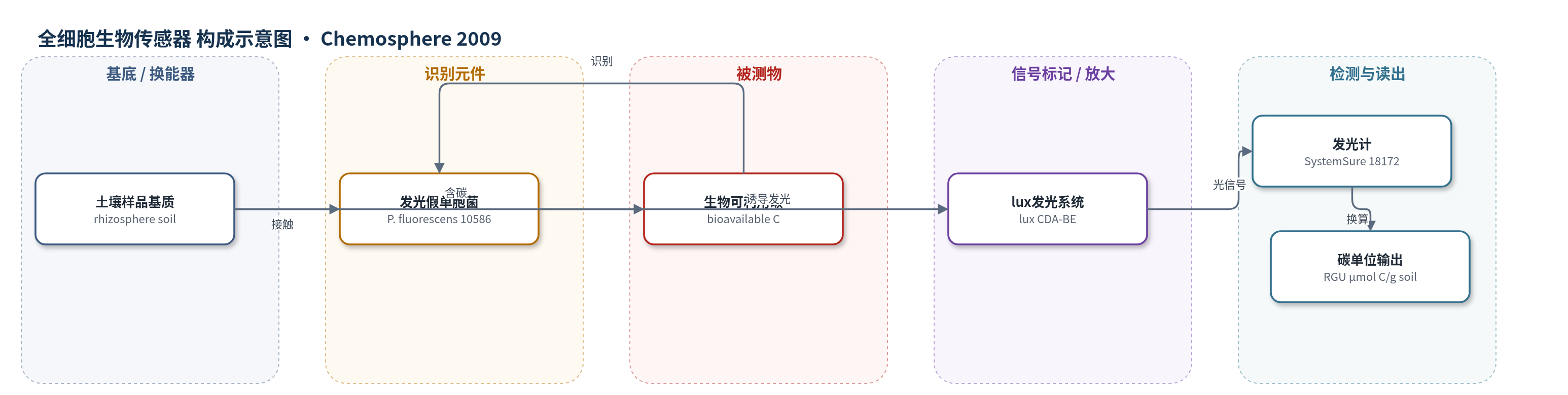
点击图片查看大图 · 依据论文自动绘制
传感器类型
全细胞生物传感器
检测对象
生物可利用碳源(bioavailable carbon sources, glucose-C equivalents);样品基质:根际土壤与 bulk 土壤
检测原理
将饥饿处理的 lux 标记 Pseudomonas fluorescens 10586 pUCD607 细胞悬液加入土壤样品并接触 20 min。若样品中存在生物可利用碳源(如根际分泌物或葡萄糖样碳),细菌摄取并代谢碳源,诱导或维持 lux CDA-BE 报告基因表达,荧光素酶催化底物氧化产生生物发光。发光强度随可利用碳浓度增加而增强。用 1–10 mM 碳浓度葡萄糖标准建立校准曲线,将发光计测得的相对发光单位(RLU)换算为相对葡萄糖碳单位(RGU,μmol glucose-C/g soil),从而定量反映根际碳沉积水平。该方法未使用电极或纳米放大策略,信号放大主要来自细菌代谢与 lux 酶催化发光。
检测灵敏度
原文未报告 LOD、线性范围、灵敏度斜率或相关系数。
效应效果
生物传感器响应在处理与采样位置效应上显著(F=46.91、12.61)。整体 HA 处理显著高于分级和对照:HA-10 为 1.39 RGU,HA-1 为 0.88 RGU,FR-I、FR-II、FR-III 为 0.59、0.57、0.56 RGU,对照 0.48 RGU;HA-10 前三层约为 HA-1 两倍。PCR-DGGE 重复性高,重复间 Dice 系数 0.9–1.0,部分 >0.85;尺寸分级使群落快速改变并持续至 60 d,聚类系数 0.84–0.92、0.79–0.88、0.87–0.91。作者认为生物传感器定量评估可利用碳,DNA 指纹区分群落结构,二者互补,适用于根际碳流与微生物过程监测。
传感器的构成
- 传感细胞层:Pseudomonas fluorescens 10586 pUCD607 活菌,作为识别与换能元件,响应生物可利用碳源
- 报告基因/信号标记层:lux CDA-BE(来自 Vibrio fischerii),编码荧光素酶系统,产生生物发光信号
- 培养与饥饿介质:LB 肉汤培养至 OD550=2.0,C-free M9 最小培养基饥饿 2 h,使细胞处于低内源碳状态
- 选择性维持剂:kanamycin 50 μg mL−1,维持 pUCD607 质粒/抗性标记
- 样品基质层:100 mg 根际土或 bulk 土壤,提供待测生物可利用碳源
- 读出系统:SystemSure luminometer Model 18172,测量 RLU 并按葡萄糖标准换算为 RGU
中文摘要
本研究利用根箱系统考察腐殖酸(HA)及其经高压尺寸排阻色谱分离的尺寸分级对玉米(Zea mays L.)根际碳沉积和根际土壤微生物群落结构的影响。根箱上部接受 HA 或分级处理,下部根际土通过尼龙膜与根系隔离,并在根系发育后按距根平面不同深度取样。采用 lux 标记生物传感器 Pseudomonas fluorescens 10586 pUCD607 测定根际生物可利用碳源沉积,结果显示整体 HA 处理显著增加根际可利用碳,而各尺寸分级处理未引起显著响应。16S rDNA PCR-DGGE 分子指纹分析表明,所有腐殖处理均改变根际微生物群落结构;较小且更易生物利用的尺寸分级比整体 HA 更易被微生物降解,而整体 HA 中疏水性强、结合紧密的腐殖分子需更多植物根际分泌物参与才能发生生物转化。研究强调结合生物传感器与 DNA 指纹等生物技术方法对根际碳流和微生物活动变化进行监测的重要性,并提示腐殖物质分子特性与根际微生物群落效应之间存在关联。
英文摘要
The effects of a humic acid (HA) and its size-fractions on plants carbon deposition and the structure of microbial communities in the rhizosphere soil of maize (Zea mays L.) plants were studied. Experiments were conducted in rhizobox systems that separate an upper soil-plant compartment from a lower compartment, where roots are excluded from the rhizosphere soil by a nylon membrane. The upper rhizobox compartment received the humic additions, whereas, after roots development, the rhizosphere soil in the lower compartment was sampled and sliced into thin layers. The lux-marked biosensor Pseudomonas fluorescens 10586 pUCD607 biosensor showed a significant increase in the deposition of bioavailable sources of carbon in the rhizosphere of soils when treated with bulk HA, but no response was found for treatments with the separated size-fractions. PCR-DGGE molecular fingerprintings revealed that the structure of rhizosphere microbial communities was changed by all humic treatments and that the smaller and more bioavailable size-fractions were more easily degraded by microbial activity than the bulk HA. On the other hand, highly hydrophobic and strongly associated humic molecules in the bulk HA required additional plant rhizodeposition before their bio-transformation could occur. This work highlights the importance of applying advanced biological and biotechnological methods to notice changes occurring in plant rhizodeposition and rhizosphere microbial activity. Moreover, it suggests correlations between the molecular properties of humic matter and their effects on microbial communities in the rhizosphere as mediated by root exudation.