组成图示
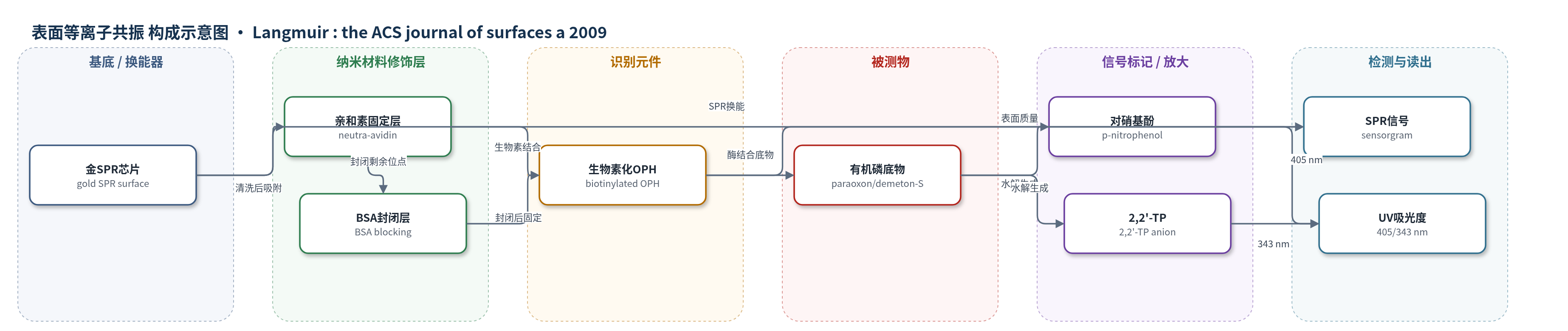
点击图片查看大图 · 依据论文自动绘制
传感器类型
表面等离子共振(SPR)生物传感器
检测对象
对氧磷(paraoxon)、demeton-S(有机磷农药/神经毒剂);样品基质:PBS缓冲液流动相(SPR流动池),溶液酶活测定使用CHES或tripart缓冲液。
检测原理
传感器以金SPR芯片为换能基底,亲和素层通过生物素-亲和素作用将生物素化OPH定向固定,BSA封闭非特异位点。有机磷底物(paraoxon或demeton-S)流经表面时进入OPH活性位点并被催化水解;paraoxon水解生成p-nitrophenol,demeton-S水解产生的硫醇与2,2'-TP反应生成可测阴离子。酶促反应使底物浓度转化为产物吸光度信号,405 nm或343 nm吸光度随底物浓度增加而升高。SPR倏逝波同时监测固定层质量/覆盖变化。K175A突变消除靠近活性位点的表面赖氨酸,减少酶面朝下固定,使活性位点更朝向溶液,提高底物可及性和表面催化效率。
检测灵敏度
线性范围: 0.048–0.462 mM(paraoxon);K175A斜率: 6.4 × 10^-16 ± 9.2 × 10^-14,R = 0.9979;WT斜率: 6.9 × 10^-16 ± 6.9 × 10^-14,R = 0.9996。
效应效果
K175A变体在溶液中保留野生型对paraoxon和demeton-S约80%活性。SPR表面覆盖显示K175A为1.8×10^10 ± 9.2×10^8 mm^-2,WT为2.16×10^10 ± 7.3×10^8 mm^-2,即K175A固定量降低17%。但单位面积酶活K175A为5.22×10^-15 ± 2.8×10^-16 μmol/s/mm^2,高于WT的4.30×10^-15 ± 1.3×10^-16 μmol/s/mm^2(paraoxon 0.05 mM),表面活性提高18%。paraoxon校准曲线线性良好(R=0.9979/0.9996)。作者认为定向固定可改善活性位点可及性,提高SPR酶传感器灵敏度。
传感器的构成
- 基底/换能器:金表面SPR芯片(gold SPR sensor surface),经piranha溶液清洗、空气/水初始化和NaOH-Triton X原位清洗,提供倏逝波换能界面。
- 固定层:neutra-avidin(中性亲和素,1 mg/mL)非特异性吸附于金表面,提供生物素结合位点。
- 封闭层:BSA(牛血清白蛋白,1 mg/mL)封闭剩余表面位点,降低非特异性结合。
- 识别元件:生物素化OPH(wild-type或K175A,1 mg/mL),通过生物素-亲和素结合定向固定,催化水解有机磷底物。
- 信号产物:p-nitrophenol(对硝基酚)由paraoxon水解产生,405 nm吸光度用于酶活读出;demeton-S水解产生的硫醇与2,2'-TP(2,2'-二硫代二吡啶)反应,在343 nm监测。
- 读出层:SPR sensorgram监测表面吸附/覆盖,流穿液UV吸光度监测水解产物。
中文摘要
蛋白质在固体界面的固定是生物传感、纯化、分离和去污等应用的关键。虽然固定可提高蛋白长期和操作稳定性,但常导致固定酶催化活性显著损失。共价固定利用氨基酸侧链反应基团,但酶表面溶剂暴露侧链分布常使蛋白通过侧链连接固定时呈现多种取向,不同固定机制和取向可能限制活性位点的可及性。本研究描述了一种将酶定向固定到表面等离子共振传感器表面的设计与实施方法。对有机磷水解酶(OPH)进行结构分析,识别表面残基作为修饰候选,以优化活性位点可及性和检测灵敏度。选择活性位点面单个表面赖氨酸 K175 突变为丙氨酸,使催化剂以优选取向固定。动力学评估表明,K175A 变体对神经毒剂底物对氧磷(paraoxon)和 demeton-S 保留野生型约 80% 活性。固定后,尽管传感器表面酶覆盖降低 17%,变体表面仍表现出更高活性。
英文摘要
Protein immobilization on solid interfaces is a crucial aspect of their successful application in technologies such as biosensing, purification, separation, decontamination, etc. Although immobilization can improve the long-term and operational stability of proteins, this is often at the cost of significant losses in the catalytic activity of the tethered enzyme. Covalent attachment methods take advantage of reactive groups on the amino acid side chains. The distribution of the solvent exposed side chains on an enzyme's molecular surface often results in an ensemble of orientations when the protein is immobilized on a surface or in a matrix through these side chain linkages. Depending on the attachment mechanism and resulting orientation, access to and from the active site could be restricted. This study describes a methodology for the design and implementation of an orientation specific attachment of an enzyme to a surface plasmon resonance sensor surface. The enzyme, organophosphorus hydrolase, was structurally analyzed to identify surface resides as candidates for modification to optimize active site accessibility and, thus, sensitivity of detection. A single surface lysine on the active site face of the enzyme dimer was selected for elimination, thus allowing for the immobilization of the catalyst in the preferred orientation. Kinetic evaluation of the enzymes determined that the surface lysine-to-alanine variant retained 80% of the wild-type activity with the neurotoxin substrates, paraoxon and demeton-S. After immobilization, surfaces bearing the variant were determined to be more active even though the enzyme coverage on the sensor surface was reduced by 17%.