组成图示
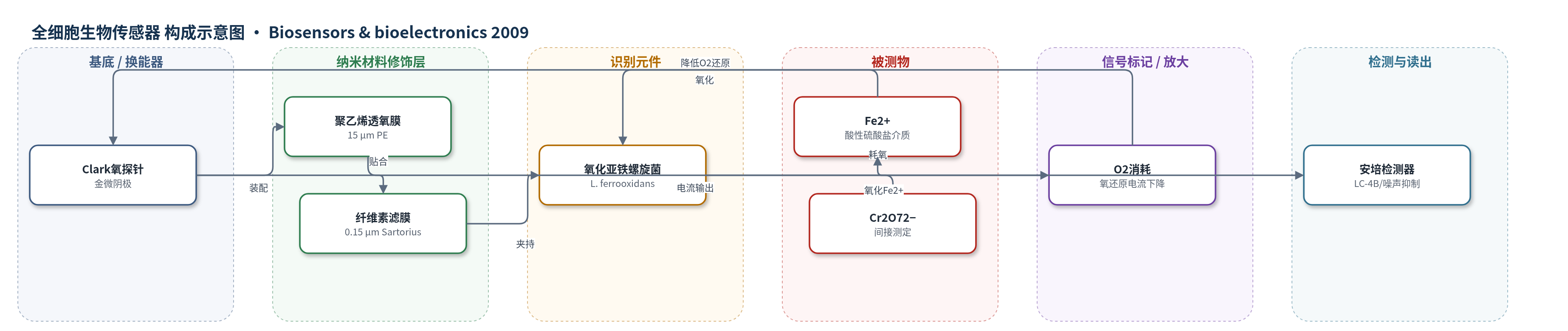
点击图片查看大图 · 依据论文自动绘制
传感器类型
全细胞生物传感器
检测对象
Fe2+(ferrous ions,亚铁离子)、Cr2O72−(dichromate,重铬酸根,间接测定);样品基质:pH 1.8 稀 H2SO4 水溶液/酸性硫酸盐介质
检测原理
传感器以 Leptospirillum ferrooxidans 全细胞为识别元件。在 pH 1.8 酸性介质中,该菌以 Fe2+ 为唯一能源,催化反应 4Fe2+ + O2 + 4H+ → 4Fe3+ + 2H2O,Fe2+ 浓度越高,细菌耗氧速率越大。O2 从溶液经 15 μm 聚乙烯透氧膜和纤维素滤膜扩散至 Clark 探针内部,在金微阴极上发生还原并产生安培电流。细菌耗氧使到达阴极的 O2 减少,氧还原电流下降,电流变化与 Fe2+ 浓度成正比。通过电流补偿和噪声抑制提高信噪比。对 Cr2O72− 的间接测定基于其氧化 Fe2+(1 mol Cr2O72− 氧化 6 mol Fe2+),使游离 Fe2+ 降低,从而引起电流下降。
检测灵敏度
LOD: 2.4 μmol L−1;线性范围: 2.1 mmol L−1(总动态线性范围;校准线性至 80 μmol L−1);灵敏度: 3.94 nA L μmol−1;R^2 = 0.9935;LOQ: 7.92 μmol L−1;Cr2O72− 灵敏度: 2.47 nA L μmol−1;R^2 = 0.9817
效应效果
传感器对 Fe2+ 的测定不受硫化合物干扰,添加至 0.6 mmol L−1 硫代硫酸盐未引起显著响应变化;但亚硫酸氢根可抑制菌体氧化亚铁活性,0.1、0.2、0.5 和 1 μmol L−1 HSO3− 分别使稳态响应降低 27%、52%、81% 和 92%。重现性良好,50 μmol L−1 Fe2+ 响应为 196 ± 2 nA(N=10,P=95%),R.S.D. <3%。室温储存 tL10 为 5 天,tL50 为 45 天。与 At. ferrooxidans 传感器相比,灵敏度相近(3.94 对 4.09 nA L μmol−1),响应时间更短(18 s 对 45 s),且无硫代硫酸盐干扰。作者认为可用于酸性硫酸盐介质中 Fe2+ 的连续在线监测,无需样品前处理。
传感器的构成
- 换能器电极:Clark 型氧探针,扁平前端并均匀分布金微阴极(Au microcathodes),用于 O2 还原电流检测
- 透氧膜:15 μm 聚乙烯(PE)塑料膜,控制 O2 扩散并影响响应时间与灵敏度
- 电解液层:探针内部电解液,连接金微阴极与透氧膜,传导 O2 还原电流
- 识别元件:Leptospirillum ferrooxidans DSM 2705T 全细胞,催化 Fe2+ 氧化并消耗 O2
- 支撑滤膜:0.15 μm Sartorius 纤维素滤膜,截留细菌并允许 O2 和 Fe2+ 透过
- 信号读出:BAS LC-4B 安培检测器、电流-电压转换器与噪声抑制单元,记录 O2 还原电流下降
中文摘要
本文报道了一种新型电化学全细胞生物传感器,将严格自养细菌 Leptospirillum ferrooxidans 作为识别元件,Clark 型氧探针作为换能器,用于 Fe2+ 的特异性测定。该菌氧化 Fe2+ 时消耗 O2,因此通过记录氧还原电流的下降实现定量。传感器检出限为 2.4 μmol L−1,灵敏度为 3.94 nA L μmol−1,在 Fe2+ 浓度 10−5–10−4 mol L−1 范围内响应时间约 18 s。该传感器还可间接测定 Cr2O72− 等氧化 Fe2+ 的物质,灵敏度达 2.47 nA L μmol−1。作者对 Clark 探针的响应时间和灵敏度进行了优化,所得分析性能与先前基于 Acidithiobacillus ferrooxidans 的传感器相当,并因菌种底物特异性而避免了硫化合物干扰。
英文摘要
A novel electrochemical biosensor integrating the strictly autotrophic bacterial strain Leptospirillum ferrooxidans as a recognition element and a Clark type oxygen probe as a transducer was designed, metrologically and analytically characterized and applied for the specific Fe(2+) determination. The bacterial Fe(2+) oxidation involves O(2) consumption, thus the quantification was performed registering the decrease of the oxygen reduction current. The limit of detection was found to be 2.4 micromol L(-1) and the sensitivity of the determinations-3.94 nAL micromol(-1). The response time of the biosensor is 18s for Fe(2+) concentrations of 10(-5) to 10(-4) mol L(-1). The biosensor was applied as well for the indirect determination of Fe(2+) oxidizing species such as Cr(2)O(7)(2-), reaching a sensitivity of 2.47 nAL micromol(-1). The transducer characteristics were evaluated and optimized to obtain short response time and high sensitivity. The analytical performances of the biosensor subject of the present work were found to be similar to that of the At. ferrooxidans based one developed by the authors earlier, avoiding however the sulfur compounds interference, because of the substrate specificity of the applied bacterial strain.