组成图示
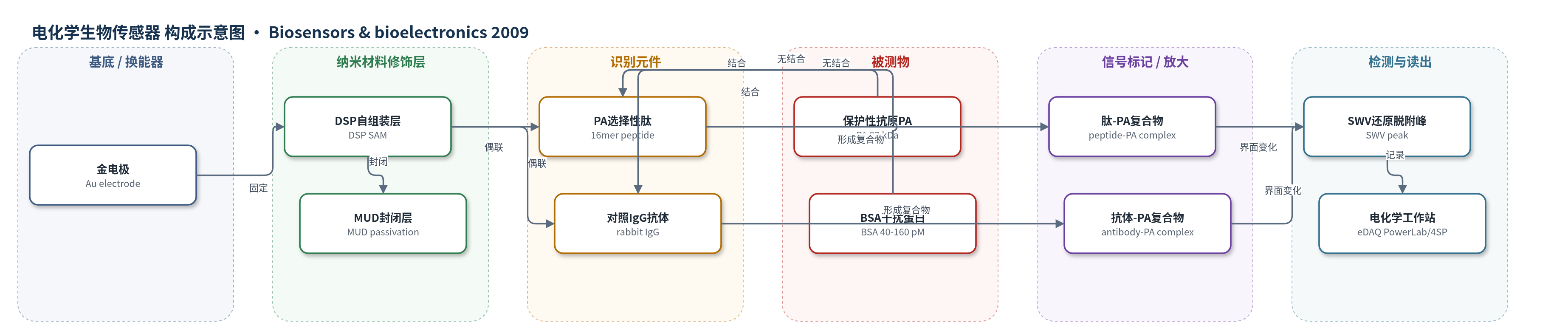
点击图片查看大图 · 依据论文自动绘制
传感器类型
电化学生物传感器
检测对象
保护性抗原(protective antigen, PA),样品基质为 PBS 缓冲液(含 BSA 干扰测试)
检测原理
金电极表面先形成 DSP 自组装单层,MUD 封闭空位,随后 PA 选择性肽或 IgG 抗体通过末端氨基与 DSP 琥珀酰亚胺基共价偶联,构成识别层。PA 与识别元件特异性结合后,传感层表面电荷密度和界面结构发生变化。由于 DSP/MUD 及肽/抗体层对 [Fe(CN)6]3− 等电活性物质具有绝缘阻隔作用,样品中其他电活性物质难以到达电极表面;PA 结合引起的界面变化通过方波伏安(SWV)还原脱附峰读出。PA 浓度越高,结合量越大,峰高变化越大。肽尺寸比抗体小约1–2个数量级,可更高密度固定,提高 PA 捕获概率,从而增强灵敏度。
检测灵敏度
肽传感器: LOD: 5.2 pM;线性范围: 40–120 pM;灵敏度: 0.316 ± 0.019 nA/pM;R^2 = 0.998;抗体对照: LOD: 16.4 pM;线性范围: 40–120 pM;灵敏度: 0.066 ± 0.005 nA/pM;R^2 = 0.996
效应效果
该传感器在 PBS 中对 PA 呈线性响应,肽基传感器灵敏度为 0.316±0.019 nA/pM,约为抗体基传感器(0.066±0.005 nA/pM)的5倍,LOD 由 16.4 pM 降至 5.2 pM。选择性测试中,40–160 pM BSA 单独存在时无明显峰;100 pM PA 在 40–160 pM BSA 存在下平均峰高为 26.7±0.3 nA,与无 BSA 时 26.9 nA 基本一致,表明对 BSA 无干扰。每个浓度采用四个独立制备的传感层测量,校准曲线相关系数分别为 0.998(肽)和 0.996(抗体)。作者认为该肽基电化学传感器具有小型化、低成本、易合成和可拓展至其他蛋白标志物诊断的应用潜力。
传感器的构成
- 基底/换能器电极:金电极(Au electrode),经打磨和 0.5 M H2SO4 循环伏安活化,作为电化学换能器。
- 自组装结合层:3,3′-二硫代二丙酸双(N-羟基琥珀酰亚胺酯)(DSP)SAM,通过二硫键还原在金表面形成,提供琥珀酰亚胺反应位点。
- 封闭层:11-巯基-1-十一烷醇(MUD),在乙醇中封闭金表面空位,减少非特异性结合。
- 识别元件:PA 选择性短肽(16mer,HKHAHNYRLPASGGKK)或对照多克隆兔 IgG 抗体,通过末端氨基与 DSP 琥珀酰亚胺基共价偶联,选择性结合 PA。
- 被测物:保护性抗原(PA,83 kDa),炭疽毒素蛋白生物标志物,结合到肽/抗体识别层。
- 信号读出:方波伏安(SWV)还原脱附峰,PA 结合改变传感层界面/电荷密度,引起峰高变化。
中文摘要
本文报道一种基于短肽的电化学生物传感器,用于选择性检测炭疽蛋白生物标志物保护性抗原(PA),以辅助炭疽诊断。与抗体相比,肽具有尺寸小、生物稳定性好、易合成等优点。通过噬菌体展示筛选获得 PA 选择性肽(16mer,HKHAHNYRLPASGGKK),将其共价偶联到金电极上预先固定的结合层上;同时以常规抗体作为对照。由于肽比抗体小约1–2个数量级,可在传感层上实现更高密度固定,从而提高 PA 检测灵敏度。通过方波伏安法记录含不同浓度 PA 样品的还原峰,并考察牛血清白蛋白(BSA)干扰。结果表明,BSA 存在时响应无干扰,证明肽基传感器具有良好选择性,显示其在疾病诊断等蛋白标志物检测中的应用潜力。
英文摘要
A short chain peptide (16mer) has been successfully utilized for the selective electrochemical detection of the protein biomarker, protective antigen (PA), for the diagnosis of Anthrax. The major motivation of using a peptide instead of an antibody for the development of a biosensor is that there are advantages associated with the smaller size, better biological stability and easy synthesizability of a peptide. PA-selective peptide was synthesized and conjugated on a binding layer previously immobilized onto gold electrode. The same sensing scheme using a conventional antibody instead of a peptide was also tested for the purpose of comparison. Since the size of the peptide is approximately 1-2 orders of magnitude smaller than that of the antibody, a more populated immobilization of peptide on the sensing layer is possible and will eventually lead to improved sensitivity for PA detection. The selectivity of the peptide-based sensor was evaluated by observing the reduction peaks of samples containing PA with different concentrations of bovine serum albumin (BSA). The resulting responses were interference-free from BSA. The results of this study demonstrate the strong analytical potential of a peptide-based biosensor for diverse applications, especially in disease diagnosis where detection of a specific protein biomarker is particularly demanding.