组成图示
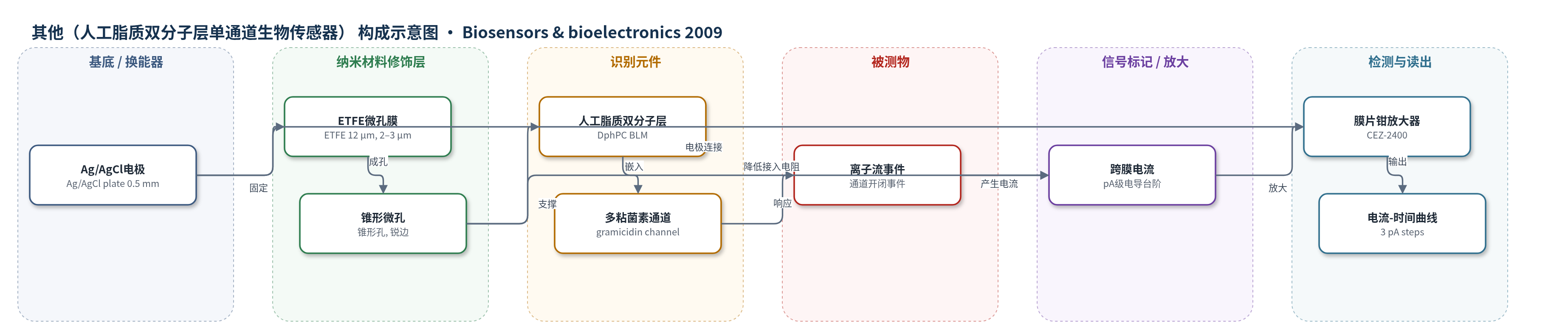
点击图片查看大图 · 依据论文自动绘制
传感器类型
其他(人工脂质双分子层单通道生物传感器)
检测对象
未报告实际分析物;模型通道:多粘菌素(gramicidin);样品基质:2 M KCl、10 mM Hepes 缓冲液
检测原理
该传感平台以ETFE微孔膜作为人工脂质双分子层支撑。DphPC脂质溶液通过painting法在2–3 μm锥形微孔上形成双分子层,gramicidin嵌入膜中形成阳离子选择性通道。在cis/trans两侧施加跨膜电压(如+100 mV)时,K+等阳离子经通道跨膜迁移,产生pA级跨膜电流;通道开放与关闭引起约3 pA的电导台阶。微孔的锥形大开口角和锐边降低溶液接入电阻,小双分子层面积降低膜电容,从而提高信噪比并增强高电压稳定性。+1000 mV下膜未不可逆破裂,电流可恢复。文中未涉及针对特定分析物的浓度依赖检测或信号放大策略,信号主要反映通道事件/离子流。
检测灵敏度
原文未报告LOD、线性范围、灵敏度斜率或相关系数。
效应效果
该方法在数秒内即可制备直径2–3 μm的ETFE微孔,且孔形可重复;钝针尖(锥角约60°)可获得大开口角锥形孔,有利于降低接入电阻。painting法在微孔上形成的DphPC双分子层电阻超过200 GΩ,膜电流为0.3–0.5 pA。gramicidin单通道记录出现稳定的3 pA电导台阶,证实双分子层可用于单通道检测。在+1000 mV高电压下双分子层未发生不可逆破裂,电压回到+100 mV后初始电流恢复,表明其高电压稳定性优于常规易碎BLM。作者认为该微孔结构可降低噪声并支持高电压记录,适用于柔性人工脂质双分子层生物传感器。
传感器的构成
- 基底/换能器电极:Ag/AgCl 板(0.5 mm 厚,中心 0.4 mm 孔),作为 cis/trans 电极与电流读出界面
- 微孔膜:ETFE(低熔点Teflon)薄膜(12 μm 厚),经加热针尖形成 2–3 μm 锥形微孔,支撑人工脂质双分子层
- 腔室密封:盖玻片、硅 O 形圈、环氧树脂 Alardaite Rapid 与 M2 螺钉,固定 ETFE 膜并分隔 cis/trans 溶液
- 识别/传感膜:DphPC(二植烷基磷脂酰胆碱)脂质双分子层,由 n-decane 脂质溶液 painting 法形成,提供离子通道嵌入环境
- 通道识别元件:gramicidin(多粘菌素,0.1 nM),形成阳离子选择性单通道,用于验证单通道记录
- 溶液环境:2 M KCl、10 mM Hepes(pH 7.3/7.4),提供离子导电介质
- 读出系统:膜片钳放大器 CEZ-2400 与 pClamp10.2 软件,记录跨膜电流
中文摘要
近年来,基于人工脂质双分子层单通道记录的生物传感器受到关注,但双分子层易碎且电流噪声大,限制了其应用。微孔支撑结构可改善双分子层稳定性与信噪比。本文提出一种利用商用低熔点Teflon(ETFE)薄膜和加热针尖快速制备微孔的方法。该方法可在数秒内可重复地制备直径2–3 μm的锥形微孔,孔口边缘锐利。作者采用painting法在微孔上形成人工脂质双分子层,并以多粘菌素(gramicidin)离子通道进行单通道记录,观察到典型的3 pA电导台阶,证实双分子层成功形成。所形成的双分子层在+1000 mV高跨膜电压下仍保持稳定,撤去高压后电流可恢复。锥形微孔可降低接入电阻并提高膜稳定性,有利于低噪声、高电压单通道记录,为开发柔性人工脂质双分子层生物传感器提供了实用化基础。
英文摘要
A number of recent studies have dealt with the development of biosensors using single-channel recording with an artificial lipid bilayer. However, the fragility of these bilayers and current noise present serious problems in their application towards biosensor development. To address this problem, many experimental investigations employing micropores in the formation of lipid bilayers have been reported. In this work, we present a method for the fabrication of micropores using commercially available low-melting Teflon film and a heated tip. This method allowed for the rapid (in a few seconds) and reproducible fabrication of micropores 2-3 microm in diameter. We employed a single-channel recording using a gramicidin channel and confirmed that the bilayer membrane can form on micropores by the painting method. The bilayer formed is stable under high voltage (+1000mV). Fabricated micropores possess a conical shape with sharp edges, features which facilitated the formation of artificial lipid bilayers which could be utilized for low-noise and high voltage recording due to decreased access resistance and increased bilayer stability. These advantages promise to improve the performance of artificial lipid bilayers when employed in the development of flexible biosensors.