组成图示
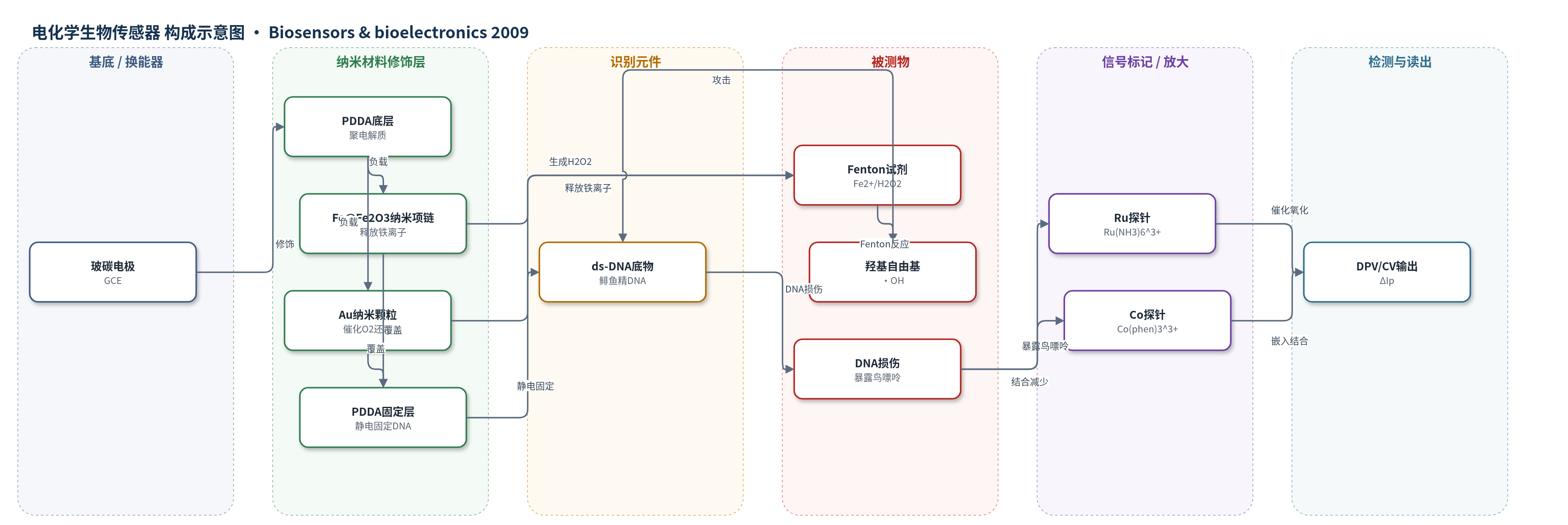
点击图片查看大图 · 依据论文自动绘制
传感器类型
电化学生物传感器
检测对象
双链DNA损伤(ds-DNA damage);样品基质:修饰膜内鲱鱼精DNA(herring sperm DNA),0.1 mol L−1 PBS pH 5.5
检测原理
在0.1 mol L−1 PBS(pH 5.5)中,修饰电极作为阴极接受阴极处理。Au纳米颗粒催化溶解氧还原生成H2O2,Fe@Fe2O3核壳纳米项链缓慢释放Fe2+/Fe3+,二者发生Fenton反应原位产生羟基自由基(•OH)。•OH攻击膜内ds-DNA,造成链断裂和碱基氧化等损伤,使鸟嘌呤从双螺旋保护中暴露。以Ru(NH3)6^3+为探针时,暴露鸟嘌呤被Ru(III)氧化,Ru(III)还原为Ru(II),Ru(II)在电极上再氧化,形成催化循环,DPV催化峰电流随DNA损伤程度增加而增大,峰电流差ΔIp作为损伤信号。也可用Co(phen)3^3+嵌入完整ds-DNA,损伤后嵌入结合减少,还原峰电流下降。信号放大来自Fenton自由基连续产生和Ru催化氧化循环。
检测灵敏度
最小可检测ds-DNA损伤浓度: 0.05 mg mL−1;DNA损伤阈值: 0.4 μg
效应效果
该传感器在Fe@Fe2O3与Au NPs体积比为10:30时信号最大,0:40或40:0时ΔIp很小,表明二者协同促进DNA损伤;pH 5.0–5.8时ΔIp最大,选择pH 5.5。无阴极处理对照中Ru(NH3)6^3+和Co(phen)3^3+峰电流无变化,说明损伤由阴极过程诱导。7个独立制备电极的ΔIp相对标准偏差为2.37%;室温空气保存15天后平均偏差小于5%(n=5)。电极经−0.6 V处理1 min并用0.5% SDS-PBS和水清洗后重新固定ds-DNA,重复7次后信号约为首次的95%。作者认为该方法可在5–10 min阴极处理内检测膜内DNA损伤,有望用于现有和新型化学物质遗传毒性的快速筛选。
传感器的构成
- 基底/工作电极:玻碳电极(GCE),导电基底与电化学换能器
- 第一层修饰:聚二甲基二烯丙基氯化铵(PDDA),带正电聚电解质,负载纳米材料并增强亲和
- 纳米材料层:Fe@Fe2O3核壳纳米项链与金纳米颗粒(Au NPs)混合物,Fe@Fe2O3缓慢释放铁离子,Au NPs催化O2还原生成H2O2
- 第二层修饰:PDDA,带正电聚电解质,通过静电作用固定ds-DNA
- 损伤底物/识别层:双链DNA(ds-DNA,鲱鱼精DNA),作为羟基自由基攻击的DNA损伤底物
- 信号探针:六氨合钌(III)(Ru(NH3)6^3+)或三(邻菲罗啉)合钴(III)(Co(phen)3^3+),电化学活性指示剂,用于DPV/CV读出
- 反应介质:0.1 mol L−1 PBS pH 5.5,提供H+、溶解O2和离子环境,支持阴极过程与Fenton反应
中文摘要
基于Fe@Fe2O3核壳纳米项链与金纳米颗粒阴极过程的DNA原位损伤灵敏电化学传感由新型生物传感器实现。该传感器由玻碳电极(GCE)修饰多层膜构成,包括聚二甲基二烯丙基氯化铵(PDDA)、Fe@Fe2O3核壳纳米项链与金纳米颗粒混合物、PDDA和双链DNA(ds-DNA)分层。阴极过程以恒定速率连续产生铁离子和H2O2(Fenton试剂),二者进一步原位反应生成羟基自由基,攻击膜内ds-DNA并造成严重损伤。该DNA损伤过程类似生物体内发生的过程,可用于模拟体内金属毒性通路。Fe@Fe2O3核壳纳米项链与金纳米颗粒对DNA损伤具有显著协同效应。采用差分脉冲伏安法和循环伏安法监测DNA损伤。与以往金属介导DNA损伤传感器不同,ds-DNA损伤过程不是在金属离子和H2O2溶液中实现,而仅在缓冲液中进行,且全程未使用不稳定酶。该生物传感器具有作为快速评估现有和新型化学物质遗传毒性的筛选工具的潜力。
英文摘要
Sensitive electrochemical sensing for the DNA damage in situ based on a cathodic process of Fe@Fe(2)O(3) core-shell nanonecklace and Au nanoparticles was performed by a novel biosensor, which was constructed via a glassy carbon electrode (GCE) modified with a multilayer film comprising of separate layers of poly(dimethyldiallylammonium chloride) (PDDA), the mixture of Fe@Fe(2)O(3) core-shell nanonecklace and Au nanoparticles, PDDA and double strand DNA (ds-DNA). Iron ions and H(2)O(2) (Fenton reagents) were generated continuously at a constant rate by the cathodic process. The two Fenton reagents reacted further to generate hydroxyl radicals in situ, which attacked ds-DNA in the film and caused severe damage of ds-DNA molecules. These courses of DNA damage were just like those happened in organism. It could be used to mimic metal toxicity pathways in vivo. Fe@Fe(2)O(3) core-shell nanonecklace and Au nanoparticles played considerable synergistic effects for DNA damage. Differential pulse voltammetry and cyclic voltammetry were applied to monitor the DNA damage. Different from the previously reported metal-mediated DNA damage sensor, the process of the ds-DNA damage was not achieved in the solution of metal ions and H(2)O(2), but merely in buffer solution, and the instable enzymes were not used in the whole course. The biosensor possesses the potential as a screening tool for rapid assessment of the genotoxicity of existing and new chemicals.