组成图示
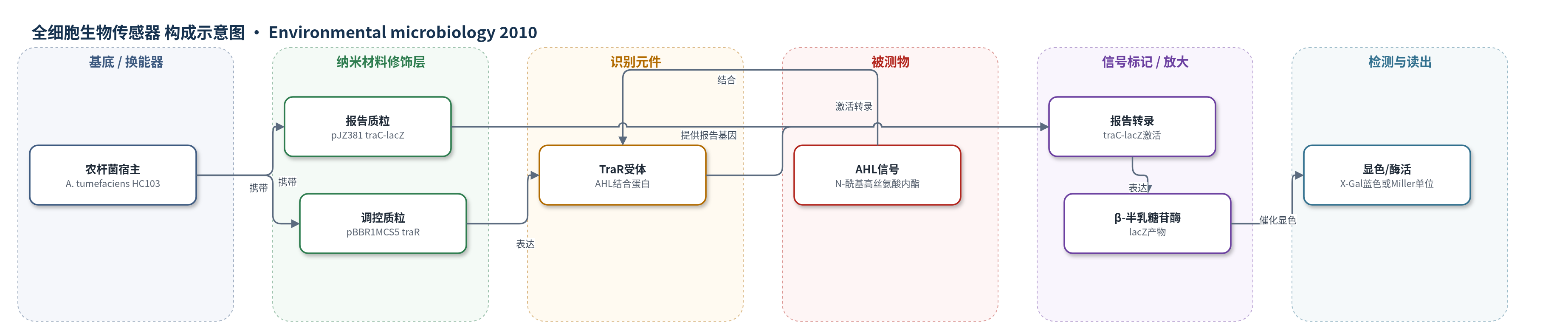
点击图片查看大图 · 依据论文自动绘制
传感器类型
全细胞生物传感器
检测对象
AHL(N-酰基高丝氨酸内酯,acyl-homoserine lactones,HSL);样品基质为农杆菌/大肠杆菌培养上清、TLC 提取物及宏基因组克隆表达产物。
检测原理
该全细胞生物传感器以根癌农杆菌 HC103(pJZ381) 为换能器。pBBR1MCS5 在 lac 启动子下表达 AHL 受体 TraR;pJZ381 携带 traC-lacZ 报告融合基因。当环境或克隆表达产生的 AHL 进入细胞并与 TraR 结合后,TraR 由不稳定状态转为稳定/激活状态,结合 traC-lacZ 启动子区并启动转录。lacZ 表达量随 AHL 浓度或 LuxI 合成酶活性增加而增加,产生 β-半乳糖苷酶。酶催化 X-Gal 水解生成蓝色产物,或用 Miller 法测定 β-半乳糖苷酶活性,从而将 AHL 浓度转换为蓝色深浅或 Miller 单位。无 AHL 时 TraR 快速降解,背景低。
检测灵敏度
原文未报告 LOD、线性范围、灵敏度斜率或相关系数。
效应效果
作者用该生物传感器筛选4个宏基因组文库:CX4约14000菌落获5弱蓝斑,CX6约5600菌落获6蓝斑并得QS6-1,CX9约20000菌落获5蓝斑但为环境lacZ,CX10约16300菌落获6蓝斑并得QS10-1、QS10-2。β-半乳糖苷酶背景3.5 Miller units,QS6-1、QS10-1、QS10-2分别为27、613、255,luxIQS6-1表达达1083;阳性对照3-O-C8 HSL为10 nM。TLC与ESI MS/MS确认各LuxI合成多种AHL。作者认为可构建宽谱AHL生物传感器,但未报告RSD、稳定性、回收率或方法对比。
传感器的构成
- 细胞基底/宿主:根癌农杆菌 A. tumefaciens HC103,作为全细胞换能器,承载 AHL 响应报告系统。
- 报告质粒:pJZ381,含 traI 非极性缺失和 traC-lacZ 融合,提供 AHL 诱导的 β-半乳糖苷酶报告基因。
- 调控质粒:pBBR1MCS5,以 lac 启动子过表达 traR,提供 AHL 识别受体 TraR。
- 识别元件:TraR 转录调控蛋白,结合 AHL 后稳定并激活 traC-lacZ 转录。
- 信号标记物:lacZ/β-半乳糖苷酶,催化 X-Gal 或 Miller 法底物产生可测信号。
- 读出试剂:X-Gal(5-溴-4-氯-3-吲哚-β-D-半乳糖苷)或 Miller 法 β-半乳糖苷酶底物,用于蓝色显色或酶活测定。
中文摘要
群体感应(QS)是细菌依据细胞密度协调行为的细胞间通讯系统,其中变形菌产生的酰基高丝氨酸内酯(AHL)研究最深入。为了解未培养微生物的 QS 系统及其在自然环境中的信号作用,作者用根癌农杆菌生物传感器菌株 HC103(pJZ381) 筛选由活性污泥和土壤 DNA 构建的宏基因组文库,寻找新型 QS 合成酶基因。共鉴定到三个编码 QS 信号的大质粒克隆 QS6-1、QS10-1 和 QS10-2,序列分析显示三者均编码新型 LuxI 家族 AHL 合成酶和 LuxR 家族转录调控蛋白。薄层色谱表明这些 LuxI 同源蛋白可合成多种 AHL;串联质谱显示 LuxIQS6-1 至少指导合成 3-O-C14:1 HSL、3-O-C16:1 HSL 和 3-O-C14 HSL,LuxIQS10-1 至少合成 3-O-C12 HSL 和 3-O-C14 HSL,LuxIQS10-2 至少合成 C8 HSL 和 C10 HSL。LuxIQS6-1 还产生两种可能的新 AHL:C14:3 HSL 和 (?)-羟甲基-3-O-C14 HSL。
英文摘要
Quorum sensing (QS) cell-cell communication systems are utilized by bacteria to coordinate their behaviour according to cell density. Several different types of QS signal molecules have been identified, among which acyl-homoserine lactones (AHLs) produced by Proteobacteria have been studied to the greatest extent. Although QS has been studied extensively in cultured microorganisms, little is known about the QS systems of uncultured microorganisms and the roles of these systems in microbial communities. To extend our knowledge of QS systems and to better understand the signalling that takes place in the natural environment, metagenomic libraries constructed using DNA from activated sludge and soil were screened, using an Agrobacterium biosensor strain, for novel QS synthase genes. Three cosmids (QS6-1, QS10-1 and QS10-2) that encode the production of QS signals were identified and DNA sequence analysis revealed that all three clones encode a novel luxI family AHL synthase and a luxR family transcriptional regulator. Thin layer chromatography revealed that these LuxI homologue proteins are able to synthesize multiple AHL signals. Tandem mass spectrometry analysis revealed that LuxI(QS6-1) directs the synthesis of at least three AHLs, 3-O-C14:1 HSL, 3-O-C16:1 HSL and 3-O-C14 HSL; LuxI(QS10-1) directs the synthesis of at least 3-O-C12 HSL and 3-O-C14 HSL; while LuxI(QS10-2) directs the synthesis of at least C8 HSL and C10 HSL. Two possible new AHLs, C14:3 HSL and (?)-hydroxymethyl-3-O-C14 HSL, were also found to be synthesized by LuxI(QS6-1).