组成图示
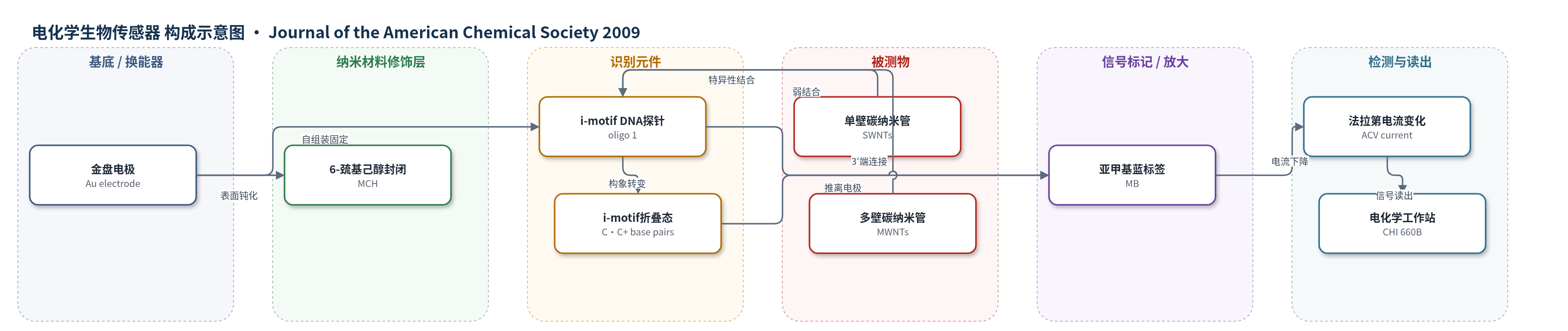
点击图片查看大图 · 依据论文自动绘制
传感器类型
电化学生物传感器
检测对象
单壁碳纳米管(SWNTs)、多壁碳纳米管(MWNTs);样品基质:缓冲液、K562 癌细胞裂解液/上清
检测原理
传感器以金电极表面自组装的巯基化人端粒 i-motif DNA 为识别元件,3′端连接氧化还原标签亚甲基蓝(MB)。pH 7.0 时 DNA 主要呈展开态,MB 靠近金表面,交流伏安法(ACV)可测得较强法拉第电流。羧基修饰 SWNTs 进入 i-motif 主沟,通过 C•C+ 碱基对与羧基间的静电作用、π-π 堆积、疏水和范德华作用稳定 i-motif 折叠,使 MB 远离电极,电子转移受阻,法拉第电流随 SWNTs 浓度增加而下降。MWNTs 直径过大,难以进入主沟,仅引起弱信号,因此可区分 SWNTs 与 MWNTs。
检测灵敏度
LOD: 0.2 ppm;细胞上清线性方程: y = 0.99 + 18.3x
效应效果
该传感器对 SWNTs 选择性明显:1 ppm 时信号下降约 39%,MWNTs 仅 7%;2 ppm 时分别为 69.2% 和 11.6%,差异约 5 倍。非互补 dA22、MB 标记寡核苷酸 3 及约 1 nm 金纳米颗粒无明显干扰。与互补 G-四链体杂交后,30 s 超纯水洗涤可恢复约 100% 信号。60 min 孵育接近最大响应,LOD 为 0.2 ppm。K562 癌细胞裂解液中可检测胞内 SWNTs,按上清加标曲线估算为 2.4 ppm;裂解液信号下降小于缓冲液,主要因蛋白吸附。作者认为其低成本、易操作,适合自动化、微型化和现场分析。
传感器的构成
- 基底/换能器电极:金盘电极(Au electrode,Φ=2 mm),提供导电基底与电子转导界面。
- 识别元件:巯基化人端粒 i-motif DNA 寡核苷酸(oligo 1),5′端巯基通过硫醇-金键自组装固定,C-rich 序列可被 SWNTs 诱导形成 i-motif。
- 信号标记物:亚甲基蓝(MB),共价连接于 DNA 3′端,作为氧化还原标签,法拉第电流反映其与电极距离。
- 封闭剂:6-巯基己醇(MCH),钝化金表面,降低非特异性吸附。
- 检测读出:交流伏安法(ACV,CHI 660B,Pt 对电极,Ag/AgCl 参比电极),监测 MB 电流变化。
中文摘要
随着碳纳米管(CNTs)全球需求增加及其安全开发使用受到关注,毒理学评价和环境监测迫切需要低成本、简单且高灵敏的 CNT 检测方法。然而,现有 CNT 检测技术均依赖昂贵专用仪器和复杂样品前处理,难以实现自动化和现场分析。基于单壁碳纳米管(SWNTs)能特异性诱导人端粒 i-motif 形成的能力,作者设计了一种电化学 DNA(E-DNA)传感器,可在缓冲液和细胞裂解液中区分单壁与多壁碳纳米管。该 E-DNA 传感器可选择性检测 SWNTs,直接检测限为 0.2 ppm,并已在癌细胞裂解液中得到验证。据作者所知,这是首个能够区分不同类型纳米管的生物传感技术。该工作为设计用于碳纳米管检测的生物传感器提供了新见解。
英文摘要
The increasing worldwide demand for carbon nanotubes (CNTs) and increasing concern regarding how to safely develop and use CNTs are requiring a low-cost, simple, and highly sensitive CNT detection assay for toxicological evaluation and environmental monitoring. However, this goal is still far from being achieved. All the current CNT detection techniques are not applicable for automation and field analysis because they are dependent on highly expensive special instruments and complicated sample preparation. On the basis of the capability of single-walled carbon nanotubes (SWNTs) to specifically induce human telomeric i-motif formation, we design an electrochemical DNA (E-DNA) sensor that can distinguish single- and multiwalled carbon nanotubes both in buffer and in cell extracts. The E-DNA sensor can selectively detect SWNTs with a direct detection limit of 0.2 ppm and has been demonstrated in cancer cell extracts. To the best of our knowledge, this is the first demonstration of a biosensing technique that can distinguish different types of nanotubes. Our work will provide new insights into how to design a biosensor for detection of carbon nanotubes.