组成图示
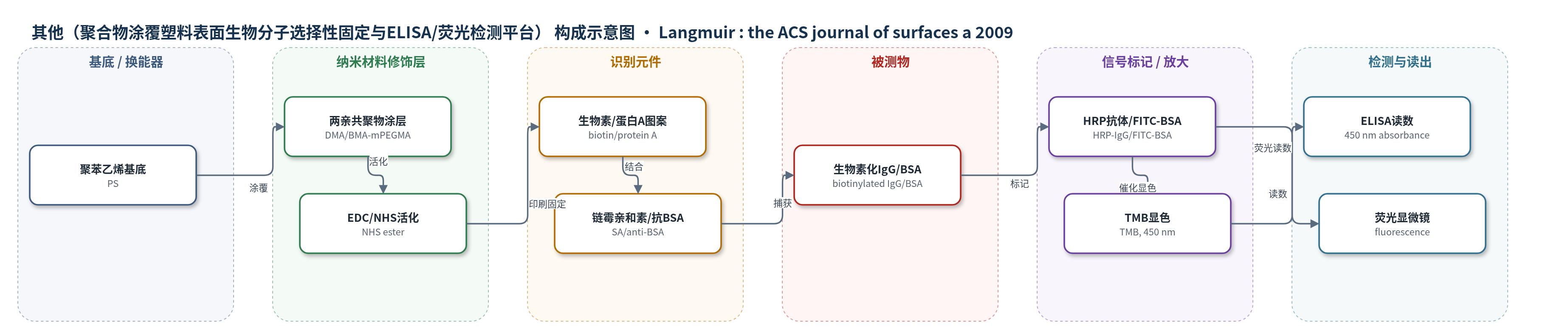
点击图片查看大图 · 依据论文自动绘制
传感器类型
其他(聚合物涂覆塑料表面生物分子选择性固定与ELISA/荧光检测平台)
检测对象
生物素化小鼠抗兔IgG(biotinylated mouse antirabbit IgG,PBS溶液)、牛血清白蛋白(BSA,PBS溶液)
检测原理
两亲共聚物通过范德华作用涂覆聚苯乙烯,PEGMA链暴露形成抗生物污损界面,羧基经EDC/NHS活化为NHS酯。微接触印刷将胺基生物素或蛋白A共价固定成图案;链霉亲和素结合生物素后捕获生物素化小鼠IgG,HRP标记二抗再结合。TMB底物被HRP催化氧化显色,450 nm吸光度随IgG浓度线性增加。蛋白A分支中,抗BSA被固定后结合FITC-BSA,荧光强度指示结合量。
检测灵敏度
LOD: 12.5 ng/mL;线性范围: 12.5–100 ng/mL;商业链霉亲和素板 LOD: 25 ng/mL
效应效果
聚合物涂层使聚苯乙烯接触角由130±7°降至74±1°和79±2°,水中1周基本稳定;1% SDS处理1 h后BMA涂层更稳定。BSA非特异吸附相对未涂覆表面仅约1.5%和9.1%。荧光图案中TRITC-链霉亲和素信号为180±34 au和150±24 au,蛋白A/BSA体系为99±15 au和53±7 au,背景低。ELISA对生物素化小鼠IgG在12.5–100 ng/mL线性,LOD约12.5 ng/mL,优于商业链霉亲和素板约25 ng/mL,且无需封闭。
传感器的构成
- 基底:聚苯乙烯(polystyrene, PS)塑料表面或96孔板,提供疏水塑料基底。
- 聚合物修饰层:两亲随机共聚物 poly(DMA-r-mPEGMA-r-MA) 或 poly(BMA-r-mPEGMA-r-MA),含锚定基团、PEGMA抗污组分和羧酸功能基,通过范德华作用涂覆。
- 活化层:EDC/NHS 将羧基转化为NHS酯,用于共价偶联胺基生物分子。
- 识别/捕获元件:生物素-NH2(biotin-NH2)或蛋白A(protein A)经微接触印刷(μCP)图案化固定;链霉亲和素(streptavidin)用于捕获生物素化抗体。
- 目标物:生物素化小鼠抗兔IgG(biotinylated mouse antirabbit IgG)或BSA/抗BSA(BSA/anti-BSA)用于图案验证。
- 信号标记物:TRITC标记链霉亲和素(TRITC-streptavidin)或FITC标记BSA(FITC-BSA)用于荧光;HRP标记抗小鼠IgG(HRP-antimouse IgG)用于ELISA。
- 显色底物:TMB底物,经HRP催化氧化显色,450 nm读取。
- 封闭/抗污层:PEGMA组分提供抗非特异蛋白吸附,无需额外封闭;商业对照使用2%脱脂奶粉封闭。
中文摘要
生物芯片和生物传感器制备中,优化生物分子在表面的固定是关键。本文报道一种简便方法,在具有抗生物污损性质的两亲聚合物涂覆塑料表面选择性固定生物分子。作者通过自由基聚合合成两类随机共聚物,分别由锚定基团、作为非特异生物分子排斥剂的聚乙二醇(PEG)组分以及用于偶联生物分子的功能基团组成。十二烷基和苄基型共聚物因含多个PEG基团而高度水溶,可在水相中简便涂覆模型塑料表面(聚苯乙烯)。以牛血清白蛋白(BSA)非特异吸附评估抗污性能,两种聚合物涂覆表面的BSA吸附均显著低于未涂覆塑料表面。最后,链霉亲和素和抗体等代表性生物分子通过微接触印刷分别以生物素和蛋白A印迹选择性固定于聚合物涂覆塑料表面,呈现强信号和低背景。
英文摘要
A key aspect of biochip and biosensor preparation is optimizing surface attachment of biomolecules. Here, we report a facile approach for selectively immobilizing biomolecules on amphiphilic polymer-coated plastic surfaces with anti-biofouling properties. To modify plastic surfaces, we synthesized two types of random copolymers by radical polymerization, which consisted of three parts: an anchoring group; a PEG component, which acted as a repellent of nonspecific biomolecules; and a functional group, to which biomolecules were conjugated. Dodecyl- and benzyl-based copolymers were highly soluble in water, presumably due to the presence of multiple PEG groups, and could easily coat the model plastic surface (polystyrene) in an aqueous environment. The antibiofouling property of each polymer-coated plastic surface was examined by measuring the extent of nonspecific protein adsorption using bovine serum albumin (BSA). Both polymer-coated plastic surfaces showed a very low level of BSA adsorption relative to that of an uncoated plastic surface (control). Finally, we showed that streptavidin and antibodies, as representative biomolecules, could be selectively immobilized on the polymer-coated plastic surfaces imprinted with biotin and protein A, respectively, by microcontact printing, exhibiting an intense signal with low background.