组成图示
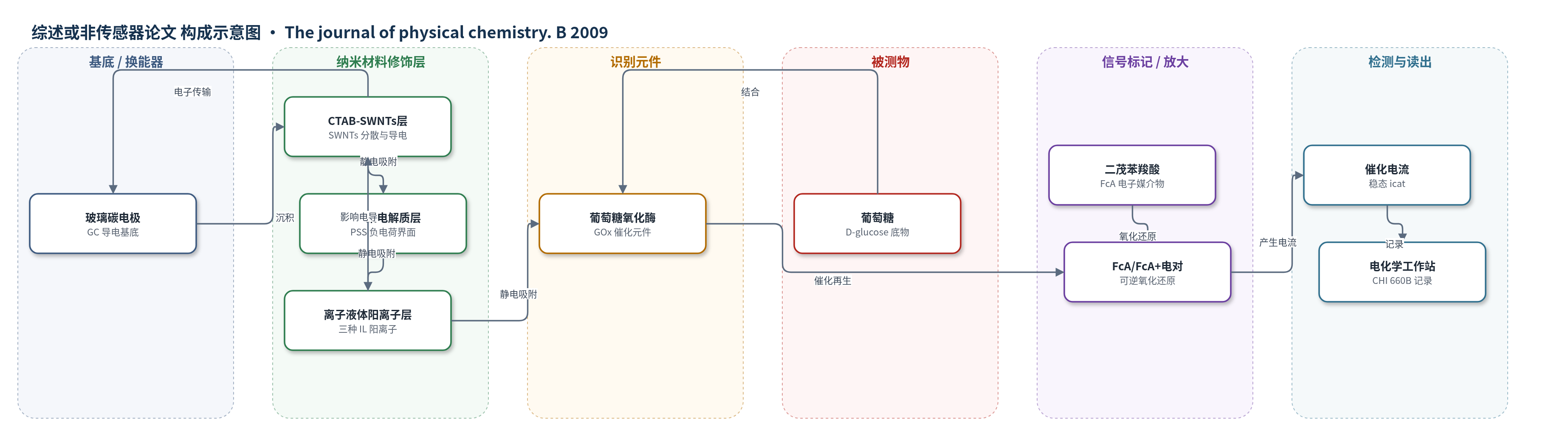
点击图片查看大图 · 依据论文自动绘制
传感器类型
综述或非传感器论文
检测对象
葡萄糖(glucose, D-glucose);样品基质:0.1 M PBS(pH 8.2)缓冲液
检测原理
葡萄糖氧化酶(GOx)固定于离子液体修饰的 SWNTs/PSS 电极表面,作为催化识别元件。葡萄糖进入 GOx 活性中心后,FAD 被还原为 FADH2,同时生成葡萄糖-δ-内酯;FADH2 将电子传递给溶液中的二茂苯羧酸氧化态 FcA+,再生 FAD 并产生 FcA。FcA 在电极表面氧化为 FcA+ 并释放电子,形成稳态催化电流。葡萄糖浓度升高时催化电流增大,约 8 mM 以上趋于饱和,呈 Michaelis-Menten 特征。离子液体阳离子通过静电作用改变 SWNTs 表面电荷分布与电子传输能力,使电子传递速率常数下降,因此催化电流和特征速率常数随 IL 性质变化。
检测灵敏度
原文未报告 LOD、线性范围、灵敏度斜率或相关系数。
效应效果
该文未报告选择性、抗干扰、实际样品加标回收率或重现性 RSD。主要实际表现为酶电极稳定性较好:连续循环伏安扫描 50 圈后催化电流几乎不变,PBS 中储存每天衰减约 0.2%。CD 光谱表明 GOx 在 IL 修饰电极上保持天然构象。GOx-SWNTs/GC 的 k2 为 717.5±14.3 s^-1、kred 为 1.49±0.32×10^4 M^-1 s^-1,接近均相 GOx/O2 体系的 750 s^-1 和 1.1×10^4 M^-1 s^-1,说明 SWNTs 固定化酶保持活性。含 IL 电极速率常数降低,顺序为 SWNTs > [bmpyri] > [bmpyrro] > [bmim];PDDA 对照与 SWNTs 相近,排除 PSS 层阻碍。作者认为 IL 性质影响 SWNT 电传输,对含 IL 薄膜生物传感器和微电子器件设计有参考价值。
传感器的构成
- 基底:玻璃碳电极(GC),提供导电基底与电子转移动力
- 纳米材料修饰层:单壁碳纳米管(SWNTs),经十六烷基三甲基溴化铵(CTAB)吸附分散,提供高比表面积并促进电子传输
- 聚电解质层:聚苯乙烯磺酸钠(PSS),通过静电吸附于 SWNTs,形成负电荷界面
- 离子液体层:[bmim]BF4、[bmpyri]BF4 或 [bmpyrro]BF4 的阳离子,通过静电吸附于 PSS,形成正电荷界面并影响 SWNTs 电传输
- 识别/催化元件:葡萄糖氧化酶(GOx),在 pH 8.2 带负电,静电组装于 IL 层,催化葡萄糖氧化
- 电子媒介物:二茂苯羧酸(FcA),在溶液中可逆氧化还原,介导 GOx 与电极间电子传递
- 缓冲介质:0.1 M PBS(pH 8.2),维持酶活性和离子环境
中文摘要
本研究采用电化学与量子化学计算,考察离子液体(ILs)对葡萄糖氧化酶(GOx)电催化氧化葡萄糖活性的影响。选取 [bmpyri]BF4、[bmpyrro]BF4 和 [bmim]BF4 三种离子液体,利用单壁碳纳米管(SWNTs)和聚苯乙烯磺酸钠(PSS)通过静电作用将 ILs 与 GOx 组装在电极表面。光谱结果表明 ILs 未改变酶的构象。循环伏安结果显示,GOx-IL-PSS-SWNTs/GC 电极的电催化活性低于 GOx-SWNTs/GC 电极。在底物饱和条件下,由循环伏安曲线评估的特征速率常数随 IL 类型降低,顺序为 SWNTs > [bmpyri] > [bmpyrro] > [bmim]。理论计算表明,IL 在 SWNT 表面会显著改变纳米管的电子传输性质,从而导致电催化活性下降。研究说明 IL 性质是影响 GOx-IL-PSS-SWNTs/GC 电极氧化葡萄糖电催化活性的主要因素,对含 IL 薄膜体系中的生物传感器和微电子器件设计具有参考价值。
英文摘要
The effects of ionic liquids (ILs) on the catalytic activity of enzymes were studied by approaches of electrochemistry and quantum chemistry calculation in this work. Three types of ILs, namely, [bmpyri]BF(4), [bmpyrro]BF(4), and [bmim]BF(4), were selected to address the effects of different types of ILs on the electrocatalytic activity of glucose oxidase (GOx) toward the oxidation of glucose. ILs and GOx were assembled on the surface of an electrode via single-walled carbon nanotubes (SWNTs) and poly(sodium 4-styrenesulfonate) (PSS) utilizing the electrostatic interaction. Spectroscopic results indicated that ILs did not affect the conformation of the enzyme. The cyclic voltammetric results showed that the electrocatalytic activity of the GOx-IL-PSS-SWNTs/GC electrode was lower than that of the GOx-SWNTs/GC electrode. The characteristic kinetic constants of the enzymatic reaction were evaluated from the cyclic voltammograms under a substrate-saturated condition. The values of the characteristic rate constant obtained at each IL-containing enzyme electrode were lower than those obtained at the GOx-SWNTs/GC electrode and decreased following the sequence of SWNTs > [bmpyri] > [bmpyrro] > [bmim]. The theoretical calculations combined with experiments were employed to address the interaction between the ILs and SWNTs, showing that the presence of IL on the surface of SWNTs could significantly affect the electrical transfer properties of the nanotube and led to the decrease of the electrocatalytic activity of the GOx-IL-PSS-SWNTs/GC electrode. These results indicate that the nature of ILs is the main factor, which affects the electrocatalytic activity of the GOx-IL-PSS-SWNTs/GC electrodes toward the oxidation of glucose. The results of this study are directly relevant for those applications where ILs are employed in the form of thin films supported on solid surfaces, such as the designing of the related biosensor, microelectronic devices in the ILs-containing system, and so forth.