组成图示
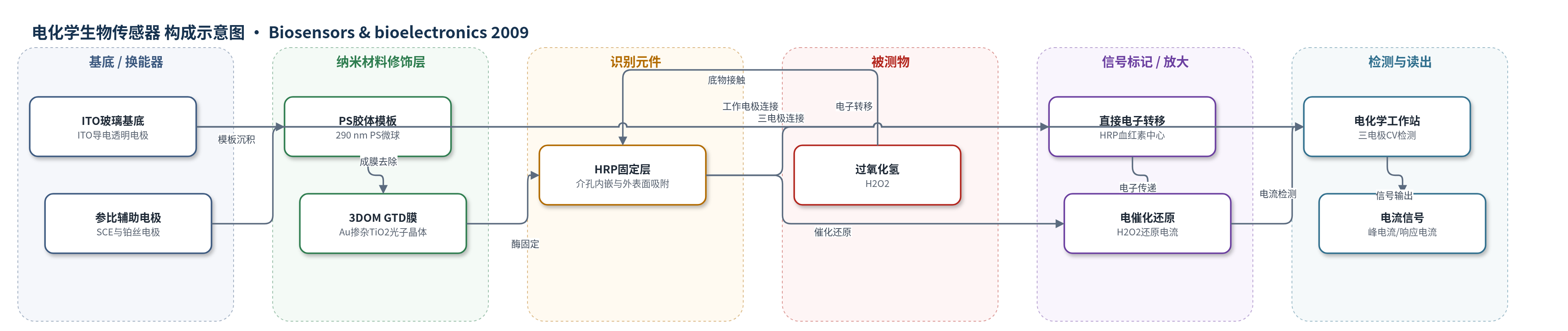
点击图片查看大图 · 依据论文自动绘制
传感器类型
电化学生物传感器
检测对象
过氧化氢(hydrogen peroxide, H2O2);样品基质:0.1 M PBS(pH 7.4)缓冲液/标准溶液
检测原理
HRP通过物理吸附固定于3DOM GTD/ITO电极,部分渗入介孔内部,部分位于膜外表面。在0.1 M PBS(pH 7.4)中,HRP血红素中心与ITO电极之间发生直接电子转移,无需外加电子媒介体。当H2O2加入时,HRP催化H2O2还原,电子经HRP、Au掺杂TiO2导电网络和ITO电极传递,产生还原电流。3DOM大孔结构提高反应物传质和酶负载,Au纳米粒子增强膜导电性并促进电子转移,因此响应电流随H2O2浓度增加而增大。低电位峰主要来自介孔内嵌HRP,高电位峰来自外表面HRP;H2O2浓度升高时低电位还原峰电流线性增加,高电位峰因快速氧化而减弱或消失。
检测灵敏度
LOD: 0.2 μM;线性范围: 0.5 μM–1.4 mM;灵敏度: 179.9 μA mM−1;相关系数: 0.9989
效应效果
该传感器对H2O2响应时间小于3 s,在0.5 μM至1.4 mM范围内呈良好线性,检出限0.2 μM,灵敏度179.9 μA mM−1。稳定性方面,电极在4 ℃ PBS中储存1个月无明显电流下降,6个月后仍保留90%初始响应。重现性方面,对50 μM H2O2连续6次测定RSD为5.3%,4个独立电极间RSD为8.6%。与HRP/TiO2光子晶体/ITO电极相比,GTD修饰电极具有更宽线性范围、更高灵敏度和更大响应电流;其灵敏度也高于文献报道的壳聚糖/碳微球、紫外激发3DOM TiO2和多孔TiO2溶胶凝胶体系。作者认为3DOM GTD可作为蛋白固定和直接电子转移研究的新平台,适用于低导电电极生物传感器。
传感器的构成
- 基底电极:氧化铟锡(ITO)玻璃,导电透明工作电极基底
- 模板层(制备后去除):聚苯乙烯(PS)微球(290±15 nm),胶体晶体模板,形成3DOM孔道后500 ℃去除
- 纳米修饰层:三维有序大孔金纳米粒子掺杂二氧化钛(3DOM GTD)光子晶体膜,由钛酸四丁酯、HAuCl4、TEA、乙醇和水溶胶凝胶制备,提供大内表面积、导电性和生物相容微环境
- 识别元件:辣根过氧化物酶(HRP),物理吸附并渗入介孔及外表面,催化H2O2并实现直接电子转移
- 信号标记物:无外源标记,HRP血红素中心直接电子转移/电催化产生电流信号
- 电解液:0.1 M磷酸盐缓冲液(PBS, pH 7.4),提供质子转移和离子导电环境
- 参比/辅助电极:饱和甘汞电极(SCE)和铂丝辅助电极,组成三电极电化学检测体系
中文摘要
本研究采用胶体晶体模板法将金纳米粒子引入二氧化钛光子晶体壁框架,制备三维有序大孔金纳米粒子掺杂二氧化钛(3DOM GTD)膜,并修饰于氧化铟锡(ITO)电极表面,用于构建过氧化氢(H2O2)生物传感器。作者研究了固定于该膜上的辣根过氧化物酶(HRP)的直接电子转移和电催化行为。3DOM GTD膜能为HRP提供保持生物活性的微环境,并具有大内表面积和优良导电性。HRP/3DOM GTD/ITO电极在0.1 M PBS(pH 7.4)中呈现两对氧化还原峰,分别对应渗入介孔内部和吸附于膜外表面的HRP,形式电位为−0.19 V和−0.52 V。介孔内嵌HRP表现为表面控制过程并伴随单质子转移;外表面吸附HRP可在无电子媒介体辅助下实现直接电子转移。该H2O2生物传感器响应时间小于3 s,线性范围为0.5 μM至1.4 mM,检出限为0.2 μM,灵敏度为179.9 μA mM−1,并具有良好的稳定性和重现性。与未掺金TiO2光子晶体修饰电极相比,GTD修饰电极显著提高了响应电流、线性范围和灵敏度。
英文摘要
Gold nanoparticles have been introduced into the wall framework of titanium dioxide photonic crystals by the colloidal crystal template technique. The three-dimensionally ordered macroporous gold-nanoparticle-doped titanium dioxide (3DOM GTD) film was modified on the indium-tin oxide (ITO) electrode surface and used for the hydrogen peroxide biosensor. The direct electron transfer and electrocatalysis of horseradish peroxidase (HRP) immobilized on this film have been investigated. The 3DOM GTD film could provide a good microenvironment for retaining the biological bioactivity, large internal area, and superior conductivity. The HRP/3DOM GTD/ITO electrode exhibited two couples of redox peaks corresponding to the HRP intercalated in the mesopores and adsorbed on the external surface of the film with the formal potential of -0.19 and -0.52V in 0.1M PBS (pH 7.4), respectively. The HRP intercalated in the mesopores showed a surface-controlled process with a single proton transfer. The direct electron transfer between the adsorbed HRP and the electrode is achieved without the aid of an electron mediator. The H(2)O(2) biosensor displayed a rapid eletrocatalytic response (less than 3s), a wide linear range from 0.5 microM to 1.4mM with a detection limit of 0.2 microM, high sensitivity (179.9 microAmM(-1)), good stability and reproducibility. Compared with the free-Au doped titanium dioxide photonic crystals modified electrode, the GTD modified electrode could greatly enhance the response current signal, linear detection range and higher sensitivity. The 3DOM GTD provided a new matrix for protein immobilization and direct transfer study and opened a way for low conductivity electrode biosensor.