组成图示
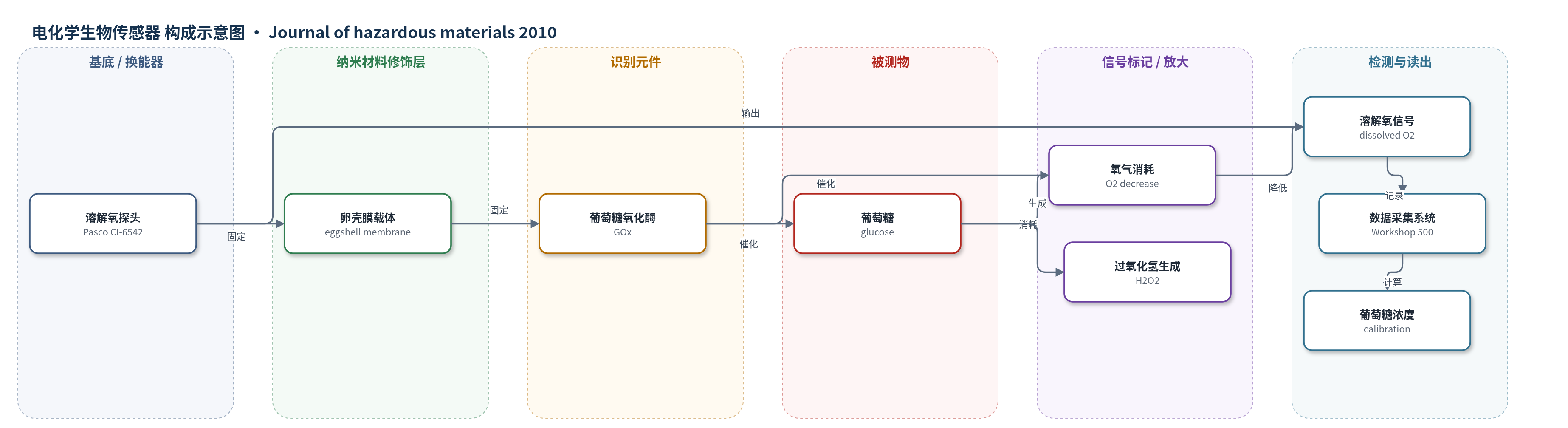
点击图片查看大图 · 依据论文自动绘制
传感器类型
电化学生物传感器
检测对象
葡萄糖 (glucose),样品基质:土壤滤液/磷酸盐缓冲液提取液
检测原理
该传感器以卵壳膜为固定化载体,将葡萄糖氧化酶(GOx)经戊二醛交联固定后置于溶解氧传感器探头表面。样品中的葡萄糖扩散进入卵壳膜,GOx 催化葡萄糖与氧气反应生成葡萄糖酸和过氧化氢:β-D-glucose + O2 + H2O → d-gluconic acid + H2O2。反应消耗溶解氧,使探头附近氧浓度下降;葡萄糖浓度越高,单位时间内氧消耗速率越大,溶解氧信号变化越明显。Pasco 溶解氧传感器将氧浓度变化转换为电信号,经 Workshop 500 数据采集系统记录,并依据葡萄糖标准溶液建立的校准曲线计算样品葡萄糖浓度。该过程无额外信号放大,主要依赖酶催化反应和氧电极响应。
检测灵敏度
R^2 = 0.99804
效应效果
文中未报告该葡萄糖生物传感器的检出限、线性范围、选择性、抗干扰、稳定性或加标回收率等指标。校准曲线相关系数为 R^2 = 0.99804,表明标准葡萄糖响应良好。实际土壤样品中,传感器每 3 h 测定一次剩余葡萄糖:无重金属对照样品葡萄糖浓度下降较快,而含重金属样品除 As 外剩余葡萄糖下降较慢,葡萄糖完全消耗时间与微热量计功率–时间曲线返回基线的时间大体一致,并与重金属毒性顺序 Cr > Pb > As > Co > Zn > Cd > Cu 相吻合。作者认为该溶解氧生物传感器可快速、灵敏地测定环境样品中的葡萄糖,并与微热量计结合用于评估土壤微生物代谢活性和葡萄糖降解动力学。
传感器的构成
- 换能器基底:Pasco CI-6542 溶解氧传感器探头,检测氧浓度变化
- 固定化载体:eggshell membrane (ESM) 卵壳膜,作为葡萄糖氧化酶固定化平台
- 识别催化元件:glucose oxidase (GOx),催化葡萄糖氧化并消耗氧气
- 交联固定剂:glutaraldehyde (GA),交联固定 GOx 于卵壳膜表面
- 缓冲介质:phosphate buffer (PBS),维持酶活性与离子环境
- 样品基质:soil filtrate 土壤滤液,提供待测葡萄糖
- 信号读出:Pasco CI-6400 Science Workshop 500 数据采集系统,记录溶解氧信号
中文摘要
本研究采用微热量计评估并比较砷、铜、镉、铬、钴、铅和锌等重金属对土壤微生物活性及群落的短期毒性效应。实验将约1.0 g土壤与5.0 mg葡萄糖和5.0 mg硫酸铵混合,连续记录微生物活性对应的功率–时间曲线,并计算微生物生长速率常数k、总放热QT、代谢焓ΔHmet和质量比热率JQ/S等热力学指标。通过比较与生长产量相关的参数,得到重金属对土壤微生物毒性的一般顺序为Cr > Pb > As > Co > Zn > Cd > Cu。培养过程中,细菌和真菌数量均随时间下降,其中细菌数量下降更明显,表明真菌对重金属胁迫更具耐受性,细菌–真菌比例会发生改变。为验证葡萄糖是否被完全消耗,作者使用卵壳膜固定葡萄糖氧化酶的溶解氧生物传感器测定土壤样品中的剩余葡萄糖。结果表明,葡萄糖完全消耗时间与微热量计曲线返回基线的时间大体一致,并受重金属毒性影响。
英文摘要
Microcalorimetry was applied to assess and compare the toxic effect of heavy metals, such as As, Cu, Cd, Cr, Co, Pb and Zn, on the soil microbial activities and community. About 1.0 g soil spiked 5.0mg glucose and 5.0mg ammonium sulfate, the microbial activities were recorded as power-time curves, and their indices, microbial growth rate constant k, total heat evolution Q(T), metabolic enthalpy Delta H(met) and mass specific heat rate J(Q/S), were calculated. Comparing these thermodynamic parameters associated with growth yield, a general order of toxicity to the soil was found to be Cr>Pb>As>Co>Zn>Cd>Cu. When soil was exposed to heavy metals, the amount of bacteria and fungi decreased with the incubation time, and the bacterial number diminished sharply. It illustrates that fungi are more tolerant, and bacteria-fungi ratio would be altered under metal stress. To determine the status of the glucose consumed, a glucose biosensor with eggshell membrane was used to measure the remaining glucose in soil sample. Results showed that the time at which glucose was consumed completely was agreed with the microcalorimetric time to a large extent, and depended on the toxicity of heavy metals as well.