组成图示
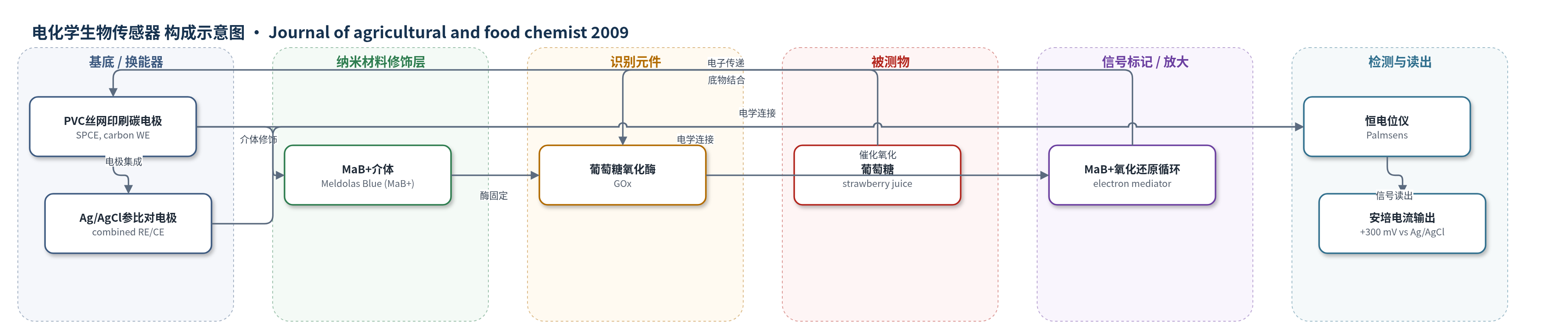
点击图片查看大图 · 依据论文自动绘制
传感器类型
电化学生物传感器
检测对象
葡萄糖(glucose, Glc);样品基质:1:20(w/v)稀释草莓汁/草莓匀浆(diluted strawberry juices/homogenates)
检测原理
该传感器为安培型葡萄糖生物传感器。GOx固定于MaB+介导的丝网印刷碳工作电极表面,作为识别元件特异性结合葡萄糖。在pH 7.2缓冲液中,GOx催化葡萄糖氧化,产生可被MaB+再氧化的还原性产物;MaB+在电极表面发生氧化还原循环,将电子传递至碳电极。恒电位仪在+300 mV(vs Ag/AgCl)下施加固定电位,记录随葡萄糖浓度增加的电流。由于MaB+介导使反应在较低电位进行,可抑制草莓汁中抗坏血酸、酚类等电活性物质干扰;样品经1:20稀释进一步降低背景。信号无额外酶级联或核酸放大,主要依靠酶催化与介体电子传递实现定量。
检测灵敏度
LOD: ca. 0.01 mg glucose g-1 FW;线性范围: 0-10 mM;灵敏度斜率: 0.626 μAs mM^-1(原文方程:(μAs) = 0.626 × glucose concentration (mM) + 0.110);R^2 = 0.99
效应效果
该传感器对葡萄糖具有选择性,添加果糖和蔗糖(0、5、10、20 mM)几乎无响应。优化后信号较初步实验提高最多3倍,重现性改善。与HPLC相比,传感器测得的葡萄糖浓度显著偏低,但两者呈强正相关(R^2=0.73,P<0.001),作者认为可采用约2倍校正因子。对8个草莓品种,传感器能按葡萄糖含量区分和排序,而TSS与葡萄糖或总糖无相关。总酚和FRAP抗氧化能力与信号无相关,表明在1:20稀释和+300 mV条件下基本无干扰;高抗坏血酸品种变异性略高。分析时间较HPLC缩短约40倍,适合草莓育种和日常品质快速筛查。
传感器的构成
- 基底/换能器电极:PVC基底上的丝网印刷碳电极(SPCE),含28 mm²碳工作电极和Ag/AgCl参比/对电极,提供电化学换能平台
- 介体修饰层:Meldolas Blue(MaB+)修饰碳工作电极,介导GOx与电极间电子传递并降低工作电位
- 识别元件:黑曲霉葡萄糖氧化酶(GOx,优化负载20 U)滴涂于MaB+工作电极表面,特异性识别并催化葡萄糖氧化
- 电解液:0.1 M磷酸钠缓冲液(pH 7.2)含0.1 M KCl,维持酶活性与离子导电
中文摘要
草莓中糖含量与风味和品质密切相关,但常规总可溶性固形物(TSS)测定常不能准确反映糖浓度。本研究构建了一种一次性原型葡萄糖生物传感器,将黑曲霉葡萄糖氧化酶(GOx)固定于以Meldolas Blue(MaB+)介导的丝网印刷碳电极上,用于测定稀释草莓汁中的葡萄糖含量。采用2^3中心复合设计优化施加电位、GOx负载量和缓冲液pH,最优条件为+300 mV(vs Ag/AgCl)、pH 7.2和20 U GOx。优化后线性范围仍为0-10 mM,但信号较初步实验提高最多3倍,且重现性改善。与HPLC相比,该传感器虽测得葡萄糖浓度偏低,但可区分并排序8个草莓品种的葡萄糖含量,而TSS不能。对总酚、抗氧化能力和有机酸等潜在干扰的研究表明,在实验条件下传感器基本无干扰。
英文摘要
Sugars are intimately related to the taste of strawberry fruit and therefore to quality. A disposable prototype glucose biosensor was constructed using glucose oxidase (GOx) immobilized onto Meldolas Blue mediated screen printed electrodes, to determine glucose content in diluted strawberry juices. Several experimental variables that affect biosensor performance, such as applied potential, GOx loading, and pH of the buffer/electrolyte solution were optimized by means of a 2(3) central composite design. Optimum applied potential, pH, and enzyme loading were +300 mV (versus Ag/AgCl), 7.2, and 20 U, respectively. Although the linear range (0-10 mM) was not significantly affected by the optimization process, the signal given by the biosensor was increased by as much as 3-fold as compared to preliminary experiments, and the reproducibility of the measurements was improved. Unlike total soluble solids (TSS), and as hypothesized, the constructed GOx biosensor was able to discriminate and rank eight different strawberry cultivars on the basis of their glucose content when compared to known concentrations measured by standard HPLC. A detailed study of the possible interferences (viz. total phenolics, antioxidant capacity, and organic acids) found in strawberry samples that could affect biosensor performance was also performed to further understand the relationship between biosensor response and sample composition. Under the imposed experimental conditions the constructed biosensor acted interference-free.