组成图示
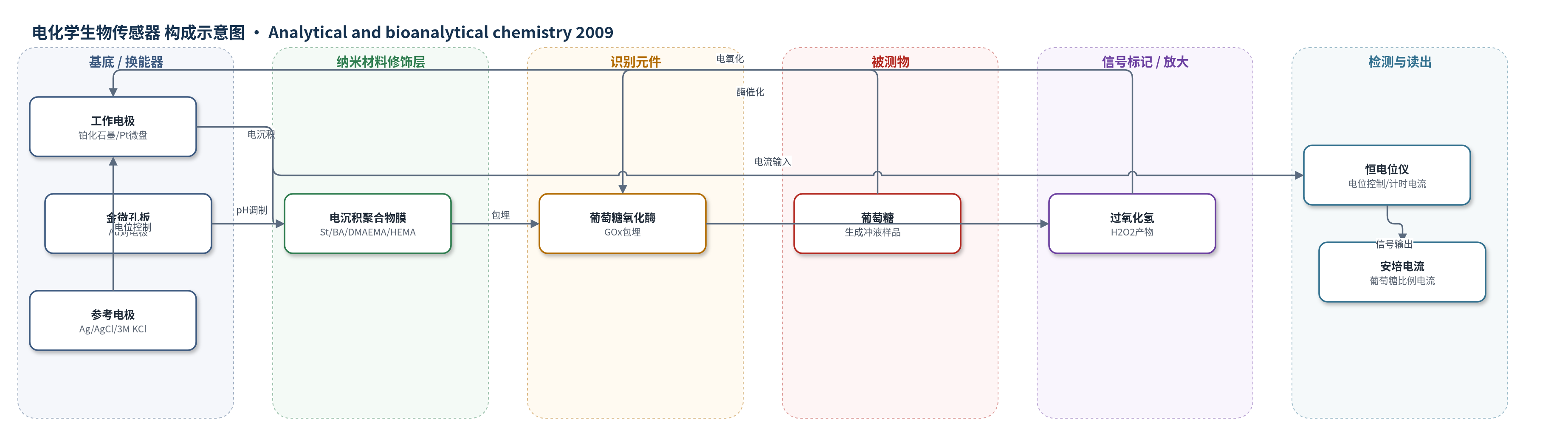
点击图片查看大图 · 依据论文自动绘制
传感器类型
电化学生物传感器
检测对象
葡萄糖(glucose, Glc),样品基质为磷酸盐缓冲液(pH 6.3)中的葡萄糖标准溶液
检测原理
传感器制备时,在含电沉积聚合物(EDP)和葡萄糖氧化酶(GOx)的溶液中施加电位脉冲,电极前方扩散层发生电化学诱导的局部 pH 变化,使 EDP 骨架电荷中和、絮凝并在电极表面沉淀,GOx 同时被包埋形成水凝胶膜。检测时,葡萄糖扩散进入 EDP 膜,被 GOx 催化氧化并生成过氧化氢(H2O2);H2O2 在 +600 mV 工作电位下于铂化石墨或 Pt 微盘电极表面发生电氧化,产生与葡萄糖浓度成正比的安培电流。EDP 膜的亲疏水平衡、厚度及葡萄糖在膜内的扩散/分配决定表观 Michaelis 常数和最大电流,未使用额外化学放大策略。
检测灵敏度
原文未报告LOD、线性范围、灵敏度斜率或相关系数。
效应效果
论文重点评价可重复性而非临床样品分析。改进后的平行合成器将加热浴温度控制精度提高到 0.2 °C,单管温度记录精度 0.5 °C,搅拌速度精度 10 rpm;自动移液和在线温度曲线用于监控聚合。共合成 16 种阴极电沉积聚合物(EDP)并自动制备葡萄糖传感器。不同 EDP 的表观最大电流 Imax app 差异可达 10 倍,P7 信号最高,P12 线性范围更好。抛光轮清洗可恢复初始电极表面,避免对/参比电极污染。未报告实际样品回收率、RSD 或方法对比;作者认为该策略为定制 EDP 理性设计安培生物传感器提供基础。
传感器的构成
- 工作电极:铂化石墨电极(platinized graphite, d=0.5 mm)或 Pt 微盘电极(250 μm),用于 H2O2 电氧化和电流读出
- 对电极:金微孔板(Au microtiter plate),制备时作为大面积对电极,保证局部 pH 调制可重复
- 参考电极:Ag/AgCl/3 M KCl 微型参考电极,用于恒电位控制
- 固定化基质:电沉积聚合物(EDP)共聚物膜,由苯乙烯(St)、丁基丙烯酸酯(BA)、二甲基氨基乙基甲基丙烯酸酯(DMAEMA)、2-羟乙基甲基丙烯酸酯(HEMA)等组成,经 pH 诱导沉淀形成水凝胶
- 识别元件:葡萄糖氧化酶(GOx),在 EDP 沉淀过程中包埋于膜内,催化葡萄糖氧化
- 信号产物:过氧化氢(H2O2),GOx 催化葡萄糖生成,在 +600 mV 下于工作电极氧化产生安培电流
中文摘要
电沉积聚合物可通过电极前方扩散层中电化学诱导的 pH 值变化在电极表面沉淀,所形成的聚合物膜可用作安培生物传感器的固定化基质。为合理控制由此获得的生物传感器性能,必须开发电沉积聚合物可重复合成策略以及非手工、可重复的传感器制备方法。基于专门设计的具有改进搅拌和温度控制的平行合成器、用于制备单体混合物和可控去除聚合抑制剂的自动移液机器人,实现了电沉积聚合物库的可重复合成。此外,利用在线热电偶监测聚合过程,表明所选策略可得到可重复的聚合反应。通过改造集成金微孔板和抛光轮自动清洗电极的电化学机器人系统,以葡萄糖氧化酶为模型酶演示了可重复的生物传感器制备。这些结果为通过选择专门设计的电沉积聚合物来理性开发生物传感器并控制传感器性能开辟道路。
英文摘要
Electrodeposition polymers can be precipitated on electrode surfaces upon electrochemical-induced modulations of the pH value in the diffusion zone in front of the electrode. The formed polymer films can be used as immobilization matrices in amperometric biosensors. In order to rationally control the thus obtained biosensor properties, it is indispensable to develop strategies for the reproducible synthesis of electrodeposition polymers as well as methods for the non-manual and reproducible sensor fabrication. Based on instrumental developments such as a specifically designed parallel synthesizer with improved stirring and temperature control, an automatic pipetting robot for the preparation of the monomer mixtures and controlled removal of polymerization inhibitors, the reproducible synthesis of libraries of electrodeposition polymers was achieved. Moreover, the polymerization process could be monitored using in-line thermocouples, and it could be shown that the chosen strategies led to reproducible polymerization reactions. By adaptation of an electrochemical robotic system integrating a Au microtiter plate and automatic electrode cleaning by means of a polishing wheel reproducible biosensor fabrication using glucose oxidase as a model enzyme could be demonstrated. These results open the route for the rational development of biosensors and control of the sensor properties by choosing specifically designed electrodeposition polymers.