组成图示
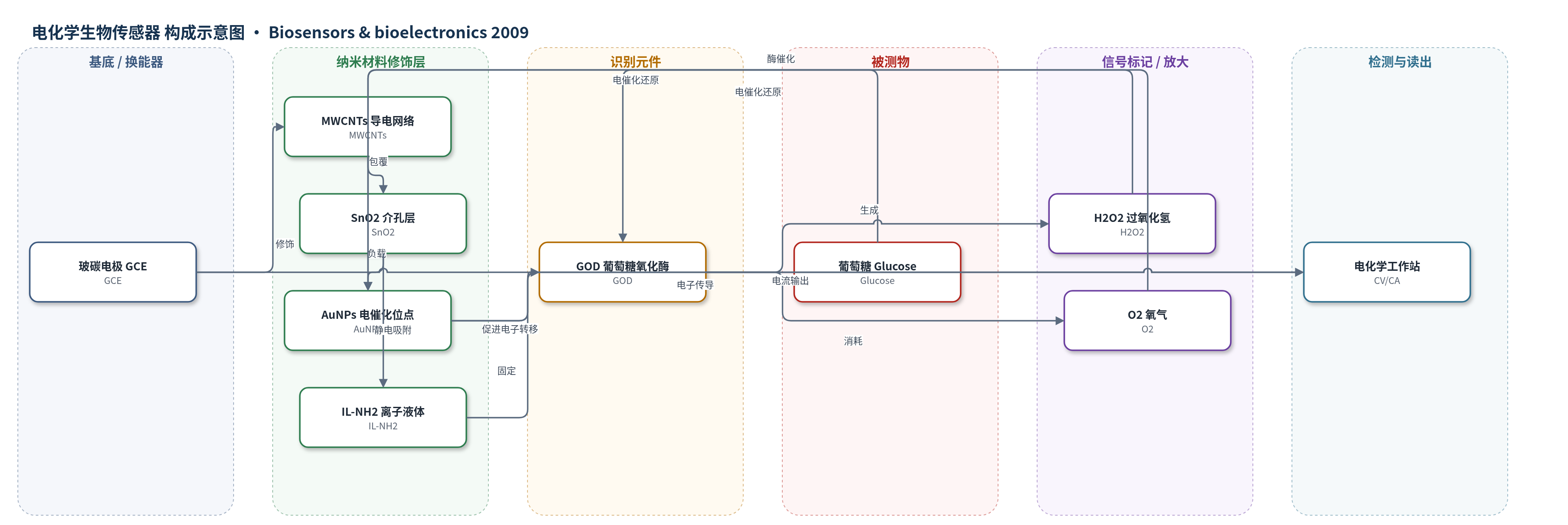
点击图片查看大图 · 依据论文自动绘制
传感器类型
电化学生物传感器
检测对象
葡萄糖(Glucose);样品基质:磷酸盐缓冲液(PBS)、人血
检测原理
葡萄糖氧化酶(GOD)催化葡萄糖与溶解氧反应,生成葡萄糖酸和过氧化氢(H2O2),同时消耗氧气(O2)。MWCNTs@SnO2-Au 复合材料中,MWCNTs 提供导电通道,SnO2 介孔结构固定 GOD,AuNPs 对 O2 和 H2O2 具有电催化还原作用,IL-NH2 通过静电作用辅助 GOD 固定并维持酶活性。GOD 在修饰电极上发生直接电子转移,葡萄糖浓度升高使界面 O2/H2O2 相关阴极电流下降,形成与浓度线性相关的安培信号。
检测灵敏度
LOD: 5 μM;线性范围: 4.0–24.0 mM(PBS);人血线性范围: 4.0–12.0 mM
效应效果
该传感器对 0.2 mM 抗坏血酸、多巴胺、尿酸、17 mM 乙醇和 1.0 mM 吗啡均无明显干扰。同一电极在 6.0 mM 葡萄糖人血中 15 次检测 RSD 为 2.5%,优于微流控人血检测(14.13%);5 个电极(10.0 mM)重现性 RSD 为 5.3%,操作稳定性 RSD 为 3.4%。4℃保存 1 周响应下降 2.6%,2 周氧化还原峰电流保持约 89%–93%,1 个月保持 87%。单次血样仅需 30 μL,电极可重复使用 15 次以上,成本低于现有血糖试纸,适合临床血糖检测。
传感器的构成
- 基底/工作电极:玻碳电极(GCE),提供导电基底并作为电子转移动力。
- 纳米复合材料修饰层:多壁碳纳米管@二氧化锡-金(MWCNTs@SnO2-Au)纳米缆线,MWCNTs 提供导电通道,SnO2 提供介孔载体,AuNPs 提供 O2/H2O2 电催化位点。
- 胺基离子液体层:胺基离子液体(IL-NH2)通过静电作用吸附于 SnO2 表面,辅助 GOD 固定并提高离子导电性。
- 识别元件:葡萄糖氧化酶(GOD),催化葡萄糖氧化并产生 H2O2,同时实现直接电子转移。
- 保护层:Nafion 117 水溶液(0.5%),覆盖在 GOD 层外,防止生物复合材料流失。
中文摘要
本文通过化学法合成多壁碳纳米管@二氧化锡-金(MWCNTs@SnO2-Au)复合材料,并用透射电镜、X射线光电子能谱和拉曼光谱表征其结构与组成。该复合材料具有良好的电催化性能,将其修饰玻碳电极后吸附葡萄糖氧化酶(GOD),构建了葡萄糖生物传感器。在 MWCNTs@SnO2-Au/GOD 修饰电极上观察到 GOD 的直接电子转移过程。该传感器在磷酸盐缓冲液中葡萄糖线性范围为 4.0–24.0 mM,适用于实际样品检测;在人血中 4.0–12.0 mM 范围内,阴极峰电流随葡萄糖浓度升高线性下降。传感器还能抗干扰物影响,并表现出良好的重现性、操作稳定性和储存稳定性,有望用于临床血糖检测。
英文摘要
Multiwalled carbon nanotubes@SnO(2)-Au (MWCNTs@SnO(2)-Au) composite was synthesized by a chemical route. The structure and composition of the MWCNTs@SnO(2)-Au composite were confirmed by means of transmission electron microscopy, X-ray photoelectron and Raman spectroscopy. Due to the good electrocatalytic property of MWCNTs@SnO(2)-Au composite, a glucose biosensor was constructed by absorbing glucose oxidase (GOD) on the hybrid material. A direct electron transfer process is observed at the MWCNTs@SnO(2)-Au/GOD-modified glassy carbon electrode. The glucose biosensor has a linear range from 4.0 to 24.0mM, which is suitable for glucose determination by real samples. It should be worthwhile noting that, from 4.0 to 12.0mM, the cathodic peak currents of the biosensor decrease linearly with increasing the glucose concentrations in human blood. Meanwhile, the resulting biosensor can also prevent the effects of interfering species. Moreover, the biosensor exhibits satisfying reproducibility, good operational stability and storage stability. Therefore, the MWCNTs@SnO(2)-Au/GOD biocomposite could be promisingly applied to determine blood sugar concentration in the practical clinical analysis.