组成图示
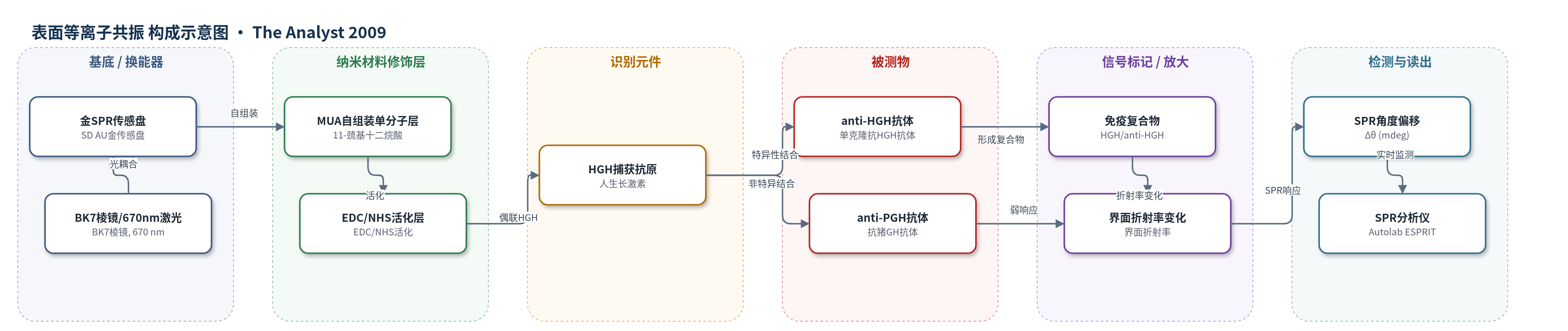
点击图片查看大图 · 依据论文自动绘制
传感器类型
表面等离子共振(SPR)生物传感器
检测对象
抗人生长激素抗体(anti-HGH antibodies);样品基质:PBS缓冲液(实验),文中提及可用于血清/血液及GH药物监测
检测原理
金SPR传感盘上先形成MUA自组装单分子层,EDC/NHS将MUA末端羧基活化为NHS酯,HGH经伯胺共价固定,乙醇胺封闭剩余活性酯基。样品中的anti-HGH抗体与固定化HGH发生特异性免疫结合,使金膜界面附近生物分子质量和折射率增加,导致SPR共振角发生偏移。该过程无需标记,信号随anti-HGH浓度升高而增大;在2.47–250 nM范围内近似线性,高于5 mM时趋于饱和。结合完成后用PBS洗脱可观察解离,50 mM NaOH/0.5% SDS可温和再生表面,实现重复检测。
检测灵敏度
LOD(最低检测浓度): 2.47 nM (0.4 mg/ml);线性范围: 2.47–250 nM;测量范围: 0.25 nM–10 mM;SPR角度偏移: ca. 6 m° @2.47 nM;信噪比: 60 (6 m°/0.1 m°)
效应效果
该传感器对anti-HGH具有良好选择性:在2.47 mM浓度下,anti-HGH产生的SPR信号比anti-PGH在HGH修饰表面的非特异结合信号高10倍以上。同一SPR芯片连续3次检测–再生循环的SPR角度偏移差异约2%,标准偏差1.9–2.3%,重复性99.1–97.7%;5个独立制备芯片的标准偏差最高5.0%,重复性95%。在PBS(pH 7.4、20 ℃)中保存21 d后,SPR信号下降不超过5%,40次检测–再生循环基线无明显变化。单个分析周期约30 min,再生仅需3 min。作者认为其适合GH治疗监测和GH药物制备中anti-HGH抗体的快速、可靠检测。
传感器的构成
- 基底/换能器:金SPR传感盘(SD AU)与BK7玻璃棱镜,构成Kretschmann衰减全反射(ATR)换能结构,670 nm Ge-As激光激发SPR。
- 自组装单分子层:11-巯基十二烷酸(MUA)在Au表面形成SAM,提供羧基末端并降低非特异吸附。
- 活化层:EDC/NHS水溶液活化MUA羧基生成N-羟基丁二酰亚胺(NHS)酯,用于共价偶联HGH。
- 识别元件:人生长激素(HGH)通过伯胺共价固定于活化MUA,作为捕获抗原识别anti-HGH抗体。
- 信号标记物:无外源标记物,anti-HGH直接结合引起界面折射率变化。
- 封闭剂:1 M乙醇胺(pH 8.5)封闭未反应NHS酯,减少非特异结合。
- 再生液:50 mM NaOH和0.5%十二烷基硫酸钠(SDS)解离HGH/anti-HGH复合并再生表面。
- 缓冲液:10 mM PBS(pH 7.4)用于结合/解离与基线稳定;10 mM NaOAc(pH 4.5)用于偶联。
- 信号读出:Autolab ESPRIT双通道SPR分析仪实时监测SPR角度偏移(mdeg)。
中文摘要
本文报道了一种基于表面等离子共振(SPR)的无标记直接检测抗人生长激素(anti-HGH)抗体的生物传感器。SPR芯片传感表面通过11-巯基十二烷酸(MUA)自组装单分子层修饰,并用N-羟基丁二酰亚胺(NHS)和N-(3-二甲氨基丙基)-N'-乙基碳二亚胺盐酸盐(EDC)活化MUA羧基,使人生长激素(HGH)经伯胺共价固定。单克隆anti-HGH抗体在0.25 nM至10 mM范围内与固定化HGH特异性结合,实验最低检测浓度为2.47 nM。单个免疫分析周期可在30 min内完成,包括结合、解离和表面再生。采用50 mM NaOH和0.5%十二烷基硫酸钠(SDS)可温和解离HGH/anti-HGH复合并再生表面,40次检测–再生循环中基线无明显变化。该SPR芯片在20 ℃ PBS中至少可保存21 d,对anti-HGH的灵敏度无明显损失。
英文摘要
A direct, label-free detection method of antibodies against the human growth hormone (anti-HGH) using a surface plasmon resonance (SPR) biosensor is reported. The sensing surface of the surface plasmon resonance biosensor chip (SPR-chip) was modified by covalent coupling of the human growth hormone (HGH) to the self-assembled monolayer of 11-mercaptoundecanoic acid (MUA). HGH was immobilized via primary amine groups after activation of the MUA carboxyl groups with a mixture of N-hydroxysuccinimide (NHS), and N-(3-dimethylaminopropyl)-N'-ethylcarbodiimide hydrochloride (EDC). The specific binding of monoclonal anti-HGH antibody on the HGH-modified surface was examined in the concentration range from 0.25 nM to 10 microM. The experimentally observed detection minimum for anti-HGH was 2.47 nM. A single immunoassay cycle could be done within 30 min including the HGH and anti-HGH association, HGH/anti-HGH complex dissociation and surface regeneration steps. The SPR biosensor response for repeatable detections of anti-HGH was highly reproducible and very stable. On the SPR-chip the formed HGH and anti-HGH complex (HGH/anti-HGH) could be gently dissociated and the sensing surface might be regenerated by 50 mM NaOH and 0.5% sodium dodecylsulfate (SDS) solution. Any changes in the original baseline level were detected during the 40 detection-regeneration cycles. This means that damage of the immobilized HGH-based sensitive layer during regeneration was minimal. It was demonstrated that the developed SPR-chip could be stored for at least 21 days before use without considerable loss of sensitivity towards anti-HGH.