组成图示
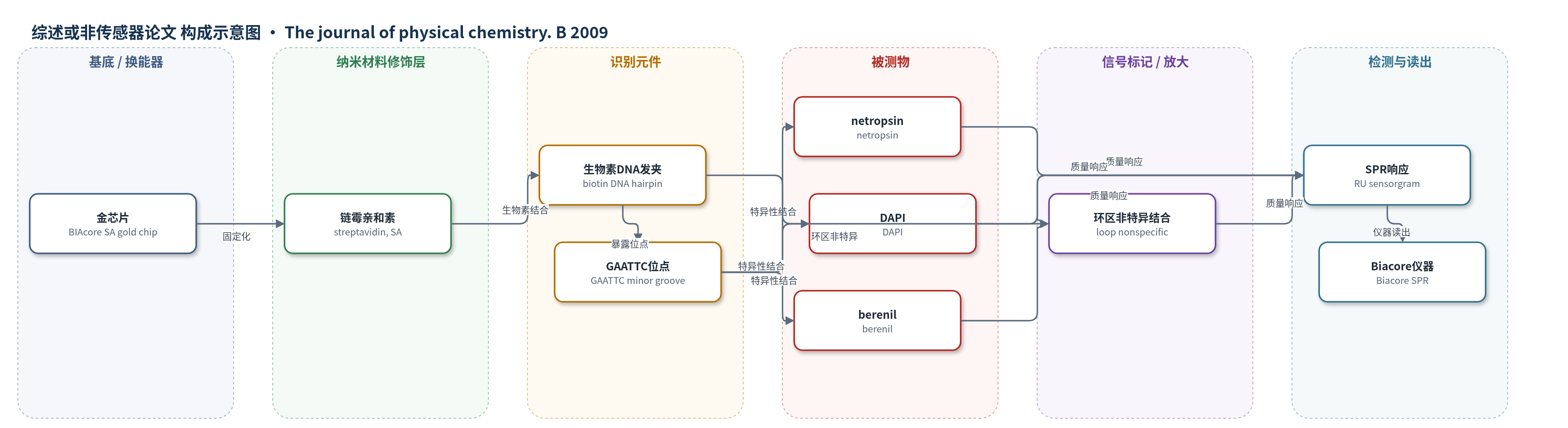
点击图片查看大图 · 依据论文自动绘制
传感器类型
综述或非传感器论文
检测对象
检测对象:netropsin(奈替罗品)、DAPI(4′,6-二脒基-2-苯基吲哚)、berenil(贝伦尼);样品基质:MES 缓冲液(含 NaCl 与 0.0005% v/v surfactant P20)
检测原理
将 5′-生物素标记 DNA 发夹通过生物素-链霉亲和素作用固定于金芯片表面,形成含 GAATTC 小沟结合位点和不同环区的识别界面。向芯片注入 netropsin、DAPI 或 berenil 后,配体首先与茎区 GAATTC 位点发生高亲和力主结合,同时在高浓度下与环区及磷酸骨架发生弱非特异结合。配体结合使界面质量增加,引起表面等离子共振角和响应单位(RU)变化;稳态 RU 与结合配体摩尔量成正比。数据按两结合位点或三结合位点模型拟合,得到主结合常数 K1 和次级结合常数 K2/K3。环区负电荷和尺寸主要影响 K2/K3,而茎区长度足够时 K1 基本不变。该体系无酶或核酸放大,信号直接来自结合质量变化。
检测灵敏度
原文未报告 LOD、线性范围、灵敏度斜率或相关系数。
效应效果
热熔实验显示,8 bp 茎发夹的 Tm 随环变化:TCTC 66.0 °C、TCTCTC 64.2 °C、6-EG 73.5 °C、3-P 67.3 °C、4-P 66.5 °C、5-P 63.2 °C、6-P 61.1 °C、7-P 59.3 °C;10 bp 茎 TCTC 79.8 °C、6-EG 83.6 °C,误差约 ±0.5 °C。SPR 结合实验中,主结合常数 K1 通常为 10^7–10^8 M^-1,且基本不受环影响;次级结合常数 K2/K3 随环增大和负电荷增多而升高。实验重复 2–4 次,K1 误差 ≤10%,K2/K3 误差最大约 60%。6-EG 非核苷酸环在提高热稳定性的同时显著降低环区非特异结合,有利于准确测定特异性结合常数,并为发夹探针、分子信标和微阵列设计提供依据。
传感器的构成
- 基底/换能器:金芯片(gold chip, BIAcore SA chip),提供 SPR 换能表面
- 固定化层:链霉亲和素(streptavidin, SA)修饰层,通过生物素-链霉亲和素作用捕获 DNA
- 识别元件:5′-生物素标记 DNA 发夹(biotin-labeled DNA hairpins),含 GAATTC 小沟结合位点和不同环
- 分析物/配体:netropsin、DAPI、berenil,A/T 特异性 DNA 小沟结合剂
- 流动相:MES 缓冲液(含 NaCl 和 0.0005% v/v surfactant P20),维持结合条件并降低非特异吸附
- 信号读出:Biacore SPR 仪器,以响应单位(RU)监测界面结合质量变化
中文摘要
发夹核酸因热稳定性高于等价双链结构,常被用作四链体、i-基序、十字形结构和分子信标等复杂环状结构的模型。尽管连接环可增强稳定性,但环如何影响小分子与相邻碱基配对区相互作用仍不清楚。本研究采用光谱法和表面等离子共振(SPR)生物传感器方法,考察不同发夹环对 A/T 特异性 DNA 小沟结合剂与共同茎序列相互作用的影响。所有发夹均含相同主结合位点 GAATTC,但环区分别为核苷酸环 TCTC、TCTCTC 和非核苷酸环 6-EG、3-P 至 7-P。热熔和圆二色性结果表明,环大小和组成显著改变发夹热稳定性,其中 6-EG 环发夹具有最高熔解温度,而茎区保持 B 型构象。SPR 结果显示,主结合常数基本不受环影响,但高浓度下的次级/非特异结合显著受环大小和负电荷数影响;较大且带更多负电荷的核苷酸环产生更强非特异响应,而低电荷非核苷酸 6-EG 环在保持茎区主结合亲和力的同时明显降低环区非特异结合。
英文摘要
Hairpin nucleic acids are frequently used in physical studies due to their greater thermal stability compared to their equivalent duplex structures. They are also good models for more complex loop-containing structures such as quadruplexes, i-motifs, cruciforms, and molecular beacons. Although a connecting loop can increase stability, there is little information on how the loop influences the interactions of small molecules with attached base-paired nucleic acid regions. In this study, the effects of different hairpin loops on the interactions of A/T specific DNA minor groove binding agents with a common stem sequence have been investigated by spectroscopic and surface plasmon resonance (SPR) biosensor methods. The results indicate that the hairpin loop has little influence on the specific site interactions on the stem but significantly affects nonspecific binding. The use of a non-nucleotide loop (with a reduced negative charge) not only enhances the thermal stability of the hairpin but also reduces the nonspecific binding at the loop without compromising the primary binding affinity on the stem.