组成图示
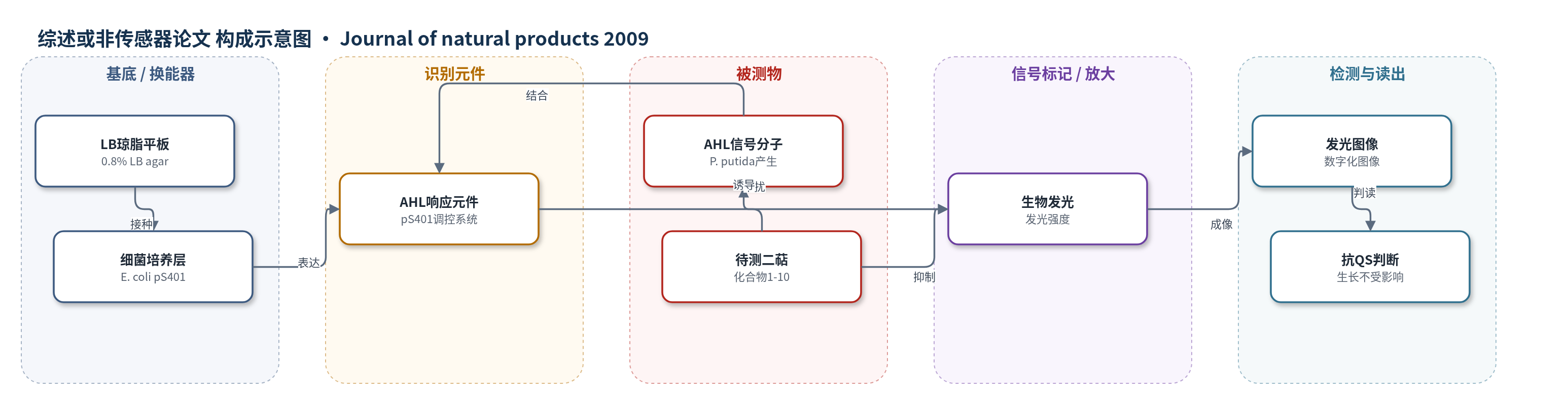
点击图片查看大图 · 依据论文自动绘制
传感器类型
综述或非传感器论文
检测对象
cembranoid 二萜化合物(knightol、knightol acetate、knightal、asperdiol、asperdiol acetate 及半合成物 6–10);样品基质:LB 琼脂平板中的细菌培养体系
检测原理
该检测基于细菌群体感应(QS)生物发光模型。P. putida IsoF 野生型产生酰基高丝氨酸内酯(AHL)信号分子,AHL 扩散至 E. coli pS401 生物传感器菌中,被其 AHL 响应调控元件识别并结合,从而诱导生物发光基因表达,产生可被成像系统检测的发光信号。待测 cembranoid 二萜从无菌纸盘扩散进入琼脂,若其干扰 AHL 信号产生、扩散或受体识别,则 E. coli pS401 的发光强度或发光圈减小。实验以发光受到抑制而细菌生长模式不变作为抗 QS 阳性判据,因此信号变化反映被测物对 QS 通路的抑制程度,而非直接定量浓度。
检测灵敏度
原文未报告 LOD、线性范围、灵敏度斜率或 R^2。
效应效果
抗菌试验中,化合物 1 抑菌圈最大(>10 mm),对革兰阳性菌更强;3 和 8 也显示广谱活性,半合成物 6–10 对部分革兰阴性菌有效。MIC 显示 knightol 对 O. pseudogringnonense 为 8 µg/disk、对 Bacillus sp. 为 2 µg/disk;knightol acetate 和 knightal 对革兰阴性菌均为 8 µg/disk,对革兰阳性菌分别为 30 和 16 µg/disk;4 对 Bacillus sp. 为 4 µg/disk;5、6、8 对两类代表菌均为 30 µg/disk,其余 >30 µg/disk。抗 QS 试验中,1、3、7、8 抑制 E. coli pS401 生物发光,1 较弱;以发光抑制且细菌生长不受影响为阳性,抑菌试验均三次重复。作者认为其可能用于防污或干扰生物膜形成。
传感器的构成
- 检测基底:LB 琼脂平板(0.8% LB agar),承载 E. coli pS401 与 P. putida IsoF 培养及化合物扩散。
- 信号菌层:E. coli pS401 生物传感器菌株,接受 AHL 诱导后产生生物发光。
- 信号分子来源:P. putida IsoF 野生型菌株,产生酰基高丝氨酸内酯(AHL)群体感应信号。
- 识别元件:E. coli pS401 菌体(AHL 响应单元),识别 AHL 并启动生物发光表达。
- 被测物加样:无菌纸盘负载 10 mg/mL 化合物溶液 10 或 20 µL,扩散至琼脂。
- 信号读出:数字化生物发光图像,以发光抑制圈且细菌生长不受影响判断抗 QS。
中文摘要
从哥伦比亚加勒比海采集的海鞭 Eunicea knighti 中分离得到三种新的 cembranoid 二萜化合物 knightol(1)、knightol acetate(2)和 knightal(3),以及已知化合物 asperdiol(4)和 asperdiol acetate(5)。通过高分辨质谱、一维和二维核磁共振、ROESY 相关以及改良 Mosher 法确定了 1–5 的结构和绝对构型。此外,首次报道了由天然产物化学转化获得的五种半合成 cembranoid 化合物 6–10。所有化合物均针对与重度污损表面相关的海洋细菌进行抗菌活性测试,并筛选抗群体感应(QS)活性。结果显示,化合物 1、3 和 8 对细菌分离株具有显著抗菌活性;化合物 1、3、7 和 8 表现出优异的抗 QS 抑制活性,该活性通过生物传感器模型系统中的生物发光抑制法测定。
英文摘要
Three new cembranoid diterpenes, knightol (1), knightol acetate (2), and knightal (3), along with the known asperdiol (4) and asperdiol acetate (5), were isolated as major compounds from the sea whip Eunicea knighti collected from the Colombian Caribbean. The structures and absolute configurations of 1-5 were determined on the basis of spectroscopic analyses and by a combination of chemical and NMR methods, multiple correlations observed in a ROESY experiment, and using the modified Mosher method. Additionally, five semisynthetic compounds, 6-10, obtained during the chemical transformations of the natural compounds are here reported for the first time. All compounds were tested for antimicrobial activity against marine bacteria associated with heavily fouled surfaces and were also screened for antiquorum sensing (QS) activity. Compounds 1, 3, and 8 showed significant antimicrobial activity against bacterial isolates, and 1, 3, 7, and 8 showed excellent anti-QS inhibition activity measured by means of bioluminescence inhibition with biosensor model systems.