组成图示
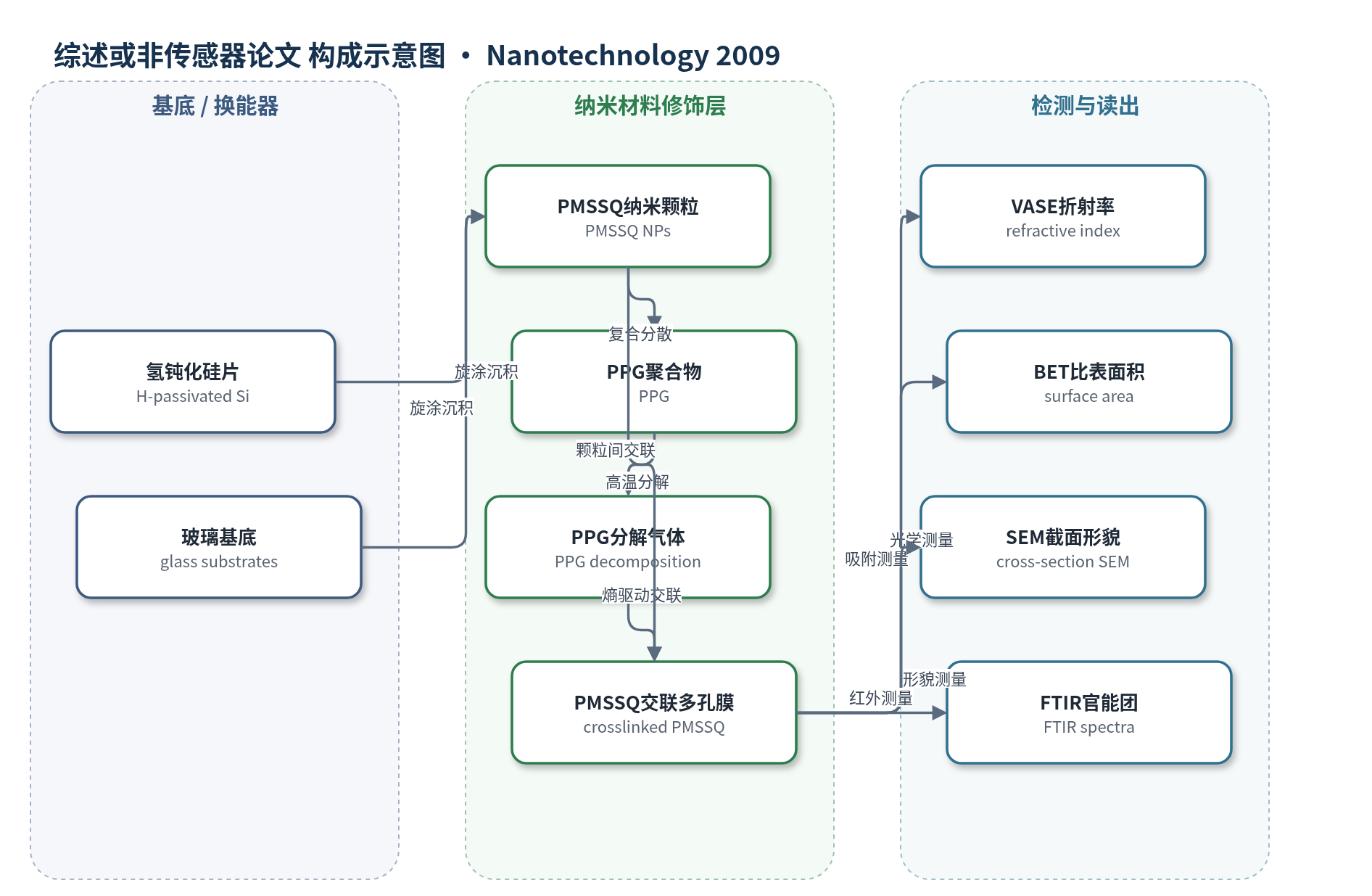
点击图片查看大图 · 依据论文自动绘制
传感器类型
综述或非传感器论文
检测对象
无(非传感论文,未报道被测物与样品基质)
检测原理
本文并非传感检测,而是多孔膜制备原理。PMSSQ 纳米颗粒与 PPG 在 PGMEA 中形成胶体分散液,旋涂于基底后,PGMEA 蒸发形成 PMSSQ-PPG 复合膜。当温度高于 PPG 分解温度(约 200 °C 以上)时,PPG 分解产生气体,使原本受限的 PMSSQ 纳米颗粒获得平动熵和迁移能力,颗粒在气体中发生布朗运动与碰撞。颗粒内和颗粒间发生缩合交联,形成 Si-O-Si 网络并固定结构,最终得到由纳米颗粒构成的多孔膜。温度决定交联程度与颗粒逸出比例,基底表面能决定颗粒与基底相互作用:中等表面能(约 35–47 mJ cm−2)利于连续多孔膜,高表面能导致致密膜,低表面能导致脱湿。
检测灵敏度
无(非传感论文,未报告LOD、线性范围、斜率或相关系数)
效应效果
作者报道了快速旋涂-高温烧结法制备 PMSSQ 多孔膜的性能。500 °C/5 min 下,氢钝化硅片上薄膜厚约 1.8 µm,呈介孔/微孔双峰分布,BET 比表面积达 1325 m2 g−1。薄膜光学平滑、疏水,折射率可低至 1.048(结论给出 1.047),低于牺牲致孔剂法常见约 1.13–1.18。530 °C 下约 3 min 达到厚度与折射率平衡。表面能研究显示,35–47 mJ cm−2 基底可形成连续多孔膜,折射率约 1.17–1.18;Piranha 玻璃(56.93 mJ cm−2)孔塌陷,折射率 1.36;HMDS 玻璃(28.03 mJ cm−2)脱湿。作者认为可用于定制多孔材料和光图案化。
传感器的构成
- 基底:氢钝化硅片(H-passivated Si)或玻璃基底,提供表面能并支撑成膜
- 前驱体分散液:聚甲基硅倍半氧烷纳米颗粒(PMSSQ NPs)分散于聚丙二醇(PPG)和丙二醇甲醚醋酸酯(PGMEA)中
- 初始复合膜:PMSSQ-PPG 复合膜,旋涂形成薄膜
- 溶剂蒸发层:PGMEA 选择性蒸发,提高 PPG/PMSSQ 比例
- 高温分解层:PPG 在 >200 °C 分解产生气体,增加 PMSSQ 纳米颗粒迁移熵
- 交联多孔膜:PMSSQ 颗粒间/颗粒内交联形成 Si-O-Si 网络,生成介孔/微孔结构
中文摘要
多孔材料在光子学、催化、半导体加工和生物传感器基础设施等领域不可或缺,但快速、节能地制备这类材料仍具挑战。本文报道了一种基于聚甲基硅倍半氧烷(PMSSQ)纳米颗粒胶体分散液的快速成膜方法。将纳米颗粒-聚合物复合材料加热至聚合物分解温度以上时,利用纳米颗粒获得的熵增,可制备由纳米颗粒组成的高多孔薄膜。该方法可获得光学平滑、疏水的薄膜,折射率可低至1.048,比表面积可高达1325 m2 g−1。文章还讨论了该体系对温度和基底表面能的依赖行为,并指出该方法原则上可推广到多种纳米颗粒-聚合物体系,用于定制多孔材料。
英文摘要
Nanoporous materials have become indispensable in many fields ranging from photonics, catalysis and semiconductor processing to biosensor infrastructure. Rapid and energy efficient process fabrication of these materials is, however, nontrivial. In this communication, we describe a simple method for the rapid fabrication of these materials from colloidal dispersions of Polymethyl Silsesquioxane nanoparticles. Nanoparticle-polymer composites above the decomposition temperature of the polymer are examined and the entropic gain experienced by the nanoparticles in this rubric is harnessed to fabricate novel highly porous films composed of nanoparticles. Optically smooth, hydrophobic films with low refractive indices (as low as 1.048) and high surface areas (as high as 1325 m(2) g(-1)) have been achieved with this approach. In this communication we address the behavior of such systems that are both temperature and substrate surface energy dependent. The method is applicable, in principle, to a variety of nanoparticle-polymer systems to fabricate custom nanoporous materials.