组成图示
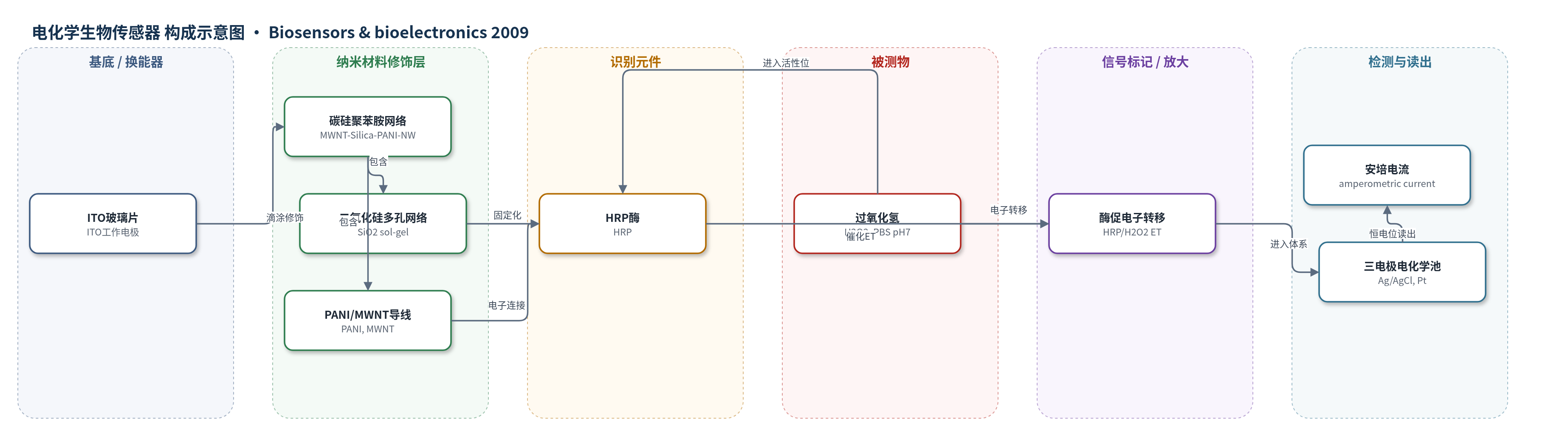
点击图片查看大图 · 依据论文自动绘制
传感器类型
电化学生物传感器
检测对象
过氧化氢(hydrogen peroxide, H2O2);样品基质为0.1 M磷酸盐缓冲液(PBS, pH 7)。
检测原理
HRP被固定于MWNT-Silica-PANI-NW三维网络中,SiO2多孔框架允许H2O2扩散并限制酶泄漏。当H2O2进入电极界面时,HRP催化其转化(H2O2还原为水),同时HRP血红素氧化还原中心发生可逆电子转移。PANI链与MWNT作为分子导线,将HRP主氧化还原位点与ITO电极连接,显著降低电子转移阻力并提高电子转移速率。在+0.1 V恒电位下,酶促电子转移产生与H2O2浓度成正比的安培电流;浓度越高,单位时间内催化转化和电子转移越多,电流越大。该体系依靠导电CNT、电子介导PANI和多孔SiO2的协同作用实现高灵敏检测,而非核酸扩增或酶催化沉积放大。
检测灵敏度
LOD: 1 pM;线性范围: 1 pM–1 mM;灵敏度: 58.1 μA mM−1
效应效果
该电极在H2O2检测中优于HRP/MWNT和HRP/MWNT-f-TMSPA电极:灵敏度58.1 μA mM−1,远高于0.71 nA mM−1和0.05 μA mM−1;检出限1 pM,优于2.1 μM和65 nM;线性范围1 pM–1 mM,比PANI修饰丝网印刷电极和PANI/SiO2/GC电极更宽。Fe(CN)63−/4−伏安峰电流5.1 μA、峰电位差79 mV,电子转移速率常数2.11 s−1。三周后HRP泄漏仅1.9%,而HRP/MWNT和HRP/MWNT-f-TMSPA分别为88.6%和9.8%;对1 mM H2O2电流响应保持98%。作者认为其适用于生物芯片和生物燃料电池。
传感器的构成
- 基底电极:ITO(indium tin oxide)玻璃片,作为导电工作电极。
- 纳米复合修饰层:MWNT-Silica-PANI-NW,共价连接MWNT、SiO2和PANI的三维网络,提供导电通道与固定化框架。
- 多孔固定化基质:SiO2(silica)溶胶-凝胶网络,开放多孔结构固定HRP并减少酶泄漏。
- 电子介导网络:PANI(polyaniline)链与MWNT(multi-walled carbon nanotubes),作为分子导线促进HRP与ITO间电子转移。
- 生物催化元件:HRP(horseradish peroxidase),催化H2O2转化并介导电子转移。
中文摘要
本文制备了由共价连接的多壁碳纳米管(MWNT)、二氧化硅和聚苯胺(PANI)链构成的三维网络(MWNT-Silica-PANI-NW),并将其作为固定化辣根过氧化物酶(HRP)的电活性基质。以该网络修饰的HRP/MWNT-Silica-PANI-NW电极在过氧化氢(H2O2)检测中表现出优于单一组分及二元组合的综合性能:酶泄漏少、稳定性高,酶到电极的电子转移速率达2.11 s−1,灵敏度为58.1 μA mM−1,检出限低至1 pM。互连的二氧化硅网络形成开放多孔框架,有利于氧化还原酶的有效固定化并减少酶流失;PANI链与MWNT共同促进电子转移,相当于分子导线,将HRP的主要氧化还原位点“连接”至电极。上述性能提升源于导电碳纳米管、电子介导聚苯胺链和多孔二氧化硅网络的协同作用。
英文摘要
A three dimensional network comprising of covalently linked multi-walled carbon nanotubes (MWNT), silica and polyaniline chains (MWNT-Silica-PANI-NW) was prepared and used as the matrix for immobilization of an enzyme (horseradish peroxidase, HRP). MWNT-Silica-PANI-NW-HRP electrode showed superior performances over the individual components and their binary combinations, in terms of enzyme stability (minimum leaching to the medium), fast electron transfer from the enzyme to the electrode (2.11s(-1)), high sensitivity (58.1microAmM(-1)) and low detection limit (1pM) for the detection of hydrogen peroxide. The interconnected silica network provides open porous frame work for effective immobilization of the redox enzyme. The PANI units and MWNTs facilitate the electron transfer process and functions as molecular cable to "wire" the primary redox site of the enzyme (HRP) to the electrode. The improved performances for MWNT-Silica-PANI-NW arise from the synergistic contributions from conducting CNT, electron mediating PANI chains and porous silica network.