组成图示
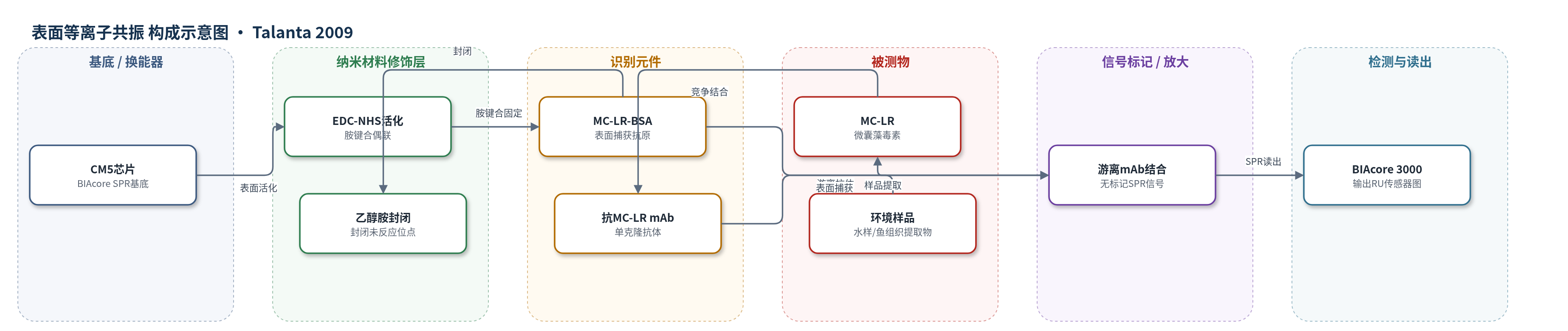
点击图片查看大图 · 依据论文自动绘制
传感器类型
表面等离子共振(SPR)生物传感器
检测对象
微囊藻毒素(microcystins, MCs;主要为MC-LR);样品基质:环境水样、鱼组织提取物
检测原理
该传感器采用间接抑制型SPR免疫分析。首先用EDC–NHS活化CM5芯片,将(MC-LR)–BSA生物偶联物胺键合固定,并用乙醇胺封闭。检测时,样品或标准品中的MC-LR与抗MC-LR单克隆抗体(mAb)预孵育30 min,MC-LR与mAb结合后降低游离mAb浓度;随后混合液注入芯片,剩余游离mAb被表面MC-LR-BSA捕获。MC-LR浓度越高,表面结合的mAb越少,SPR响应越低;反之响应越高。BIAcore 3000实时记录响应单位(RU)随时间变化,无需酶或荧光标记。检测后用40 mM NaOH再生芯片,实现重复使用。
检测灵敏度
线性范围: 1–100 μg L−1;R^2 = 0.9667
效应效果
该SPR免疫传感器在1–100 μg/L范围内线性良好(R^2=0.9667),覆盖WHO饮用水限值1 μg/L。单次检测约50 min,包括30 min预孵育和20 min BIAcore分析,仅需40 μL样品,无需标记和繁琐洗涤。芯片经50次检测-再生循环后,mAb结合能力由218 RU降至179 RU,损失小于20%。环境水样和鱼组织提取物检测结果与间接竞争ELISA基本一致,ELISA最大RSD为6.6%;鱼组织样品SPR结果为2.4、2.8和14.5 μg/L,ELISA为2.70、2.50和10.17 μg/L。作者认为其简单、快速、可再生,适合环境样品MCs检测,并有望开发为现场便携式实时监测设备。
传感器的构成
- 基底/换能器:CM5传感器芯片,BIAcore 3000用SPR换能基底,提供羧基表面用于固定
- 活化偶联层:EDC–NHS体系,活化CM5表面羧基并形成氨基反应位点
- 识别/捕获元件:(MC-LR)–BSA生物偶联物,MC-LR与BSA摩尔比2.4,固定于表面用于捕获游离mAb
- 封闭剂:乙醇胺(ethanolamine,1 M,pH 8.0),封闭未反应表面位点
- 溶液相识别元件:抗MC-LR单克隆抗体(mAb),与样品中MC-LR竞争结合
- 信号标记物:无标记免疫复合物,游离mAb结合引起SPR光学响应
- 再生剂:NaOH(40 mM),解离表面抗体-抗原复合物实现芯片再生
中文摘要
开发了一种间接抑制型表面等离子共振(SPR)免疫分析方法用于检测微囊藻毒素(MCs)。将MC-LR与牛血清白蛋白(BSA)的生物偶联物通过胺键合固定于CM5传感器芯片表面。将MC-LR标准品或样品与单克隆抗体(mAb)预先混合后注入功能化芯片,剩余游离mAb被表面MC-LR-BSA捕获,并在BIAcore 3000生物传感器上实时监测免疫反应,信号强度随MCs浓度降低而增强。该SPR免疫分析在1–100 μg/L范围内具有较宽定量范围。虽然灵敏度不及常规酶联免疫吸附试验(ELISA),但SPR生物传感器具有独特优势:(1)芯片经50次检测-再生循环后结合活性无明显损失;(2)单次检测约50 min完成,包括30 min预孵育和20 min BIAcore分析;(3)无需多步操作。该SPR生物传感器还用于环境样品中MCs检测,结果与ELISA一致。作者认为SPR生物传感器在MCs检测中具有突出优势,未来可进一步开发为现场便携式传感器,用于MCs实时原位监测。
英文摘要
An indirect inhibitive surface plasmon resonance (SPR) immunoassay was developed for the microcystins (MCs) detection. The bioconjugate of MC-LR and bovine serum albumin (BSA) was immobilized on a CM5 sensor chip. A serial premixture of MC-LR standards (or samples) and monoclonal antibody (mAb) were injected over the functional sensor surface, and the subsequent specific immunoreaction was monitored on the BIAcore 3000 biosensor and generated a signal with an increasing intensity in response to the decreasing MCs concentration. The developed SPR immunoassay has a wide quantitative range in 1-100 microg L(-1). Although not as sensitive as conventional enzyme-linked immunosorbent assay (ELISA), the SPR biosensor offered unique advantages: (1) the sensor chip could be reusable without any significant loss in its binding activity after 50 assay-regeneration cycles, (2) one single assay could be accomplished in 50 min (including 30-min preincubation and 20-min BIAcore analysis), and (3) this method did not require multiple steps. The SPR biosensor was also used to detect MCs in environmental samples, and the results compared well with those obtained by ELISA. We conclude that the SPR biosensor offers outstanding advantages for the MCs detection and may be further developed as a field-portable sensor for real-time monitoring of MCs on site in the near future.