组成图示
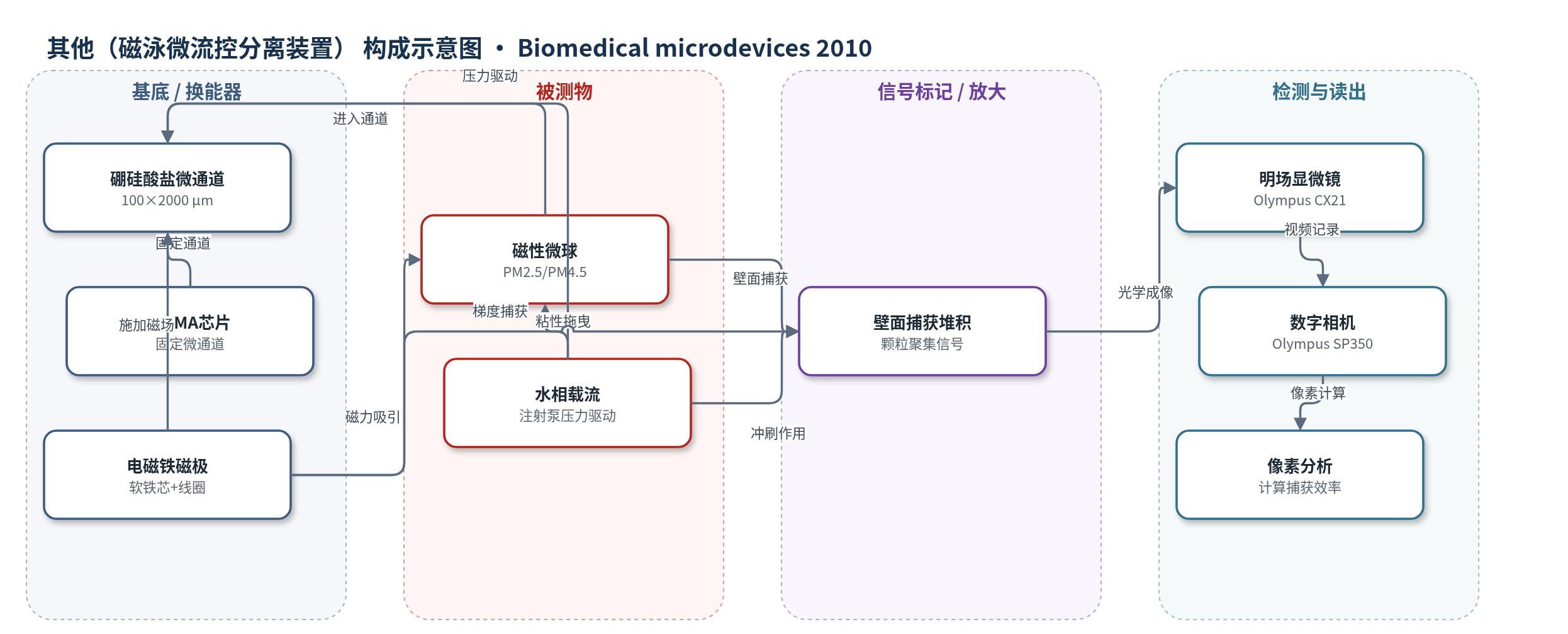
点击图片查看大图 · 依据论文自动绘制
传感器类型
其他(磁泳微流控分离装置)
检测对象
磁性微球(magnetic microspheres, PM2.5/PM4.5),样品基质:水相载流(稀释磁性微球悬液)
检测原理
本装置不依赖生物识别反应,而是利用磁场梯度对磁性微球施加横向磁力。外部电磁铁在微通道壁面附近形成非均匀磁场,磁性微球在磁场梯度中受到磁力Fm,同时受压力驱动流体的粘性拖曳Fd。当无量纲参数Π=I^2a^2/(ηQ)超过临界值Πcrit时,磁力足以克服粘性拖曳,颗粒发生横向迁移并被捕获在磁极附近壁面;低于临界值时颗粒随流逃逸。捕获效率CE随Π*=χP^2a^2/(ηUmaxh^5)增大而提高,因为磁极强度P、粒径a、磁化率χ增大或流速Umax、粘度η、通道高度h减小均增强磁力相对作用。信号读出通过明场显微成像比较入口与出口平面的时间平均像素密度,CE=(入口像素密度-出口像素密度)/入口像素密度,从而将颗粒捕获事件转化为可量化的光学信号。
检测灵敏度
原文未报告LOD、线性范围、灵敏度斜率或相关系数。
效应效果
实验与数值结果均表明,捕获效率CE可由无量纲参数Π*唯一描述。在4×10^9<Π*<3×10^10范围内,CE约从15%升至95%,实验与数值曲线重合,均方根误差为7.26%。每个实验点由5–9次重复平均,低捕获效率下图像噪声使标准偏差增大。临界捕获参数Πcrit在磁极位置1平均为1.025×10^-7,位置2平均为0.065×10^-7;磁极靠近通道使临界电流降低约2.25倍。临界电流随流量近似按Q^0.5、粘度按η^0.56、粒径按a^-1.09变化。数值网格独立性显示120×50网格下速度场和轨迹变化小于0.5%。作者认为该参数化方法可用于选择微流控磁泳分离器的操作参数并预测MEMS生物传感器中分离模块的性能。
传感器的构成
- 微流控通道:硼硅酸盐玻璃微通道(100 μm×2000 μm×5 mm,Vitrocom),承载载流并限制颗粒运动。
- 芯片基底:PMMA 芯片,固定微通道并钻孔安装刀边磁极。
- 磁场换能器:电磁铁线圈(200匝、500 μm铜线)与软铁芯(点极/刀边极),产生磁场梯度。
- 磁性颗粒:磁性聚苯乙烯微球(PM2.5/PM4.5,直径2.5/4.5 μm,内含5–15 nm氧化铁超顺磁颗粒),作为可被磁场捕获的载体。
- 流体驱动:注射泵(Evadrop)压力驱动水相载流,提供粘性拖曳。
- 光学读出:明场显微镜(Olympus CX21)与数字相机(Olympus SP350),记录颗粒轨迹和捕获图像。
- 图像处理:Magnus Image Pro/MATLAB 像素阈值与时间平均,计算捕获效率。
中文摘要
磁泳隔离是微流控生物MEMS和生物传感器中用于分离生物化学与有机实体的常用手段。本文对微流控通道中磁性微球在外部磁场梯度作用下的磁泳捕获进行了实验与数值研究。实验采用PMMA芯片固定的硼硅酸盐微通道,以注射泵驱动载有水相的2.5 μm和4.5 μm磁性聚苯乙烯微球,通过电磁铁产生磁场梯度,并用明场显微镜记录颗粒轨迹。数值模型采用Eulerian–Lagrangian方法,耦合流体动量方程与颗粒轨迹积分,考虑磁力、粘性拖曳和壁面修正。结果表明,边际捕获条件可用唯一临界参数Πcrit=Icrit^2a^2/(ηQ)描述,其正比于磁力与粘性力之比;流量、粘度、磁极位置和粒径均改变临界电流。颗粒轨迹也受同一无量纲参数支配。捕获效率CE随Π*=χP^2a^2/(ηUmaxh^5)增大而提高,实验与数值结果在4×10^9<Π*<3×10^10范围内吻合,均方根误差为7.26%。该结果可用于选择微流控磁泳分离器的操作参数并预测其性能。
英文摘要
Magnetophoretic isolation of biochemical and organic entities in a microfluidic environment is a popular tool for a wide range of bioMEMS applications, including biosensors. An experimental and numerical analysis of magnetophoretic capture of magnetic microspheres in a microfluidic channel under the influence of an external field is investigated. For a given microfluidic geometry, the operating conditions for marginal capture is found to be interrelated in such a manner that a unique critical capture parameter [Pi(crit) = ((Iota(crit)a))(2)/Q(eta)], that is proportional to the ratio of the magnetic force to viscous force, can be identified. Influences of the flow rate, magnetic field and other parameters on the particle trajectories in the microfluidic channel are investigated both numerically and through bright-field imaging under a microscope. Like the event of critical capture, particle trajectories are also found to be guided by a similar parameter, pi. Magnetophoretic capture efficiency of the device is also evaluated as a function of a nondimensional number [Pi(*) = chiP(2)a(2) / (U(null)etah(5)], when both numerical and experimental results are found to agree reasonably well. Results of this investigation can be applied for the selection of the operating parameters and for prediction of device performance of practical microfluidic separators.