组成图示
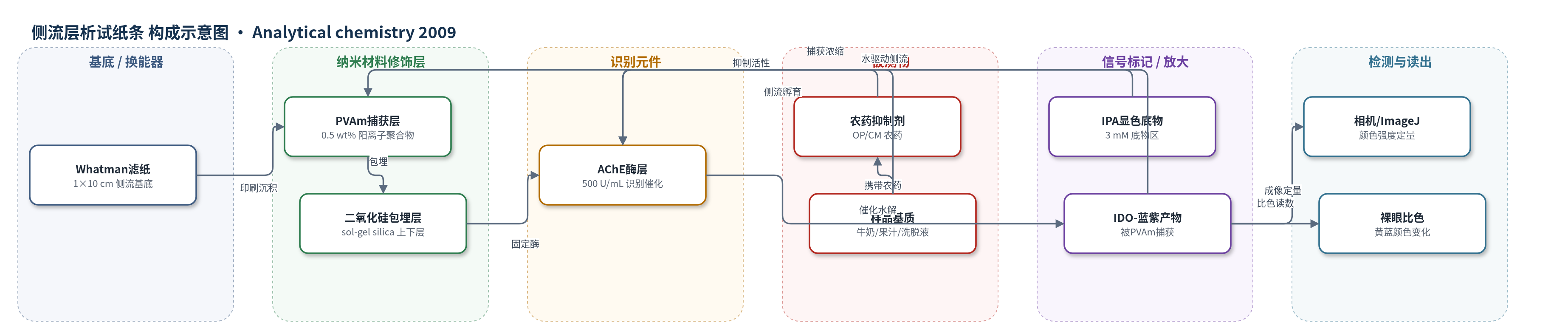
点击图片查看大图 · 依据论文自动绘制
传感器类型
侧流层析试纸条
检测对象
农药类乙酰胆碱酯酶抑制剂(acetylcholinesterase inhibitors, AChE inhibitors),包括bendiocarb(苯线磷)、carbaryl(西维因)、paraoxon(对氧磷)、malathion(马拉硫磷);样品基质为牛奶、苹果汁及苹果/生菜表面农药残留洗脱液。
检测原理
含农药样品从试纸一端侧流至传感区,与包埋于溶胶-凝胶二氧化硅中的AChE孵育约5 min。有机磷或氨基甲酸酯农药抑制AChE活性。随后试纸倒置,另一端浸入ddH2O,水驱动底物区包埋的IPA反向侧流至传感区。未被抑制的AChE在pH 8.0催化IPA水解,生成蓝紫色indophenoxide阴离子(IDO-);IDO-被传感区PVAm阳离子聚合物捕获并浓缩,形成局部蓝色显色。农药浓度越高,AChE活性越低,IDO-生成越少,蓝色越浅。通过裸眼或数字相机/ImageJ对颜色强度定量,实现无试剂比色检测。
检测灵敏度
LOD: bendiocarb ∼1 nM; carbaryl ∼10 nM; paraoxon ∼1 nM; malathion ∼10 nM;IC50: bendiocarb 10 nM; carbaryl 50 nM; paraoxon 50 nM; malathion 50 nM
效应效果
该传感器响应时间约5 min,可裸眼观察颜色变化。加标牛奶和苹果汁中paraoxon的LOD均为1 nM,基质效应可忽略;苹果汁需调pH至7-8,牛奶无需预处理。食品表面paraoxon残留检测中,10 µM喷洒约产生50%抑制,10 mM接近完全抑制,苹果与生菜结果可重复。与ESI-MS/MS方法比较,纸基检测结果基本在误差范围内一致,质谱校准R^2=0.996。试纸4 ℃保存至少1个月后保留>90%初始信号变化。传感器可检测任何AChE抑制剂(如galanthamine),但不能区分具体抑制剂,需质谱二次确认,适合现场快速筛查。
传感器的构成
- 基底:Whatman #1 滤纸(1×10 cm),提供毛细侧流通道与支撑
- 捕获浓缩层:PVAm(polyvinylamine,0.5 wt%),阳离子聚合物,捕获并浓缩蓝紫色 IDO- 产物
- 传感区包埋层:sol-gel derived silica(溶胶-凝胶二氧化硅),上下包埋 AChE,保持酶活性并允许小分子扩散
- 识别催化元件:AChE(acetylcholinesterase,500 U/mL),被农药抑制并催化 IPA 水解
- 底物区显色底物:IPA(indophenyl acetate,3 mM),被 AChE 水解生成 IDO-
- 底物区包埋层:sol-gel derived silica,上下包埋 IPA,稳定底物并允许侧流释放
- 驱动液:ddH2O(蒸馏去离子水),从另一端引入以驱动 IPA 反向侧流
- 样品引入:含农药溶液/牛奶/苹果汁/食品洗脱液,从一端侧流至传感区孵育
中文摘要
本文报道了一种无试剂生物活性纸基固相生物传感器,用于检测乙酰胆碱酯酶(AChE)抑制剂,包括有机磷农药。试纸由1×10 cm滤纸支撑体构成,AChE和显色底物靛酚乙酸酯(IPA)分别通过生物相容性溶胶-凝胶二氧化硅墨水包埋于传感区和底物区。检测时,先将含农药样品经侧流引入传感区并孵育;随后将试纸另一端浸入蒸馏去离子水(ddH2O),使纸载IPA反向侧流至传感区,启动酶催化底物水解,产生黄到蓝的颜色变化。该传感器无需外加试剂即可检测农药,检出限优异(bendiocarb约1 nM、carbaryl约10 nM、paraoxon约1 nM、malathion约10 nM),响应时间约5 min。试纸在加标牛奶和苹果汁中检测农药时基质效应可忽略,食品样品农药残留检测结果与常规质谱方法一致,适用于环境和食品样品中痕量有机磷及氨基甲酸酯农药的快速筛查。
英文摘要
A reagentless bioactive paper-based solid-phase biosensor was developed for detection of acetylcholinesterase (AChE) inhibitors, including organophosphate pesticides. The assay strip is composed of a paper support (1 x 10 cm), onto which AChE and a chromogenic substrate, indophenyl acetate (IPA), were entrapped using biocompatible sol-gel derived silica inks in two different zones (e.g., sensing and substrate zones). The assay protocol involves first introducing the sample to the sensing zone via lateral flow of a pesticide-containing solution. Following an incubation period, the opposite end of the paper support is placed into distilled deionized water (ddH(2)O) to allow lateral flow in the opposite direction to move paper-bound IPA to the sensing area to initiate enzyme catalyzed hydrolysis of the substrate, causing a yellow-to-blue color change. The modified sensor is able to detect pesticides without the use of any external reagents with excellent detection limits (bendiocarb approximately 1 nM; carbaryl approximately 10 nM; paraoxon approximately 1 nM; malathion approximately 10 nM) and rapid response times (approximately 5 min). The sensor strip showed negligible matrix effects in detection of pesticides in spiked milk and apple juice samples. Bioactive paper-based assays on pesticide residues collected from food samples showed good agreement with a conventional mass spectrometric assay method. The bioactive paper assay should, therefore, be suitable for rapid screening of trace levels of organophosphate and carbamate pesticides in environmental and food samples.