组成图示
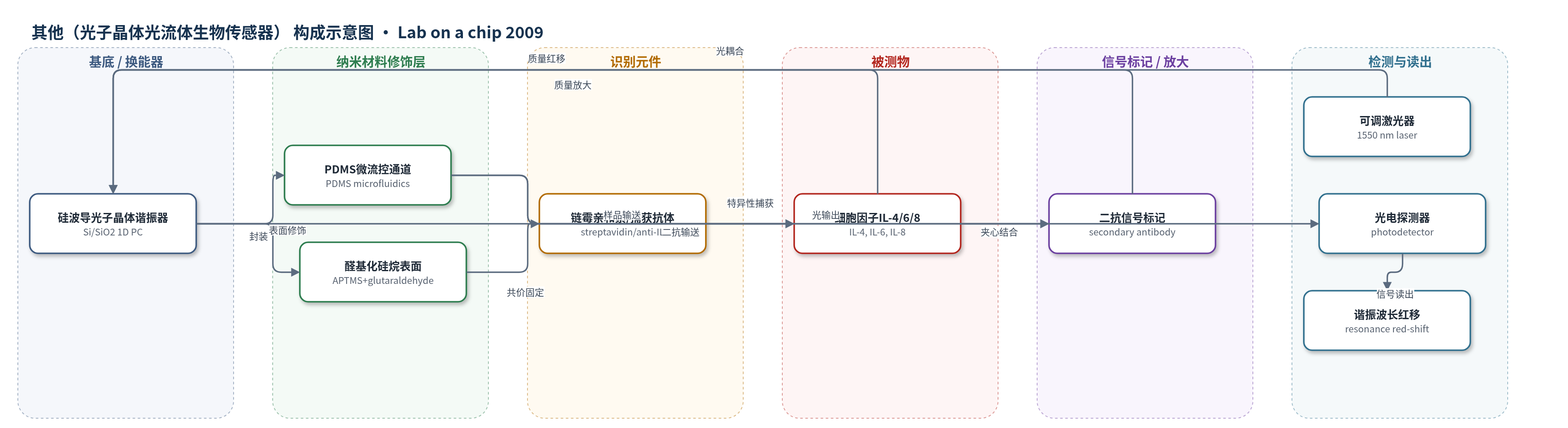
点击图片查看大图 · 依据论文自动绘制
传感器类型
其他(光子晶体光流体生物传感器)
检测对象
白细胞介素-4(IL-4)、白细胞介素-6(IL-6)、白细胞介素-8(IL-8);样品基质为PBST缓冲液(体外重组细胞因子,模拟血清)
检测原理
该传感器采用倏逝耦合的一维光子晶体谐振器阵列,每个谐振器具有不同腔长和唯一谐振波长。样品流经PDMS微流控通道时,表面固定的链霉亲和素或单克隆捕获抗体与目标细胞因子结合;随后二抗结合形成夹心复合物,使谐振器表面及孔内局部折射率增加。结合质量改变光腔有效光程,导致对应谐振峰发生红移。由于光子晶体孔内光场强且模体积小,光与结合物重叠度高,红移幅度可反映结合质量。通过监测总线波导输出光谱中各谐振峰位移,可区分不同通道并定量目标浓度;在固定波长监测输出功率还可实时观察结合动力学。
检测灵敏度
LOD: 63 ag 总结合质量;动态范围: 1–100 mg/ml;灵敏度: 0.35 nm/nm(每纳米多层生长);折射率灵敏度: 130 nm/RIU;最小可分辨红移: 0.01 nm
效应效果
选择性良好:交叉反应位移小于0.02 nm,醛基化对照小于0.01 nm,链霉亲和素对照0.02 nm。多路检测目标通道平均位移0.72 nm(6次均值),标准差0.1 nm。Q值约3000,最小可分辨红移0.01 nm,估算质量检出限63 ag,优于飞克级光学传感器;折射率灵敏度130 nm/RIU,比多数WGM器件高约一个数量级。与Choi等500 mg/ml兔IgG产生1 nm红移相比,本文约低5倍浓度即得约1 nm红移。当前可检测1–100 mg/ml抗体,适用于HIV检测和药物筛选,但尚不能直接检测1–10 pg/ml血清细胞因子;提高Q值或纳米颗粒标记可进一步提升。
传感器的构成
- 基底/换能器:SOI硅波导与一维光子晶体谐振器阵列(Si/SiO2),形成缺陷腔谐振,光场局域于孔内,结合质量改变局部折射率并引起谐振波长红移
- 微流控层:PDMS微流控通道,覆盖芯片并输送样品、缓冲液与抗体,实现原位免疫检测
- 表面化学修饰层:APTMS胺丙基三甲氧基硅烷与戊二醛/氰基硼氢化钠处理,形成醛基化表面,用于共价固定蛋白
- 识别元件:链霉亲和素水合肼(streptavidin hydrazide)或生物素化单克隆抗体(anti-IL-4/6/8 mAb),特异性捕获目标细胞因子
- 封闭层:PBST(PBS+0.1% Tween-20+0.2 mg/ml牛血清白蛋白),封闭非特异吸附位点
- 信号标记/放大元件:多克隆二抗(secondary polyclonal antibody),与目标细胞因子结合增加结合质量,产生可测红移
- 质量响应标定层:PEI/PAA聚电解质多层,用于表征结合质量与谐振波长响应
中文摘要
光学技术因可在含水环境中进行高保真测量、受背景溶液pH和离子强度影响小,并支持无标记检测,而适合原位生物分子传感。近年来,高Q值光学谐振生物传感器受到关注,其窄线宽可分辨极小结合质量,从而获得很低的检出限;但多数谐振电磁能量被限制在固体导光结构内,与结合物质重叠有限,限制了器件灵敏度。本文提出一种新型光流体生物传感器平台,集成独特的一维光子晶体谐振器阵列,使光场更强地与孔内及表面结合物相互作用。结合平面光子晶体将光场局域到波长立方量级模体积,作者估算总结合质量检出限约为63 ag,器件灵敏度比类似器件高约一个数量级。通过夹心免疫法,该平台实现白细胞介素-4(IL-4)、白细胞介素-6(IL-6)和白细胞介素-8(IL-8)的单独与同时检测,展示了低质量多路无标记生物传感能力。
英文摘要
Optical techniques have proven to be well suited for in situ biomolecular sensing because they enable high fidelity measurements in aqueous environments, are minimally affected by background solution pH or ionic strength, and facilitate label-free detection. Recently, there has been significant interest in developing new classes of optically resonant biosensors possessing very high quality-factors. This high quality-factor enables them to resolve the presence of very small amounts of bound mass and leads to very low limits of detection. A drawback of these devices is that the majority of the resonant electromagnetic energy is confined within the solid light-guiding structure thus limiting the degree to which it overlaps with the bound matter. This in turn lowers the ultimate device sensitivity, or the change in output signal in response to changes in bound mass. Here we present a novel optofluidic biosensor platform that incorporates a unique one-dimensional photonic crystal resonator array which enables significantly stronger light-matter interaction. We show here how this, coupled with the ability of planar photonic crystals to spatially localize the optical field to mode volumes on the order of a wavelength cubed, enables a limit of detection on the order of 63 ag total bound mass (estimated using a polyelectrolyte growth model) and a device sensitivity an order of magnitude better than similar devices. The multiplexing capabilities of our sensor are demonstrated by the individual and concurrent detection of interleukins 4, 6 and 8 using a sandwich assay.