组成图示
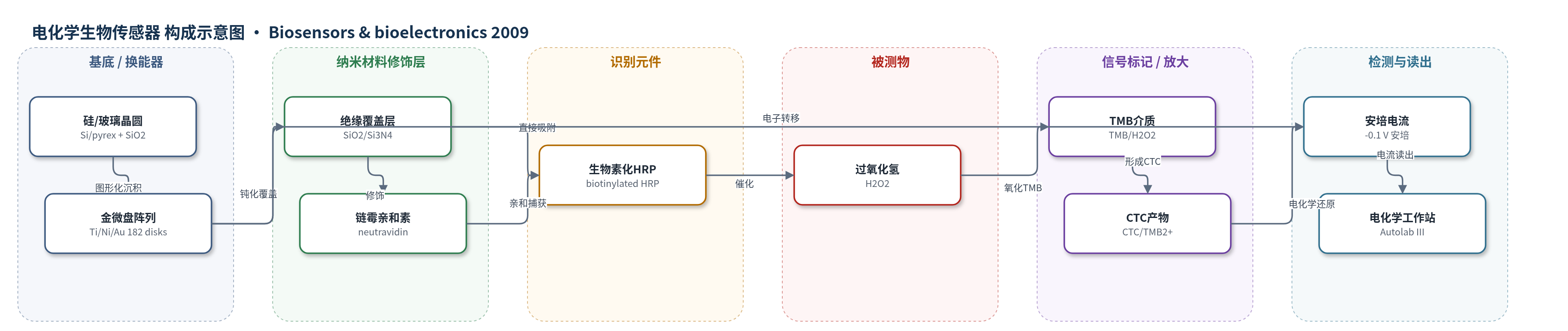
点击图片查看大图 · 依据论文自动绘制
传感器类型
电化学生物传感器
检测对象
辣根过氧化物酶(HRP)、过氧化氢(H2O2);样品基质:TMB/H2O2 底物溶液、PBS 或柠檬酸-磷酸缓冲液(pH 5)
检测原理
传感器以金微盘阵列为换能器,微盘间 SiO2/Si3N4 惰性表面经链霉亲和素-生物素亲和捕获或直接吸附固定 HRP。加入 TMB/H2O2 底物后,HRP 催化 H2O2 氧化 TMB,生成 TMB+ 与 TMB2+,并与 TMB 形成蓝色电荷转移复合物 CTC。CTC/TMB2+ 在 -0.1 V 下于金微盘发生可逆电化学还原,产生与 HRP 活性或 H2O2 浓度相关的阴极电流。微电极阵列提供径向传质增强,小体积下工作-对电极间距缩短引发氧化还原循环,进一步放大电流;检测前对金微盘进行电化学激活可去除封闭蛋白,提高电子转移速率,使灵敏度高于传统宏电极体系。
检测灵敏度
LOD: 6 fM HRP;LOD: 0.54 pM HRP;LOD: 5.4 μM H2O2(activated arrays);线性范围: 0–0.8 pM HRP;摘要报告: 0.54 pM H2O2 或 25 pM HRP(5 s,10 μl)
效应效果
选择性方面,以仅 BSA 修饰电极为阴性对照,亲和捕获 HRP 2.5/5 pM 信号为对照的 1.6/2.4 倍,激活后为 3/9 倍;25 pM HRP 非特异吸附电流 11.7 nA,总信号 27 nA。重现性 CV 低于 8%。电化学激活使 HRP 2.5/5 pM 电流由 10.5/12.5 nA 增至 18.5/26.6 nA,接近翻倍;H2O2 10/20 μM 信号提高 15–20 倍,50–200 μM 提高 2–6 倍,LOD 由 >20 μM 降至 5.4 μM。小体积下因氧化还原循环,HRP 30/60 pM 电流在 200 μl 为 18/31 nA,高于 500 μl 的 7/14 nA。作者认为该平台比传统宏电极更快、更灵敏,适用于微升级酶促检测,但阵列间差异和物理吸附随机性仍需改进。
传感器的构成
- 基底/换能器:硅或硼硅酸盐玻璃晶圆(Si/pyrex)及 1 μm 热氧化层,提供绝缘支撑
- 金属电极层:Ti/Ni/Au 三层(20/20/150 nm)光刻图形化,形成 182 个半径 10 μm 金微盘阵列,作为工作微电极
- 绝缘覆盖层:SiO2/Si3N4 钝化层,暴露金微盘并作为微盘间惰性功能化表面
- 识别/酶层:链霉亲和素(neutravidin)亲和捕获或直接物理吸附生物素化 HRP(biotinylated HRP),固定于微盘间表面,催化 H2O2/TMB 反应
- 封闭剂:2% BSA,封闭非特异结合位点
- 信号介质/底物:TMB(3,3′,5,5′-tetramethylbenzidine)与 H2O2 底物溶液,TMB 作为氧化还原介质/电子供体
- 参比/对电极:外部 Ag/AgCl 或氯化银丝伪参比,芯片集成 Pt 对电极,用于安培/伏安读出
中文摘要
生物传感器性能取决于换能器是否被合适的生物识别元件有效功能化。功能化过程中通常进行表面封闭,以避免后续非特异性结合并保证传感器特异性;但在电化学体系中,封闭步骤可能有害,因为信号换能最终依赖电极与溶液中氧化还原物质之间的电子转移。本文提出一种基于微加工圆盘微电极阵列的新型安培生物传感平台,对活性金微盘周围的惰性表面进行功能化,使器件检测灵敏度比使用相同阵列制备的传统生物传感器提高一倍以上。该方法具有三方面优势:可功能化更宽的表面、可在检测前立即激活微电极、可利用微电极增强传质速率以提高灵敏度。作者首先研究了金圆盘微电极阵列上四甲基联苯胺(TMB)的电化学行为,随后以 TMB 为氧化还原介质实现 HRP/H2O2 的安培生物传感。在仅 10 μl 酶底物溶液中,5 s 酶活性内可检测低至 0.54 pM 的 H2O2 或 25 pM 的 HRP。作者认为微电极阵列可用于开发比传统生物传感器更快、更灵敏的新型电化学生物传感平台。
英文摘要
Biosensor performance depends on the effective functionalisation of a transducer with suitable biorecognition elements. During functionalisation, surface blocking steps are normally carried out to avoid later binding of undesirable molecules and thus guarantee biosensor specificity. However, these blocking steps may be deleterious in electrochemical systems where transduction ultimately relies on electron transfer between the electrode and a redox species in solution. This work presents a novel approach to develop improved amperometric biosensing platforms using microfabricated disk microelectrode arrays, based on the functionalisation of the inert surface surrounding the active microdisks. These devices more than doubled assay sensitivity compared to conventional biosensors produced using the same arrays. This approach benefits from three advantages: the functionalisation of a broader surface, the possibility to activate the microelectrodes immediately before detection, and access to enhanced rates of mass transport to microelectrodes that improve device sensitivity. To demonstrate this, we first studied the electrochemical behaviour of tetramethylbenzidine (TMB) at gold disk microelectrode arrays, and then used TMB as the redox mediator for the amperometric biosensing of HRP/H(2)O(2). Down to 0.54pM H(2)O(2) or as little as 25pM HRP were detected within 5s of enzyme activity in just 10 microl of enzyme substrate solution. We postulate that microelectrode arrays may be used to develop novel electrochemical biosensing platforms that are faster and more sensitive than conventional biosensors.