组成图示
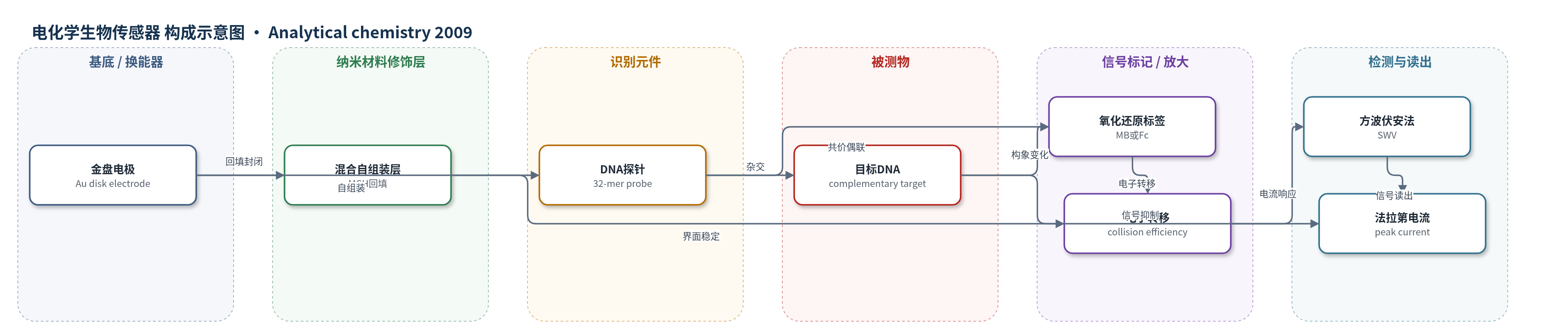
点击图片查看大图 · 依据论文自动绘制
传感器类型
电化学生物传感器
检测对象
互补目标DNA(complementary target DNA / oligonucleotide);样品基质:HEPES/NaClO4缓冲液、20%胎牛血清/血液血清
检测原理
传感器以金电极为换能器,32碱基DNA探针经5′端硫醇自组装固定,3′端共价连接MB或Fc氧化还原标签,MCH回填形成混合SAM。无目标时,单链探针柔性摆动,使氧化还原标签频繁碰撞电极,发生可逆氧化还原反应,SWV产生较大法拉第峰电流。加入互补目标DNA后,探针-目标形成刚性双链,限制标签运动并降低其与电极碰撞/电子转移效率,峰电流下降。信号抑制程度随目标浓度增加而增大,达到饱和。MB与Fc均依赖此机制,但Fc氧化态易受亲核攻击且血清蛋白非特异吸附,导致稳定性差。
检测灵敏度
未报告LOD、线性范围、灵敏度斜率、相关系数。
效应效果
两种标签均可检测互补DNA,饱和目标(1 µM)下Fc信号抑制87.2±2.6%,MB为70.2±0.9%;Fc亲和力略高(KD 25±4 nM),MB为44±18 nM。MB在缓冲液15次再生循环中稳定,信号抑制约70%,首次损失约10%,后续恢复至原信号5%以内;100次SWV扫描损失2%,180 h储存损失38%。Fc再生后降至约50%,100次扫描损失约50%,180 h储存损失91%。20%血清中MB再生85%–90%,相对误差约5%;Fc仅恢复50%,误差约25%。作者认为MB稳定性更优,更适合电化学DNA传感器。
传感器的构成
- 基底/换能器电极:金盘电极(Au disk electrode, 2 mm),机械与电化学清洗后作为电子转移动态界面。
- 识别元件:32碱基线性DNA探针(probe DNA),5′端C6二硫体连接臂经TCEP还原后形成硫醇并自组装于金表面,3′端C7-NH2氨基用于偶联氧化还原标签。
- 信号标记物:亚甲基蓝(MB)或二茂铁(Fc)氧化还原标签,经NHS酯(MB-NHS/Fc-NHS)与探针3′端氨基共价偶联,提供可逆氧化还原法拉第电流。
- 封闭/回填层:6-巯基-1-己醇(6-mercapto-1-hexanol, MCH),与探针共同形成混合自组装单分子层,封闭金表面并降低非特异吸附。
- 检测介质:HEPES/NaClO4缓冲液(10 mM HEPES, 0.5 M NaClO4, pH 7.0)或20%胎牛血清/血液血清混合缓冲液,用于杂交、再生与复杂基质测试。
中文摘要
近年来,许多电化学生物传感器方法采用氧化还原标记(最常见为亚甲基蓝或二茂铁)的寡核苷酸探针定点连接于检测电极。此类传感器已报道多种探针结构,包括单链和双链DNA、更复杂的DNA结构、DNA和RNA适配体,以及DNA-小分子杂合体。其信号通常基于结合诱导的共价连接氧化还原标签与检测电极之间电子转移效率变化。本文研究氧化还原标签性质如何影响此类传感器性能,具体比较以二茂铁(Fc)或亚甲基蓝(MB)为信号氧化还原基团制备的电化学DNA(E-DNA)传感器在信号与稳定性方面的差异。结果表明,两种标签均支持高效E-DNA信号,Fc传感器在信号增益和目标亲和力方面略优;但这些微小优势伴随潜在显著代价:Fc传感器稳定性明显低于MB传感器,尤其在长期储存、重复电化学检测、重复传感/再生循环以及血液血清等复杂样品基质中。
英文摘要
Many electrochemical biosensor approaches developed in recent years utilize redox-labeled (most commonly methylene blue or ferrocene) oligonucleotide probes site-specifically attached to an interrogating electrode. Sensors in this class have been reported that employ a range of probe architectures, including single- and double-stranded DNA, more complex DNA structures, DNA and RNA aptamers, and, most recently, DNA-small molecule chimeras. Signaling in this class of sensors is generally predicated on binding-induced changes in the efficiency with which the covalently attached redox label transfers electrons with the interrogating electrode. Here we have investigated how the properties of the redox tag affect the performance of such sensors. Specifically, we compare the differences in signaling and stability of electrochemical DNA sensors (E-DNA sensors) fabricated using either ferrocene or methylene blue as the signaling redox moiety. We find that while both tags support efficient E-DNA signaling, ferrocene produces slightly improved signal gain and target affinity. These small advantages, however, come at a potentially significant price: the ferrocene-based sensors are far less stable than their methylene blue counterparts, particularly with regards to stability to long-term storage, repeated electrochemical interrogations, repeated sensing/regeneration iterations, and employment in complex sample matrices such as blood serum.