组成图示
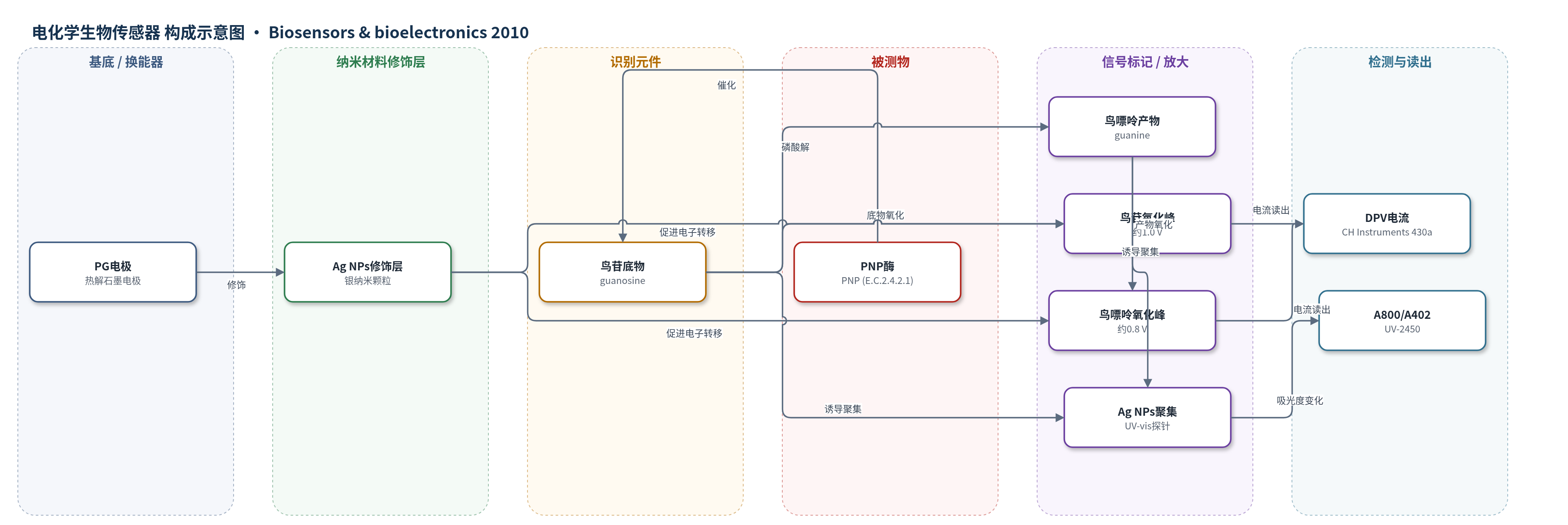
点击图片查看大图 · 依据论文自动绘制
传感器类型
电化学生物传感器
检测对象
嘌呤核苷磷酸化酶(purine nucleoside phosphorylase, PNP)活性;样品基质:人血清(human serum)、磷酸盐缓冲液(PBS)样品
检测原理
该传感器以 PNP 酶促反应为识别事件:样品中 PNP 在 30 mM PBS(pH 6.5)中催化鸟苷磷酸解,生成鸟嘌呤。Ag NPs 修饰的 PG 电极促进鸟苷和鸟嘌呤电子转移,使二者在 DPV 中分别于约 1.0 V 和 0.8 V 出现氧化峰。PNP 活性升高时,鸟苷消耗使其峰电流下降,鸟嘌呤生成使其峰电流上升,以峰电流定量酶活性。UV–vis 法中,鸟苷和鸟嘌呤通过外环氨基与 Ag NPs 作用并诱导不同程度聚集,改变表面等离子共振吸收,A800/A402 随 PNP 活性增加而增大。方法无偶联酶放大,主要依靠 Ag NPs 电子转移促进和聚集光学信号增强。
检测灵敏度
LOD: 0.1 unit/mL;线性范围: 2–20 unit/mL (guanosine peak);I = 0.1244 [PNP] (unit/mL) + 10.7052 (R2 = 0.9993);线性范围: 5 unit/mL–20 unit/mL (guanine peak);I = 0.1009 [PNP] (unit/mL) + 0.8745 (R2 = 0.9934);UV–vis 线性范围: 4–20 unit/mL。
效应效果
电化学方法在 10 unit/mL PNP 下,鸟苷峰批内/批间 CV 为 4.57% 和 8.9%,鸟嘌呤峰为 2.46% 和 4.94%。加入 1 mg/mL BSA、10 μM β-凝血酶和 1 mg/mL 人血红蛋白后,DPV 响应与纯 PNP 基本无显著差异。人血清加标样品测得 5.29、9.86、20.86 unit/mL,相对误差分别为 5.8%、1.4%、4.3%,均小于 6%。UV–vis 法批内/批间 CV 为 0.9% 和 2.4%,可在 10 min 内完成。作者认为电化学传感器灵敏度高于 UV–vis 法和既往方法,适用于临床诊断,并可避免偶联酶或放射性试剂。
传感器的构成
- 工作电极/换能器:热解石墨电极(PG electrode),作为电子转移基底并承载银纳米颗粒。
- 纳米材料修饰层:银纳米颗粒(Ag NPs,约 7 nm),修饰于 PG 电极表面,促进鸟苷和鸟嘌呤的电子转移反应性。
- 催化底物/识别元件:鸟苷(guanosine),被样品中 PNP 特异性磷酸解,作为酶活性的识别底物。
- 产物/信号分子:鸟嘌呤(guanine),由 PNP 催化生成,在 Ag NPs 修饰电极上产生约 0.8 V 氧化峰。
- 光学信号元件:Ag NPs,鸟苷/鸟嘌呤诱导其聚集,引起表面等离子共振吸收变化。
中文摘要
本文报道了一种用于测定嘌呤核苷磷酸化酶(purine nucleoside phosphorylase, PNP)活性的电化学生物传感器。由于修饰在电极表面的银纳米颗粒(Ag NPs)能够促进鸟苷(guanosine)和鸟嘌呤(guanine)的电子转移反应性,这些物质的电化学响应可清晰反映 PNP 的酶活性。该电化学生物传感器具有较宽的线性范围(4–20 unit/mL)和 0.1 unit/mL 的检测限,足以满足临床应用需求。此外,基于鸟苷和鸟嘌呤可诱导银纳米颗粒发生不同程度聚集的发现,作者还建立了一种快速紫外–可见光谱法用于 PNP 活性测定。该方法可能具有可接受的可靠性和特异性,并可避免以往报道中所需的偶联酶或放射性试剂的使用。
英文摘要
In this paper, an electrochemical biosensor to assay purine nucleoside phosphorylase (PNP) activity is reported. Due to the facilitation of sliver nanoparticles, which are modified on an electrode surface, to the electron transfer reactivity of guanosine and guanine, the electrochemical response of these species can clearly reveal the activity of the enzyme PNP. This electrochemical biosensor for the assay of PNP activity may have a broad linear range of 4-20 unit/mL with a detection limit of 0.1 unit/mL, which is good enough for clinical applications. Meanwhile, on the basis of the finding that guanosine and guanine can induce silver nanoparticles to different agglomeration degrees, we have also developed a rapid UV-vis spectroscopy assay method for PNP activity. This work may show acceptable reliability and specificity for the assay of PNP activity, and may avoid the utilization of coupled enzymes or radiochemical reagents, which are required to the previous reports.