组成图示
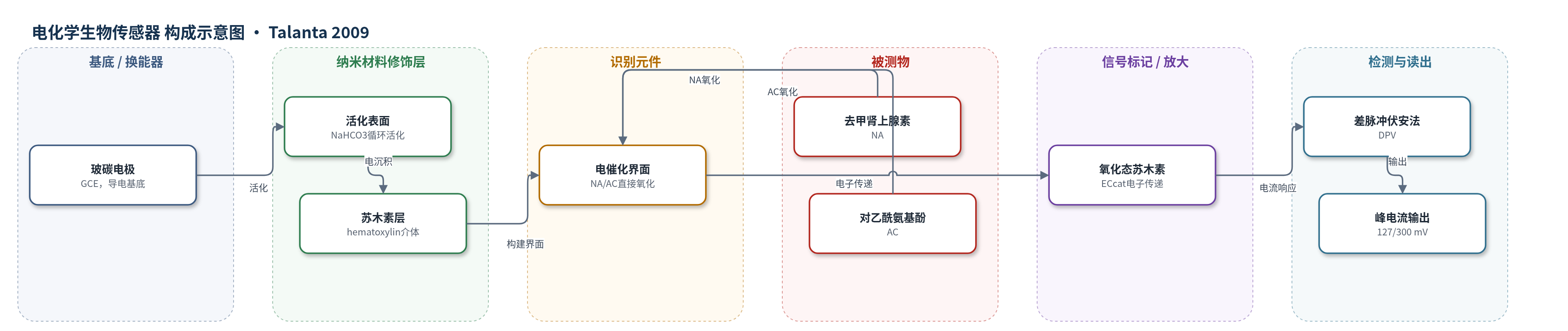
点击图片查看大图 · 依据论文自动绘制
传感器类型
电化学生物传感器
检测对象
去甲肾上腺素(noradrenalin, NA)、对乙酰氨基酚(acetaminophen, AC);样品基质:0.15 mol L−1磷酸盐缓冲液(PBS,pH 7.0)及药物制剂(NA注射液、AC口服液、AC片剂)
检测原理
苏木素在活化GCE表面电沉积形成表面固定氧化还原偶联,作为电催化介体。NA扩散至电极界面后,与氧化态苏木素发生交叉电子转移而被氧化,苏木素还原态再被电极氧化再生,形成ECcat过程,使NA在约150 mV(vs SCE)低过电位下产生阳极电流。AC在修饰电极表面于约300 mV被氧化,与NA峰(约127 mV)分离。DPV通过脉冲电压降低充电电流,峰电流随NA或AC浓度增加而线性增大;NA峰电流在两段线性范围内响应,AC存在不改变NA灵敏度,因此可同时定量。
检测灵敏度
LOD: 0.14 μmol L−1(NA);线性范围: NA 5.0 × 10⁻¹ to 65.40 μmol L−1 和 65.40–274.20 μmol L−1;AC 12.00–59.10 μmol L−1 和 59.10–261.70 μmol L−1;灵敏度: NA 0.0673 μA μmol−1 L(5.0 × 10⁻¹–4.00 μmol L−1),NA 0.0652 μA μmol−1 L(无AC)和0.0697 μA μmol−1 L(有AC),AC 0.0255 μA μmol−1 L;R^2 = 0.9943(NA低浓度)
效应效果
pH 7.0下NA与AC的DPV峰分别约127 mV和300 mV,裸GCE仅约304 mV宽峰,选择性良好。有无AC时NA灵敏度为0.0652和0.0697 μA μmol−1 L,基本一致,AC不干扰NA。5.00 μmol L−1 NA连续16次测定平均峰电流1.13±0.03 μA,RSD 2.6%,稳定且无表面污染。药物加标回收率NA 99–103%、AC 97–103%,加标RSD 1.0–2.3%;与标签值比较:NA注射液0.98 mg mL−1(标签1.0)、AC口服液23.37 mg mL−1(标签24.0)、AC片剂724.62 mg g−1(标签725.3),RSD 2.9–3.1%,可用于药物常规分析。
传感器的构成
- 基底电极:玻碳电极(GCE),经0.05 μm氧化铝抛光并在0.1 mol L−1 NaHCO3中循环活化,作为导电基底与换能器
- 修饰层:电沉积苏木素(hematoxylin)层,在0.15 mol L−1 PBS(pH 7.0)中由0.10 mmol L−1苏木素经8次循环沉积,形成表面固定氧化还原偶联并介导NA电催化氧化
- 识别元件:无生物识别元件,NA与AC直接通过电极表面电催化氧化产生信号
- 电子供体/被测物:去甲肾上腺素(NA)与对乙酰氨基酚(AC),在电极表面被氧化并提供电子
- 电解质体系:0.15 mol L−1磷酸盐缓冲液(PBS,pH 7.0),提供离子导电环境
- 辅助电极:铂电极(Pt)作对电极,饱和甘汞电极(SCE)作参比电极,构成三电极伏安体系
中文摘要
本文在玻碳电极(GCE)表面电沉积苏木素(hematoxylin),构建了一种高效去甲肾上腺素(NA)生物传感器。循环伏安法在0.25 mmol L−1 NA溶液中显示典型ECcat过程,并利用循环伏安法和旋转圆盘电极法估算了电子转移系数α、催化电子转移速率常数k′和标准催化电子转移速率常数k0。在生理pH 7.0下,差脉冲伏安法(DPV)中NA与对乙酰氨基酚(AC)的氧化峰明显分离,因此可在同一传感器上同时测定两者。NA在5.0×10⁻¹–65.40 μmol L−1和65.40–274.20 μmol L−1、AC在12.00–59.10 μmol L−1和59.10–261.70 μmol L−1范围内呈线性。有无AC存在时NA灵敏度基本相同,表明两者可独立测定且无干扰。对5.00 μmol L−1 NA连续16次测定的平均峰电流为1.13±0.03 μA。该传感器用于药物制剂中NA和AC的测定,结果与标签值一致。
英文摘要
A highly efficient noradrenalin (NA) biosensor was fabricated on the basis of hematoxylin electrodeposited on a glassy carbon electrode, GCE. The cyclic voltammetric responses of the hematoxylin biosensor at various scan rates, which were obtained in a 0.25 mmol L(-1) NA solution, showed the characteristic shape typical of an EC(cat) process. The kinetic parameters such as electron transfer coefficient, alpha, the catalytic electron transfer rate constant, k', and the standard catalytic electron transfer rate constant, k(0), for oxidation of NA at the hematoxylin biosensor surface were estimated using cyclic and RDE voltammetry. The peaks of differential pulse voltammetric (DPV) for NA and acetaminophen (AC) oxidation at the hematoxylin biosensor surface were clearly separated from each other when they co-exited in the physiological pH (pH 7.0). It was, therefore, possible to simultaneously determine NA and AC in the samples at a hematoxylin biosensor. Linear calibration curves were obtained for 5.0x10(-1) to 65.40 micromol L(-1) and 65.40-274.20 micromol L(-1) of NA, and for 12.00-59.10 micromol L(-1) and 59.10-261.70 micromol L(-1) of AC. The sensitivities of the biosensor to NA in the absence and presence of AC were found virtually the same, which indicates the fact that the electrocatalytic oxidation processes of NA are independent of AC and, therefore, simultaneous or independent measurements of the two analytes (NA and AC) are possible without any interference. The results of 16 successive measurements show an average voltammetric peak current of 1.13+/-0.03 microA for an electrolyte solution containing 5.00 micromol L(-1) NA. The hematoxylin biosensor has been satisfactorily used for the determination of NA and AC in pharmaceutical formulations. The results obtained, using the biosensor, are in very good agreement with those declared in the label of pharmaceutical inhalation products.