组成图示
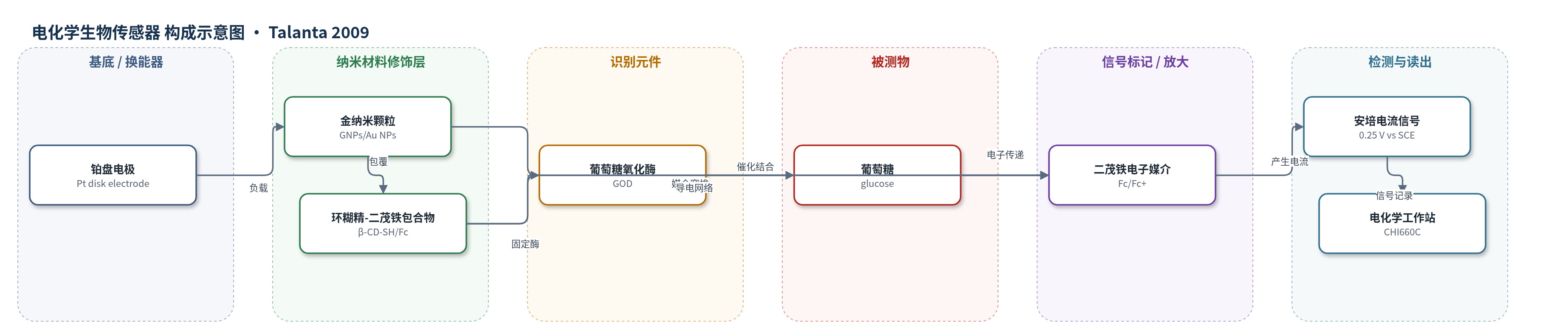
点击图片查看大图 · 依据论文自动绘制
传感器类型
电化学生物传感器
检测对象
葡萄糖(glucose, Glc);样品基质:PBS缓冲液、人血浆/血清
检测原理
葡萄糖进入GNPs/CD–Fc/GOD复合膜后,被GOD特异性催化氧化为葡萄糖酸并产生H2O2,GOD氧化态被还原为GODred。GODred将电子传递给包合物中的Fc+,使其还原为Fc;Fc随后在铂电极表面被氧化为Fc+,形成可循环的乒乓电子穿梭机制。GNPs提供导电网络,CD–Fc包合物将Fc稳定固定并降低泄漏,使电子在酶与电极间高效传递。因此,在0.25 V(vs SCE)低电位下,阳极电流随葡萄糖浓度增加而增大,且低电位抑制了抗坏血酸、多巴胺等易氧化物干扰。
检测灵敏度
LOD: 15 μM (S/N = 3);线性范围: 0.08–11.5 mM;灵敏度: ca. 18.2 mA M−1 cm−2;响应时间: 5 s;KM: 6.42 mM
效应效果
在生理浓度干扰实验中,抗坏血酸(0.1 mM)、多巴胺/3-羟酪胺(0.2 mM)、对乙酰氨基酚(0.05 mM)和L-半胱氨酸(0.02 mM)对5.6 mM葡萄糖响应的影响分别为3%、5%、4%和1.5%,尿酸(0.5 mM)影响为18%,总体抗干扰能力较好。5个电极对1 mM葡萄糖的50次连续测量RSD为5.87%。在pH 7.0 PBS中4 ℃保存30天后仍保留82%响应电流。人血浆/血清5例样品检测结果与医院Olympus AU2700生化分析仪一致,相对误差为−4.1%至+3.7%,表明该传感器具有实际检测潜力。
传感器的构成
- 基底电极:铂盘电极(Pt,直径1 mm),作为换能器与电子传导基底
- 纳米材料修饰层:金纳米颗粒(GNPs/Au NPs),提供导电网络、生物相容性与酶固定位点
- 媒介固定层:单-6-硫-β-环糊精(β-CD-SH)/二茂铁(Fc)包合物,通过-SH包覆GNPs,将Fc稳定固定
- 信号标记物:二茂铁(Fc/Fc+),作为电子穿梭媒介,在电极表面氧化还原产生电流
- 识别元件:葡萄糖氧化酶(GOD),特异性催化葡萄糖氧化
- 介质/平衡层:0.1 M PBS(pH 7.0),维持酶活性与离子传导;原文未使用额外封闭剂
中文摘要
本文报道了一种基于金纳米颗粒(GNPs)表面包覆单-6-硫-β-环糊精/二茂铁(CD–Fc)包合物并固定葡萄糖氧化酶(GOD)的新型安培型葡萄糖传感器。CD–Fc包合物通过硫醇基与金纳米颗粒结合,将二茂铁稳定固定在颗粒表面,作为电子穿梭媒介,使葡萄糖可在相对于饱和甘汞电极(SCE)0.25 V的低电位下检测,显著降低易氧化干扰物的影响。传感器响应时间约5 s,检出限为15 μM(S/N=3),灵敏度约为18.2 mA M−1 cm−2,葡萄糖线性范围为0.08–11.5 mM。作者认为,GNPs/CD–Fc复合膜在蛋白与电极之间提供了便捷的电子隧道路径,从而提高了灵敏度。此外,该生物传感器表现出良好的抗干扰能力、稳定性和使用寿命;其稳定性归因于温和的制备过程未损伤酶分子,以及金纳米颗粒良好的生物相容性可保持固定酶的活性。
英文摘要
A novel amperometric glucose sensor based on inclusion complex of mono-6-thio-beta-cyclodextrin/ferrocene capped on gold nanoparticles (GNPs/CD-Fc) and glucose oxidase (GOD) was described. The inclusion complex of mono-6-thio-beta-cyclodextrin/ferrocene capped on gold nanoparticles played an effective role of an electron shuttle and allowed the detection of glucose at 0.25 V (versus SCE), with dramatically reduced interference from easily oxidizable constituents. The sensor (GNPs/CD-Fc/GOD) showed a relatively fast response time (5 s), low detection limit (15 microM, S/N=3), and high sensitivity (ca. 18.2 mA M(-1) cm(-2)) with a linear range of 0.08-11.5mM of glucose. The excellent sensitivity was possibly attributed to the presence of the GNPs/CD-Fc film that can provide a convenient electron tunneling between the protein and the electrode. In addition, the biosensor demonstrated high anti-interference ability, stability and natural life. The good stability and natural life can be attributed to the following two aspects: on the one hand, the fabrication process was mild and no damage was made on the enzyme molecule, on the other hand, the GNPs possessed good biocompatibility that could retain the bioactivity of the enzyme molecules immobilized on the electrode.