组成图示
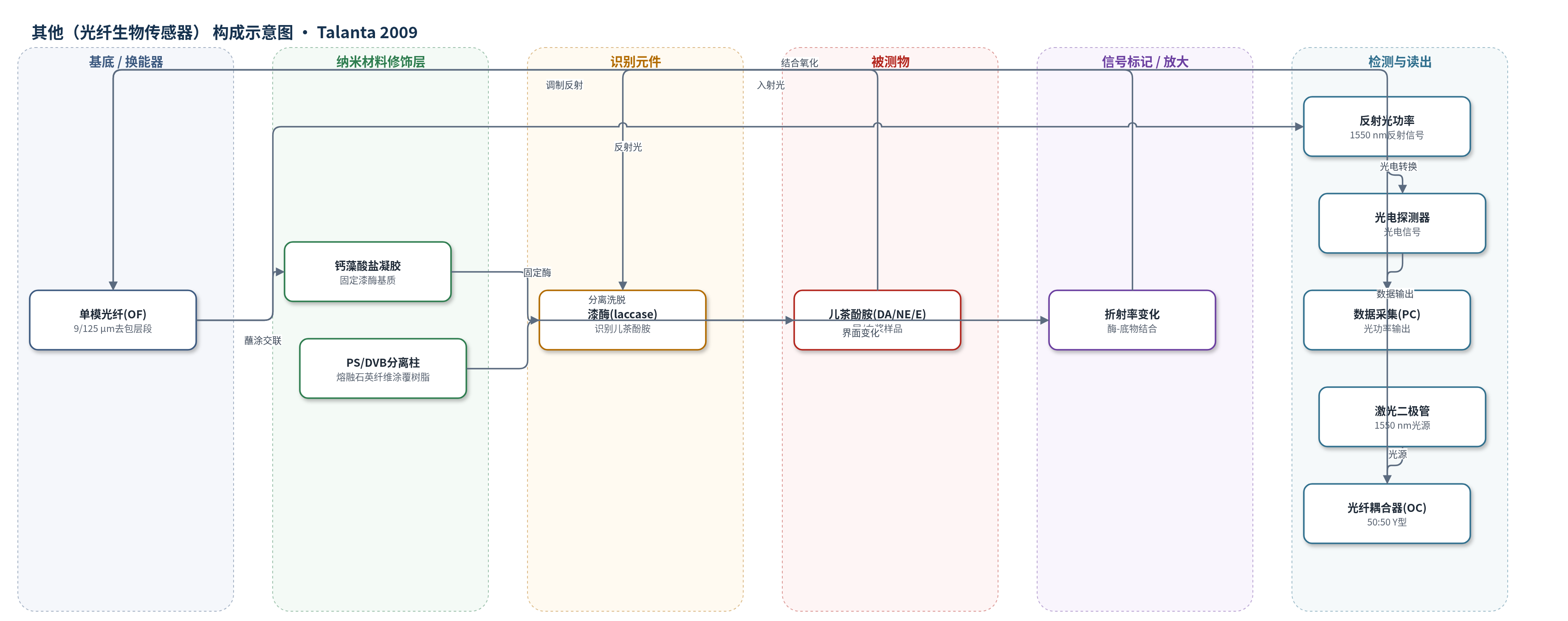
点击图片查看大图 · 依据论文自动绘制
传感器类型
其他(光纤生物传感器)
检测对象
多巴胺(dopamine, DA)、去甲肾上腺素(norepinephrine, NE)、肾上腺素(epinephrine, E);样品基质:人尿和血浆(经SPE前处理)
检测原理
样品经PS/DVB色谱柱分离后,儿茶酚胺依次进入光纤敏感区。漆酶固定于钙藻酸盐包层中,作为识别元件与儿茶酚胺结合并催化其氧化为相应氨基醌。结合事件改变酶-藻酸盐敏感包层的局部折射率,进而调制去包层单模光纤中1550 nm光的反射/传输状态。反射光经50:50 Y型光纤耦合器分束后由光电探测器转换为电信号,光功率变化(dB)与儿茶酚胺浓度成正比。由于不同儿茶酚胺保留时间不同,系统可在约3 min内完成三种物质的分离与检测;浓度越高,酶-底物结合引起的折射率变化越大,光功率变化越大。
检测灵敏度
LOD: 2.1 pg mL−1 (dopamine)、2.6 pg mL−1 (norepinephrine)、3.4 pg mL−1 (epinephrine);线性范围: 5–125 pg mL−1;灵敏度斜率: 0.344 dB/pg mL−1 (dopamine)、0.252 dB/pg mL−1 (norepinephrine)、0.140 dB/pg mL−1 (epinephrine);比较回归 r^2: 0.99997 (dopamine)、0.99998 (norepinephrine)、0.99997 (epinephrine)。
效应效果
该LacOF系统约3 min完成三种儿茶酚胺分离;normetanephrine和metanephrine保留时间不同,未干扰。35 pg/mL样品连续2个月重复测量RSD<5%,第13周后信号略降,传感头可12周后更换。与HPLC-ED比较,10–100 pg/mL标准液5次重复,ANOVA无显著差异(p=0.431、0.832、0.704),回归斜率1.0±0.1、0.998±0.002、1.001±0.002,r^2为0.99997–0.99998,残差标准差1.9–2.5 pg/mL。人尿和血浆结果与HPLC-ED无显著差异(p>0.84),作者认为其紧凑设计可替代经典方法。
传感器的构成
- 基底/换能器:单模光纤(single-mode optical fiber, OF),芯径9 μm、包层125 μm,去包层段作为敏感区,传输1550 nm光并检测反射光功率变化
- 识别/固定基质:藻酸盐(alginate)与0.2 M氯化钙(CaCl2)交联形成钙藻酸盐凝胶,固定漆酶并构成折射率敏感包层
- 识别元件:漆酶(laccase, EC 1.10.3.2,来自Trametes versicolor),识别并氧化儿茶酚胺,引起敏感包层折射率变化
- 分离柱:玻璃管(GT)内熔融石英纤维涂覆聚苯乙烯/二乙烯苯树脂(PS/DVB, 50–100 mesh),用于儿茶酚胺色谱分离
- 流动相:5%乙腈(ACN)、0.025 M磷酸钠、0.025 M柠檬酸、0.001 M庚烷磺酸,pH 2.85,0.75 mL/min,输送样品并洗脱
- 光学读出:1550 nm激光二极管、50:50 Y型光纤耦合器(OC)和光电探测器(photodetector),产生、分束并检测反射光功率
- 样品前处理:固相萃取(SPE),尿样用Bio-Rex 70阳离子交换树脂,血浆用Oasis MAX柱,富集儿茶酚胺
中文摘要
本文开发了一种基于漆酶识别能力的光纤生物传感器,用于测定多巴胺、去甲肾上腺素和肾上腺素等儿茶酚胺。该装置采用由熔融石英纤维涂覆聚苯乙烯/二乙烯苯(PS/DVB)树脂构成的玻璃管作为色谱分离单元,实现三种儿茶酚胺的分离。传感器以单模光纤为换能元件,在去包层光纤表面通过蘸涂法固定漆酶/藻酸盐敏感包层,并用氯化钙交联。研究首先对分析仪进行校准,并将其儿茶酚胺检测性能与经典高效液相色谱-电化学检测(HPLC-ED)方法比较。结果表明,该分析装置对多巴胺、去甲肾上腺素和肾上腺素的检出限分别为2.1、2.6和3.4 pg/mL;在5–125 pg/mL浓度范围内建立的校准曲线斜率分别为0.344、0.252和0.140 dB/(pg/mL)。PS/DVB光纤可在3 min内完全实现儿茶酚胺的分离。该传感器在人尿和血浆样品中的分析性能评价表明,其适用于人体生物样品中儿茶酚胺的筛查。
英文摘要
An optical fiber biosensor has been developed for the determination of catecholamines (dopamine, norepinephrine and epinephrine) based on the recognition capacity of the enzyme laccase. In this study, a glass tube constituted by a fused silica fiber coated with a film of polystyrene/divinylbenzene resin (PS/DVB) was used for catecholamines separation. Firstly, the analyzer was tested for calibration and its analytical performance for catecholamines detection was compared with a classical analytical method, namely high performance liquid chromatography-electrochemical detector (HPLC-ED). The developed analytical device shows a high potential for catecholamines quantification with a detection limit of 2.1, 2.6 and 3.4 pg mL(-1) for dopamine, norepinephrine and epinephrine, respectively. The analytical sensitivity, inferred from the slope of the calibration curves established for a range of concentrations between 5 and 125 pg mL(-1), was found to be 0.344, 0.252 and 0.140 dB/pg mL(-1) for dopamine, norepinephrine and epinephrine, respectively. Furthermore, catecholamines speciation with the PS/DVB fiber was completely achieved in 3 min. The analytical performance of the reported sensor was also evaluated and found adequate for catecholamines determination in human urine and plasma samples.