组成图示
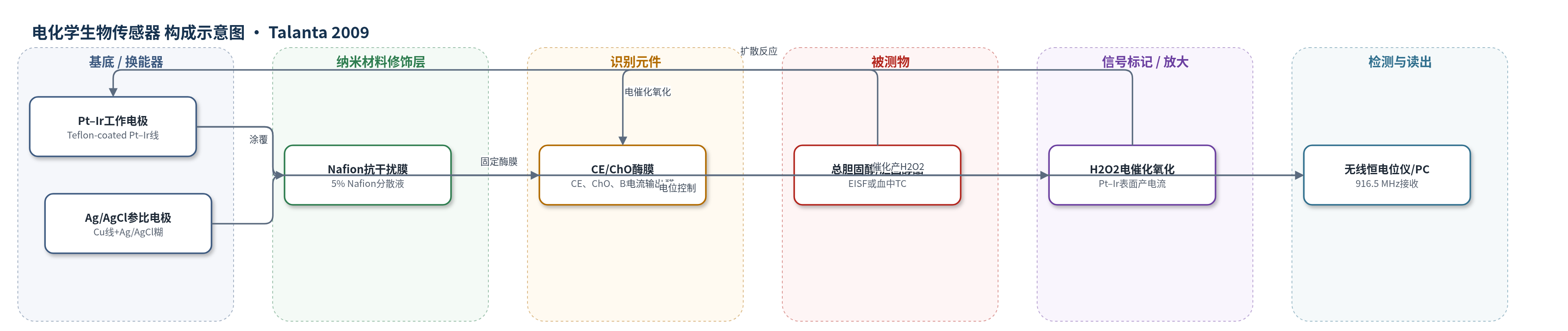
点击图片查看大图 · 依据论文自动绘制
传感器类型
电化学生物传感器
检测对象
总胆固醇(total cholesterol, TC;胆固醇酯/胆固醇),样品基质:尼罗罗非鱼(Nile tilapia)眼巩膜下间质液(EISF)、血液/血浆
检测原理
传感器采用酶促–电催化安培法。EISF中的胆固醇酯先被胆固醇酯酶(CE)水解为胆固醇和脂肪酸;胆固醇再被胆固醇氧化酶(ChO)催化,与溶解氧反应生成4-胆甾烯-3-酮和过氧化氢(H2O2)。H2O2扩散至Pt–Ir工作电极表面,在+650 mV(vs. Ag/AgCl)下发生电催化氧化,生成O2、H+和电子,形成与H2O2浓度成正比的安培电流。由于酶反应速率受底物浓度控制,总胆固醇浓度越高,产生的H2O2越多,输出电流越大。Nafion膜可阻挡EISF中其他氧化性干扰物,提高选择性。系统通过恒电位仪采集电流,并结合一点或两点体内校准将电流换算为总胆固醇浓度。
检测灵敏度
线性范围: 2.65–403 mg dl−1;R = 0.9970
效应效果
传感器以Nafion膜阻挡EISF中氧化性干扰物,在pH 8.0和15–30 ℃下可产生足够稳定电流;pH>6.5响应下降,>40 ℃信号噪声大。五个传感器在100 mg dl−1标准液中重复20次,RSD为4.58±2.52%,绝对响应2.97–6.49 nA。有线连续监测230 min,实际EISF总胆固醇与传感器电流相关系数为0.8961(n=6)。两点校准误差为−1.18 mg dl−1,优于一点校准的−13.11 mg dl−1。无线系统在自由游动尼罗罗非鱼中连续监测超过40 h,可替代繁琐、耗时、昂贵的比色法,用于水产养殖鱼体健康实时监测。
传感器的构成
- 工作电极:Teflon-coated Pt–Ir wire(φ0.178 mm),剥离1.0 mm Teflon暴露Pt–Ir作为传感腔,用于电催化氧化H2O2产生安培电流
- 参比/对电极:copper wire(φ0.1 mm)缠绕于Teflon表面并涂Ag/AgCl paste,作为稳定参比/对电极
- 绝缘封装:Teflon coating、heat-shrink tubing、epoxy adhesive,用于绝缘、连接保护和植入固定
- 抗干扰膜:5% Nafion dispersion solution涂覆于工作电极,阻挡EISF中氧化性干扰物引起的噪声
- 识别催化层:cholesterol esterase(CE)和cholesterol oxidase(ChO)酶膜固定于工作电极尖端,催化胆固醇酯水解和胆固醇氧化
- 交联固定剂:25% glutaraldehyde与BSA用于酶膜交联固定,重复两次以增强稳定性
中文摘要
为满足水产养殖中对鱼体健康快速监测的需求,作者开发了一种用于连续监测尼罗罗非鱼(Oreochromis niloticus)总胆固醇浓度的无线生物传感器系统。血浆总胆固醇水平与细菌挑战后鱼体死亡率显著相关,可作为鱼体健康状况指标。该传感器以直径0.178 mm的铂铱(Pt–Ir)线为工作电极,Ag/AgCl糊为参比电极,胆固醇氧化酶(ChO)和胆固醇酯酶(CE)经戊二醛交联固定于工作电极。传感器输出在2.65–403 mg dl−1范围内与胆固醇浓度呈良好线性关系(R=0.9970),覆盖鱼类总胆固醇水平。为避免血液凝固和蛋白聚集,传感器植入眼球巩膜下间质液(EISF)。EISF可反映多数血液成分且不含干扰物质,其总胆固醇与血液总胆固醇强相关(R=0.8818,n=72,血液范围74–480 mg dl−1)。结合体内校准和无线监测系统,可在自由游动鱼中连续监测超过40 h,为水产养殖中实时监测鱼体健康提供了快速便捷方法。
英文摘要
The rapidly increasing demand for cultured fish as a food resource requires simple, effective methods for controlling fish health in culture conditions. Plasma total cholesterol levels are significantly related to fish mortality following bacterial challenge, and are thus a good indicator of the general health of fish. We developed a wireless biosensor system to continuously monitor the total cholesterol concentration in fish (Nile tilapia, Oreochromis niloticus). The biosensor was constructed with Pt-Ir wire (phi0.178 mm) as the working electrode and Ag/AgCl paste as the reference electrode. Cholesterol oxidase and cholesterol esterase were immobilized on the working electrode using glutaraldehyde. The sensor output was linear and strongly correlated with the cholesterol level (R=0.9970) in the range of 2.65-403 mg dl(-1). This range covers the range of total cholesterol levels in fish. To avoid blood coagulation and proteins coalescing on the sensor, we implanted the sensor in the fluid under the scleral surface of the eyeball (EISF). The EISF is presumed to reflect the levels of most blood components and does not include the substances contained in blood that inhibit sensor measurement. Total cholesterol concentrations in blood and EISF were strongly correlated (R=0.8818, n=72) in the blood total cholesterol range of 74-480 mg dl(-1). Therefore, we used EISF as an alternative to blood and performed continuous in vivo-monitoring of the total cholesterol concentration in fish. We also investigated the application of the calibration method and wireless monitoring system. These applications enabled us to securely monitor total cholesterol levels in free-swimming fish in an aquarium for over 40 h. Thus, our newly developed sensor provided a rapid and convenient method for real-time monitoring of total cholesterol concentrations in free-swimming fish.